






Mucitler Elektrik
Corporate
- Thread Author
- #1
Although modern machine vision systems provide speed and flexibility in automation processes, the harsh conditions of industrial environments can negatively affect their performance and lifespan. Dust, dirt, vibration, temperature fluctuations, and light changes can lead to measurement errors, incorrect readings, and even sensor failures. So, how are these challenges overcome?
─────────────────────────
🛡️ Protective Enclosures and Environmental Conditions
While industrial cameras often have high protection ratings like IP65 and IP67, some industries require additional measures. For example, in the pharmaceutical and food industries, special enclosures are essential due to chemicals and washdown sprays. According to John Sprinkle, product engineer at AutomationDirect, stainless steel enclosures and acrylic windows instead of glass to prevent breakage are commonly used in such environments.
─────────────────────────
🌡️ Dealing with Temperature Fluctuations
The maximum temperature at which image sensors can operate reliably is typically around 50°C (122°F). Exceeding these limits can affect the sensor's lifespan and accuracy. In cold food processing environments, the sensor's own heat within the enclosure may be sufficient, while in hot environments (e.g., roofing material production), special enclosures or compressed air cooling systems can be used to protect cameras. For some 3D cameras, additional heat sinks are available.
─────────────────────────
⚙️ Combating Vibration: The Key to Precision
Vibration is one of the biggest enemies of image system designers. Instead of mounting the camera on vibrating machinery, it is preferable to mount it on the floor or a separate structure. Additionally, in cyclical machines, timing image acquisition to moments of minimal vibration is an effective method. In situations with vibration and high speed, filling the inspection area with as much light as possible, especially with strobe lighting, reduces the effect of vibration by shortening the exposure time. Lights from brands like Wenglor and Lumher can reach up to four times their normal brightness with short bursts.
─────────────────────────
💡 Ambient Light Control and Optimization

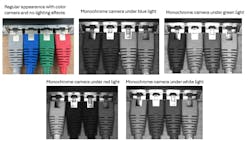
In the early days of machine vision, covers were placed over parts to block ambient light. Today, thanks to bandpass filter technology, the wavelength of light seen by monochrome cameras can be precisely controlled. For example, when examining an object illuminated with red light, a red bandpass filter attached to the camera lens ensures that only this specific red light reaches the sensor. This method can also be applied to different wavelengths such as blue, green, and even infrared.
The interaction of colors with light is also important: When red light is shone on a product with red lettering, these letters appear white to a monochrome camera. Similarly, green lettering also appears white under green light. Conversely, when green or blue light is shone on red letters, these letters appear dark. Therefore, trial and error methods are used to achieve the best contrast. Cameras like the IFM O2D series facilitate these trials with integrated red, green, blue, and white lights.
Infrared illumination, on the other hand, can pass through ink, allowing for strobe use without disturbing operators.
─────────────────────────
🔧 Preventive Maintenance and Calibration
Most cameras do not have ready-made predictive maintenance automation unless they use a factory-calibrated sensor. However, some cameras using IO-Link can report if the camera's position has changed or if temperatures have gone outside the recommended range.
Maintenance is usually the user's responsibility. In dusty environments, cleaning the lens cover with compressed air at the beginning of each shift or using PLC-controlled air nozzles are common practices. Some vendors also offer mechanical cleaning technologies similar to wipers.
John Sprinkle states that he uses the brightness tool as a maintenance automation in dusty environments: The brightness tool is set to a clean spot in the camera's field of view. When the brightness of this spot falls below a certain value, the system notifies the operator that the lens cover may be dirty.
IFM and di-soric cameras have internal calibration wizards to maintain measurement accuracy. These wizards help optimize camera settings using a calibration grid.
─────────────────────────
Despite the challenges in industrial environments, modern vision systems continue to deliver sharp and reliable performance with the right technology and maintenance strategies. These solutions play a critical role in increasing the efficiency and quality of production processes.