





Erkan Teskancan
Corporate
- Thread Author
- #1
🚗 Revitalizing Old Car Parts: 3D Digitalization and Reverse Engineering 🚀
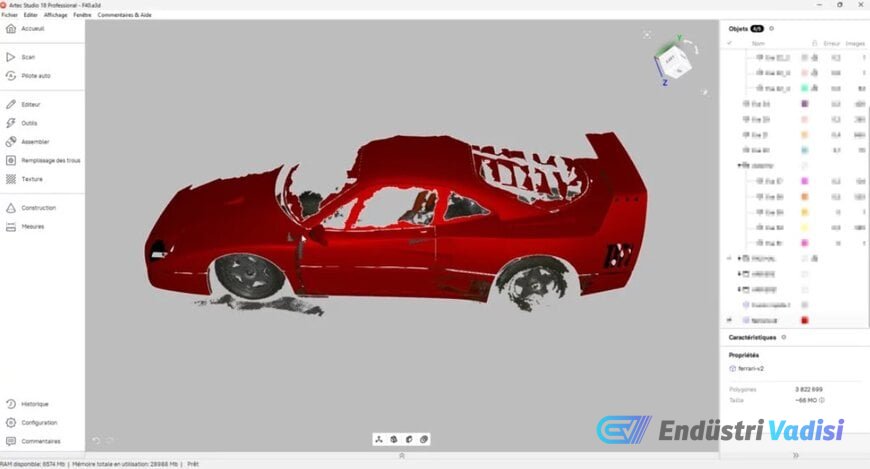
The maintenance and restoration of classic vehicles often encounter difficulties due to the obsolescence of original components that are unavailable in the spare parts market. To overcome this limitation, Azur Media 3D, a design workshop based in Nice, specializes in the digitalization of physical structures. The company undertook the task of completely scanning a Ferrari F40. The technical objective was to create a precise digital replica that would enable reverse engineering, custom part design, and the adaptation of replacement mechanical or structural components.
─────────────────────────
🔍 Geometric and Material Capture Constraints 💡
The three-dimensional capture of a car body requires obtaining complex surface data, including sharp edges, hard-to-reach cavities, and materials exhibiting varying levels of reflectivity. The operation also required preserving the integrity of the existing surfaces, prohibiting the use of adhesive markers or any direct physical contact with the vehicle. To meet these requirements, the workshop chose the Artec Leo 3D scanner. This wireless device integrates on-board processing capabilities, providing real-time visual feedback on the quality of the captured mesh.
The absence of cables simplifies the operator's movement around the vehicle, allowing geometric data to be obtained without additional positioning tools. Mathieu Fabris, Director of Azur Media 3D, explained, "For the owner, the use of the Artec Leo was a prerequisite because it allows for risk-free intervention with high precision, while remaining agile during capture."
─────────────────────────
⚙️ Data Processing and Operational Gains 📊
The use of this data acquisition solution allowed the three-dimensional scanning phase to be completed in approximately one hour. The raw point clouds were then processed using the Artec Studio software environment. The software uses alignment and merging algorithms to clean the data and create a solid model compatible with computer-aided design (CAD) tools. Automation functions integrated into the interface significantly reduced modeling time.
According to the company, this methodology resulted in an estimated productivity gain of about ten hours across the entire post-processing workflow. Mathieu Fabris stated, "What makes the difference is the ability to quickly move from capture to a usable model. Artec Studio allows us to work much faster while maintaining high precision."
─────────────────────────
🏭 Expansion of Industrial Applications 🌍
Beyond the preservation of historic vehicles and scaled reproductions, the resulting three-dimensional models feed databases that can be used for additional engineering and archiving operations. Azur Media 3D also uses these data acquisition technologies for applications involving heavy industrial vehicles. The company recently digitized the architecture of a Renault Trucks commercial vehicle as part of a retrofit project adapting the vehicle to a hydrogen-powered propulsion system, demonstrating the integration of 3D scanning into reverse engineering and structural modification workflows.