








Hasan S. Cemkan
Corporate
- Thread Author
- #1
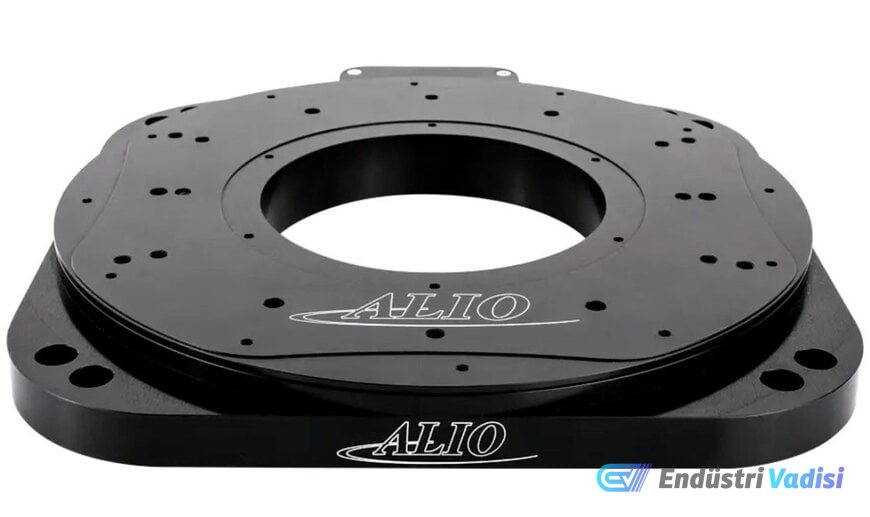
✨ Next-Generation Rotary Stage from Allient
Allient Inc. has introduced ThruSight-Theta, a new rotary stage with a large aperture and ultra-thin profile, designed for automation and semiconductor manufacturing systems. This innovative product revolutionizes the industry by offering high-precision positioning and continuous rotation capability.
⚙️ Ironless Motor Technology
ThruSight-Theta eliminates "cogging torque" thanks to its ironless motor design and axial flux technology. This minimizes speed fluctuations and positioning errors seen in traditional motors, ensuring extremely smooth motion and enhanced positioning accuracy.
- Height: Only 25 mm! This ultra-thin structure reduces moving mass, minimizing Abbe error.
- Abbe Error: A critical factor in precise motion control, this error refers to the linear increase of angular deviations as they move away from the measurement axis. ThruSight-Theta's low profile significantly reduces this error.
🎯 Integrated Design and Feedback Options
This rotary stage can be easily integrated into existing machine architectures. Its large 110 mm aperture allows cabling, laser beams, or optical components to pass directly through the center of rotation. This feature provides a significant advantage, especially for semiconductor manufacturing and photonic applications.
The system offers immediate position feedback upon power-up. Users can choose from 1 Vp-p Sin-Cos analog, Digital AQB, and absolute encoder outputs. These options, along with standard three-meter cabling, ensure compatibility with a wide range of industrial controllers.
📊 Competitive Advantages
ThruSight-Theta competes with direct-drive rotary stages from leading brands like Aerotech and Physik Instrumente in the high-precision motion control sector. While competitors with similar apertures range from 30 mm to 50 mm in height, this product offers an extremely compact form factor with its 25 mm profile.
This reduced vertical height provides a lower center of gravity during integration, offering mechanical advantages in multi-axis automation systems. This reduces cantilever effects and shortens dynamic settling times.





















