








Ahmet Ö.
Corporate
- Thread Author
- #1
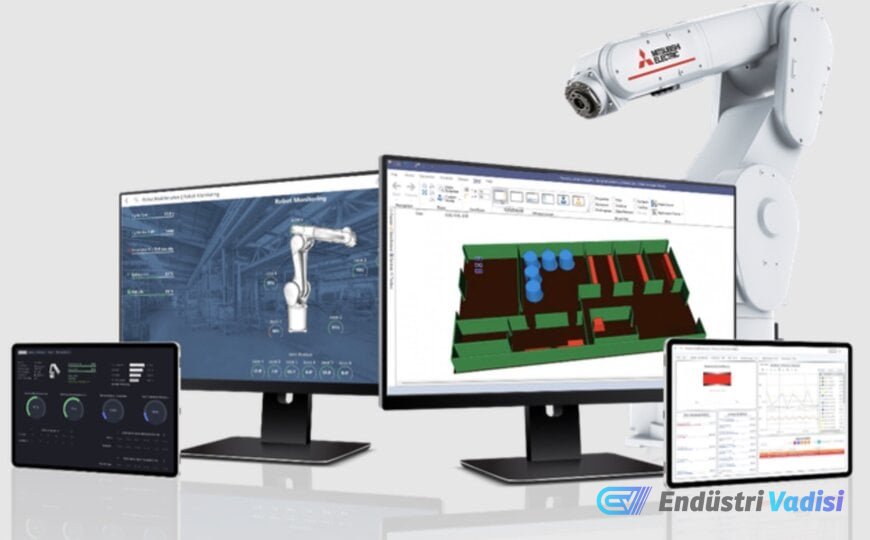
🚀 MELFA E4 Update from Mitsubishi Electric: A New Era in Manufacturing!
Mitsubishi Electric is raising the bar in connected manufacturing with the innovations it has brought to its industrial robot platform, MELFA E4. This update takes industrial automation to the next level with AI-powered predictive maintenance, deterministic network capabilities, and enhanced machine vision integration.
🧠 AI and Standardization of Maintenance Mechanisms
Thanks to these features now integrated into the robot controller, joint health is continuously monitored, and potential failures are predicted in advance. AI-powered force control optimization and thermal balancing algorithms maintain the robot's precision despite temperature changes, thereby improving production quality. This eliminates the need for external hardware and reduces the total cost of ownership.
⚡ Deterministic Communication and Axis Synchronization
The CR800-D robot controller supports CC-Link IE TSN networks, enabling high-speed and time-sensitive communication. This technology ensures seamless synchronization of robot arms with other automation hardware in the factory. Furthermore, the integration of MR-J5-B servo drives as synchronized external axes reduces maintenance costs thanks to battery-free absolute encoders and offers safety communication compliant with the ISO 10218 standard.
👁️ Dynamic Tracking for Machine Vision Applications
For applications requiring continuous spatial adaptation, a dynamic tracking and tracing command has been added. This new architecture allows the controller to directly capture encoder values from signals coming from external, third-party vision systems. This increases hardware compatibility for highly automated tracking applications on moving conveyor belts or assembly lines.
💡 Why Is It Important?
In the industrial robotics sector, controller architectures are now evaluated based on local network determinism and embedded analytical capabilities. While competing platforms offer similar features, CC-Link IE TSN integration sets this system apart. This technology allows high-speed IT data and deterministic operational technology control data to share the same network infrastructure without packet collisions or delays. Additionally, the transition to battery-free absolute encoders on auxiliary axes significantly reduces hazardous waste and routine maintenance downtime.



















