






Erkan Teskancan
Corporate
- Thread Author
- #1
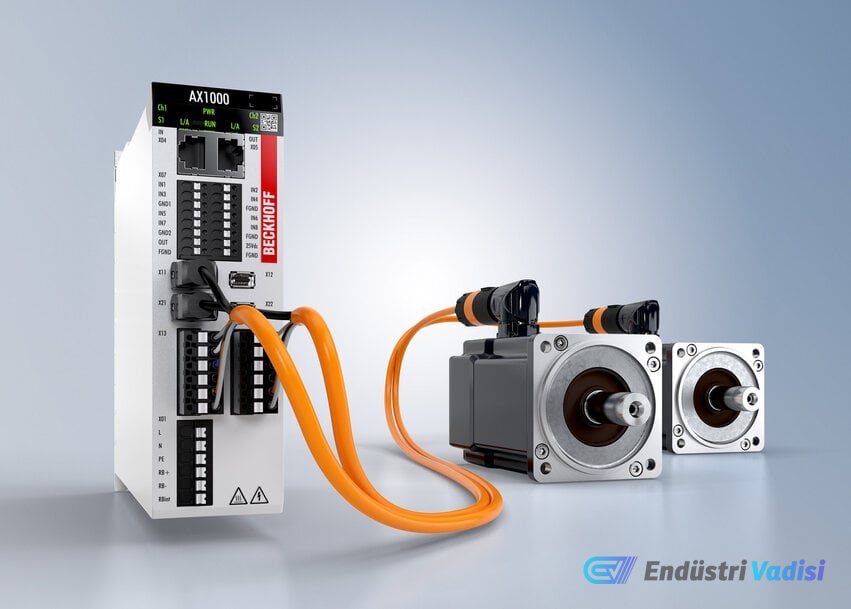
Beckhoff, a trailblazer in the world of industrial automation, has introduced its new AX1000 economic servo drive series, designed for low and medium power range applications. These compact and system-integrated drives mark a new era in the industry by offering advanced motion control features at an affordable cost.
─────────────────────────
💡 TwinCAT Integration and Easy Setup
The AX1000 series provides full integration with Beckhoff's powerful automation platform, TwinCAT, via EtherCAT. This means that the standard commissioning workflows, software features, and integrated diagnostic tools used in the company's high-end AX series are fully available in this economic series. Engineers can work quickly and efficiently in a familiar environment.
─────────────────────────
⚡ Electrical Infrastructure and Module Layout
The AX1000 power platform comes with two main voltage options to meet different machine layouts and factory power requirements:
[]Low Power Version: Ideal for compact or low-voltage applications with single-phase 1 x 240 V AC supply.
[]High Power Version: Supports operating currents from 1.65 A to 12 A with three-phase 3 x 480 V AC supply.
─────────────────────────
⚙️ Motor Compatibility and Automation Software
This servo drive platform offers extensive motor interfacing capabilities. Notably, it is compatible with AM8000 synchronous servo motors featuring One Cable Technology (OCT). OCT reduces wiring complexity by combining power and feedback signals into a single physical cable harness. It also supports asynchronous motors and reluctance motors, with or without external encoder feedback.
For parameterization, system deployment, and operational analysis, the series seamlessly integrates with TwinCAT automation software. Engineers can benefit from features such as TwinCAT Drive Manager 2, automatic Autotuning routines, Bode Plot frequency analysis, and specialized cogging compensation tools that minimize speed ripple.
─────────────────────────
🔬 Advanced Synchronization and Power Management
Servo drive architectures designed for advanced fieldbus integration rely on synchronized clock protocols to achieve multi-axis coordination. The EtherCAT network utilizes a Distributed Clocks (DC) mechanism, where the master clock continuously measures and compensates for propagation delays across the serial network topology. This timestamp synchronization ensures synchronization accuracy below 1 microsecond, guaranteeing the simultaneous execution of position loop updates in adjacent single-axis and dual-axis drive modules. This tight timing is critical for complex applications such as interpolated CNC profile paths, multi-axis gantry electronic gearing, and high-speed flying cut systems.
The generation of internal control voltages via the main DC link circuit employs a buck switching power supply configuration. In industrial drive systems, isolating the logic board power supply from external 24 VDC auxiliary connections enhances system resilience against local voltage drops or external electrical disturbances. During momentary mains power dips or total power outages, the drive utilizes residual kinetic and potential energy stored in the main DC link capacitor bank to keep its microprocessors and fieldbus communication stack online. This configuration allows the drive to log the fault, send immediate diagnostic telemetry to the PLC, and execute a controlled, safe emergency stop sequence before internal logic fully shuts down.
Motor feedback loop topologies have been enhanced through digital single-cable interfaces like One Cable Technology (OCT). Traditional servo motors require two separate cables: a heavy-duty shielded cable for three-phase AC stator currents and a separate, low-signal twisted pair cable for encoder signals (such as EnDat, BiSS, or resolver outputs). OCT combines these two paths by directly superimposing high-frequency bidirectional digital telemetry onto extra signal wires embedded within the main motor power cable. This digital data modulation uses robust frequency shift keying or specialized serialization layers to protect position data from electromagnetic noise generated by adjacent pulse width modulation (PWM) inverter lines, thereby minimizing hardware cost and cabling volume.
─────────────────────────
📊 Conclusion: Efficiency and Cost Advantage
Beckhoff's AX1000 series sets a new standard in industrial automation by combining advanced motion control with an economical solution. Thanks to its compact design, broad motor compatibility, and full integration with the TwinCAT platform, it enables businesses to increase their efficiency while reducing costs. This series stands out as a future-proof investment that meets the needs of modern production facilities.