




Cengiz Özemli
Academic
- Thread Author
- #1
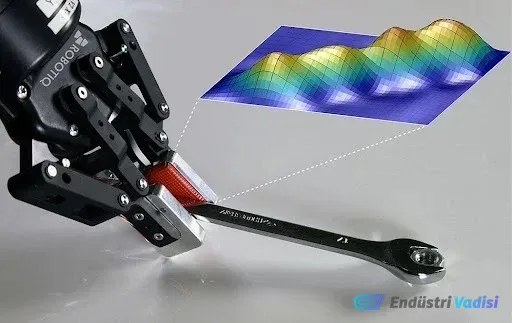
Robotiq has introduced the TSF-85 tactile finger kit, capable of sensing pressure and vibration to enhance gripping performance on robot arms.
Robotiq, the Canadian manufacturer of robotic end-effectors, has launched its tactile finger kit, TSF-85, which improves the sensing capabilities of ordinary robotic operations. This new sensor aims to increase robot gripping consistency and part-holding reliability by providing high-resolution pressure and vibration data beyond standard gripping feedback. This will allow for more detailed data collection in physical AI, where every movement can be analyzed to optimize operations.
### Robotiq TSF-85 Features
- Touch-like data collection with a 4x7 pressure sensor matrix
- Ability to sense pressure and vibration
- Soft, durable neoprene coating
- Maximum gripping force: 225 N
Gripping feedback in robots is not a new concept. Grippers powered by electricity or pneumatics can monitor their status using position sensors and motor current or pressure sensors. Basic feedback typically answers questions like "is the gripper open/closed?" or "is the part held correctly?".
However, more advanced questions are also important: Is the part gripped the same way every time? Are there identifying holes or protrusions on the part? Is the part centered within the gripper? With this information, gripping operations can be made more consistent and reliable over time, cycle times can be reduced, and system variability can be tolerated.
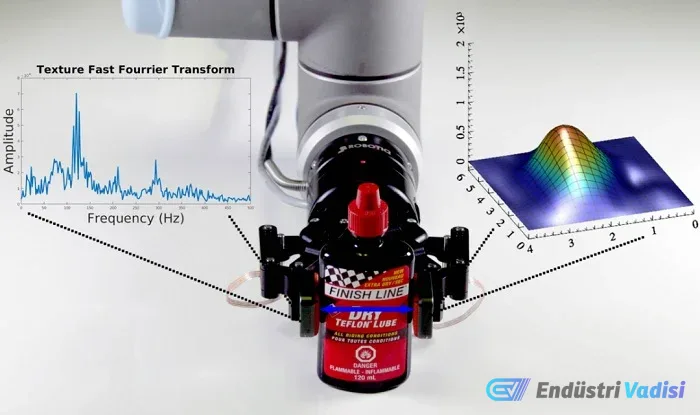
The TSF-85 offers this solution in an efficient package. The 4x7 sensor matrix provides a feel similar to a pressure-sensitive touchscreen. The neoprene coating offers both flexibility and the ability to securely hold most previously gripped parts. With the Software Development Kit (SDK), gripping profiles can be viewed graphically.
For example, during the testing phase, the grip might appear stable when the robot moves slowly; however, the gripping position might change as speed increases. Thanks to the precise position sensing offered by the TSF-85, the robot can adapt to these small speed changes.
Another example: when gripping a cube part with a hole through its center, if only position sensing is available, it's impossible to know if the holed surface is being gripped. However, with a 2D gripping profile, the robot can detect the part's features, position, and orientation, allowing for more accurate placement.
Although TSF-85 data is not currently integrated directly into robot control systems, projects are progressing rapidly as the user base grows. Data is transmitted to a PC via USB for graphic display and analysis.
As the need for more data increases, the real challenge is not the sensors themselves, but rather integrating these sensors correctly without affecting processes and transforming the data into KPI analysis and process improvement.