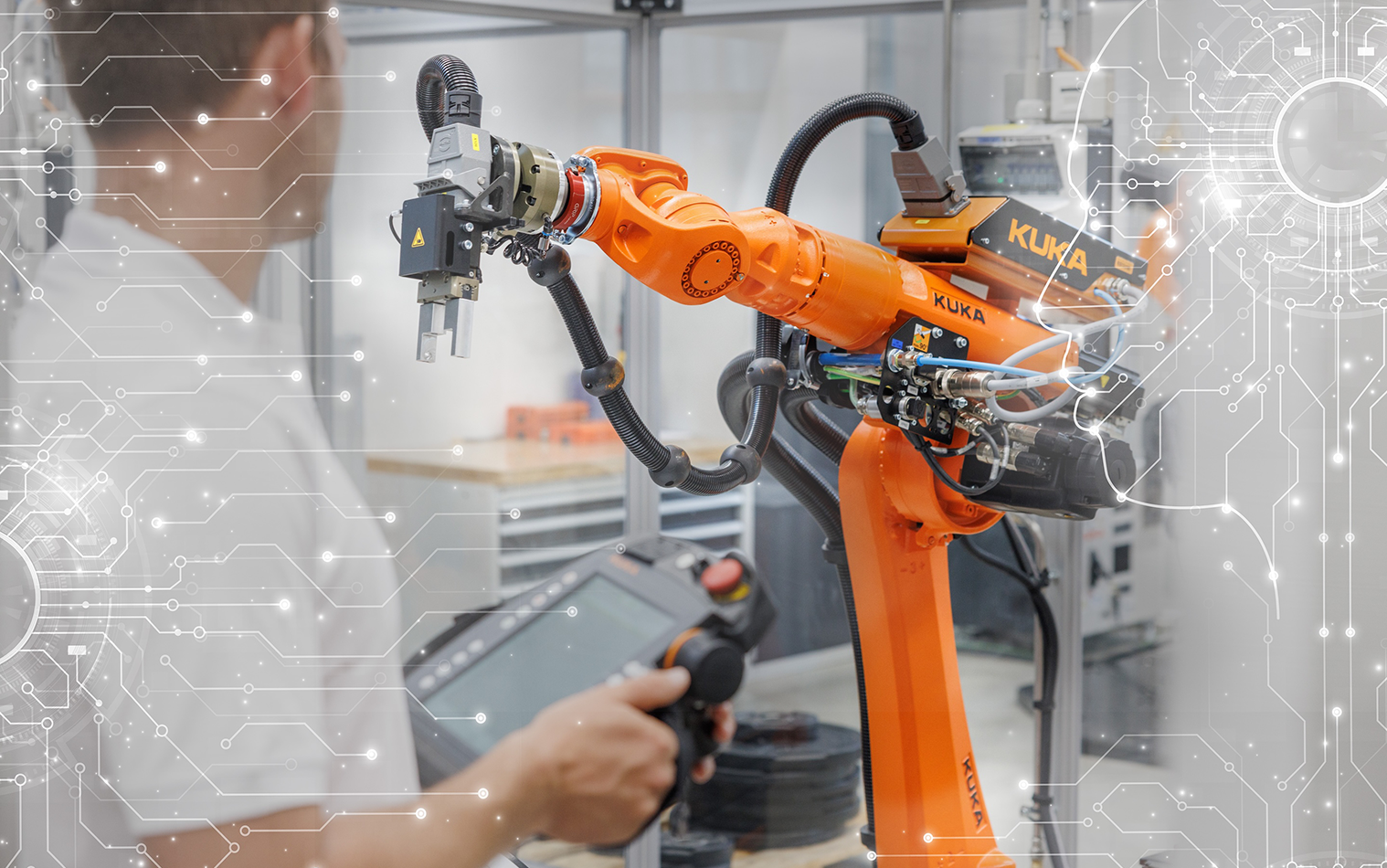
\n\n## KUKA's Vision for Automation 2.0 in the Era of Physical AI\n\nKUKA is repositioning itself to expand its global leadership role in the era of physical artificial intelligence. Its new automation platform, KUKA AMP, accelerates the transition to physical AI in manufacturing by combining traditional rule-based systems with AI-powered intent-based automation.\n\n### Smart Automation with KUKA AMP\n\nIntroduced on April 14, 2026, in Shelby Township, Michigan, KUKA AMP integrates object detection, decision-making, and autonomous movement functionalities to offer faster and more flexible automation solutions. A KUKA robot on stage at NVIDIA’s GTC conference in San Jose demonstrated the beginning of a new era in industrial automation: AI is no longer just for analysis but is evolving into systems that make decisions and act autonomously in the physical world.\n\nPhysical AI and advanced robotics technologies are boosting efficiency and competitiveness in manufacturing processes, supply chains, and industrial services. Large-scale AI models, simulation-driven innovations, and powerful computer architectures are accelerating this transformation. KUKA stands out as a pioneer among global automation companies in this field.\n\n### KUKA Group CEO Christoph Schell's Remarks\n\n\"Robots and automation systems are no longer programmable machines but are transforming into intelligent collaborators that can learn, adapt, and work safely alongside humans,\" says Schell. \"Open software platforms like KUKA AMP combine rule-based systems with intent-based automation, making the transition from concept to implementation faster, more accurate, and cost-effective.\" KUKA AMP was publicly unveiled for the first time at NVIDIA GTC.\n\n### From Automation 1.0 to Physical AI and Automation 2.0\n\nKUKA will integrate intent-based and physical AI capabilities into robotics, system integration, warehouse management, healthcare automation, and simulation. Intent-based systems convert the user's objective into automatic decisions and actions, leaving intermediate steps to technology. KUKA aims to strengthen its global leadership with Automation 2.0, which offers new flexibilities, while maintaining the importance of rule-based systems, which it calls \"Automation 1.0.\"\n\n### KUKA's Strategic Growth and R&D Investments\n\nIn 2025, under the leadership of CEO Christoph Schell, the KUKA Group made its highest ever R&D investment of 213 million euros ($245.8 million). The company continues its global growth by balancing its revenues across Europe, the Middle East and Africa, the Americas, and Asia-Pacific regions.\n\n### Global Expansion and Innovation Centers\n\nKUKA is increasing its global footprint with centers established in partnership with Danang University in Vietnam and an expanding market presence in rapidly growing markets like India. In the US, a software and AI excellence center was established in Silicon Valley. Here, the team, featuring key figures like award-winning robotics expert Melonee Wise, introduced KUKA AMP at NVIDIA GTC.\n\nKUKA provides customers with complete automation solutions that integrate hardware, software, and digital solutions. This includes a broad portfolio ranging from industrial and mobile robots to simulation, cranes, warehouse systems, and healthcare automation. Additionally, it manages production facilities using Robots-as-a-Service models.\n\n### About KUKA\n\nKUKA is a global automation group with approximately 15,000 employees and a turnover of 3.7 billion euros. It offers resource-saving automation solutions such as industrial robots, autonomous mobile robots (AMR), controllers, software, and cloud-based digital services. It develops fully networked production systems for the automotive (especially e-mobility and battery), electronics, metal, plastics, consumer goods, food, e-commerce, retail, and healthcare sectors. Its headquarters are in Augsburg, Germany.