






Elif Özaksu
Corporate
- Thread Author
- #1
🚀 A Revolutionary Step from Pickering Interfaces! 🚀
Pickering Interfaces introduces a standard hardware architecture designed to route high-voltage signals and manage power supplies within the automotive data ecosystem. This new system simplifies high-power signal routing in many technical applications, from electric vehicle battery testing to solar inverter validation and advanced aerospace developments.
🔌 60-191 LXI Series: A New Era in Power Management 🔌
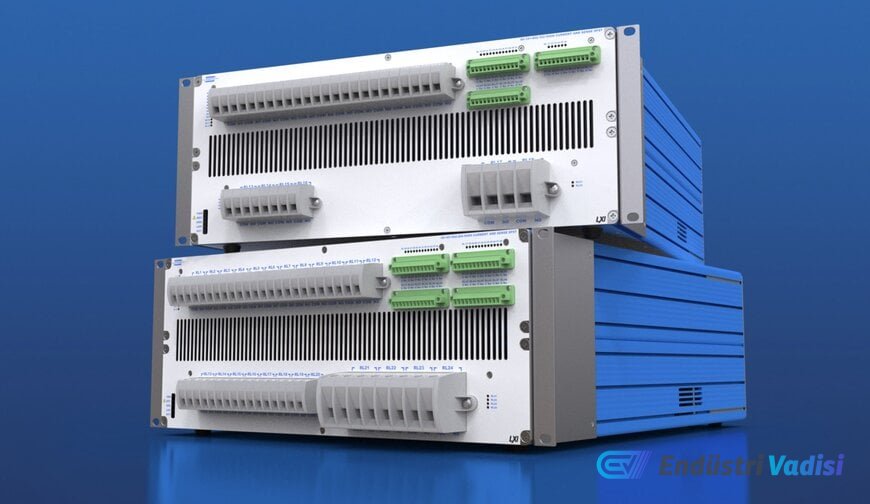
Pickering Interfaces' newly launched 60-191 LXI family of high-current and sensing single-pole single-throw (SPST) switching is designed to manage high-power signal routing up to 80 A and 300 V. This hardware facilitates the distribution, sequencing, and management of multiple high-current power supplies.
🛠️ Easy Integration into Automated Test Systems 🛠️
Integrating high-current switching into automated test systems previously required engineers to create custom setups using separate contactors and digital output modules. The 60-191 family replaces these custom structures with a standard, easy-to-maintain 4U enclosure. This hardware architecture supports functional testing in areas such as fuel cell research, hydrogen electrolysis, and high-current automotive electronics where reliable, automated power distribution is critical.
⚙️ Relay Configuration and Control Mechanisms ⚙️
The switching units are available in four standard configurations, accommodating up to twenty 40 A and four 80 A hermetically sealed SPST normally open (NO) contactors. These are paired with the same number of 1 A SPST relays specifically dedicated to sensing lines. Hardware engineers can programmatically connect and disconnect the positive and negative outputs of a power supply unit, along with their respective high and low sensing lines, via front panel screw terminal connections.
The system allows for independent control of each relay or grouped operation of two high-current and two low-current relays with a single command. This grouping mechanism simplifies the switching of standard four-wire power supply connections, reducing the complexity of control code required to manage multi-channel power injection.
💾 Sequence Storage and Network Connectivity 💾
To reduce host operations and minimize system latency, each unit features an onboard sequencing service capable of storing up to 5,000 predefined switching sequences. These sequences are executed via software commands or configurable hardware triggers directly from the chassis.
The hardware operates via an LXI 1.5 compliant 1000Base-T Ethernet interface, using an application programming interface (API) or an embedded software front panel. System integration is supported by Interchangeable Virtual Instrument (IVI) and direct I/O drivers compatible with Windows, Linux, LabVIEW, Python, C/C++, C#, MATLAB, and Simulink. Additional diagnostic features include front panel light-emitting diodes (LEDs) for status indication and local relay cycle counting to support predictive maintenance schedules and compensate for physical wear on current switching paths.
💡 Why Pickering 60-191? 💡
In the automated test equipment (ATE) market, LXI switching systems are typically manufactured by companies such as Keysight Technologies and VTI Instruments (AMETEK). The primary target benchmarks for these systems are maximum internal current carrying capacity and the integration of native sensing lines for four-wire measurements.
Standard high-density LXI mainframes, such as the Keysight 34980A or VTI EX1200 series, typically support internal multiplexer and matrix modules rated between 1 A and 16 A. To approach continuous currents of 80 A, test engineers often have to route low-voltage control signals from the LXI chassis to external, third-party electromechanical contactors. By integrating 80 A and 40 A hermetically sealed contactors, along with 1 A sensing relays, directly into a single LXI 1.5 compliant 4U chassis, the 60-191 architecture eliminates the need for distributed external contactor wiring, thereby reducing the overall volumetric footprint of the test rack and decreasing potential failure points in the wiring harness.