







Erkan Teskancan
Corporate
- Thread Author
- #1
## Fundamentals of Digital Twins: Core Concepts and Supporting Technologies
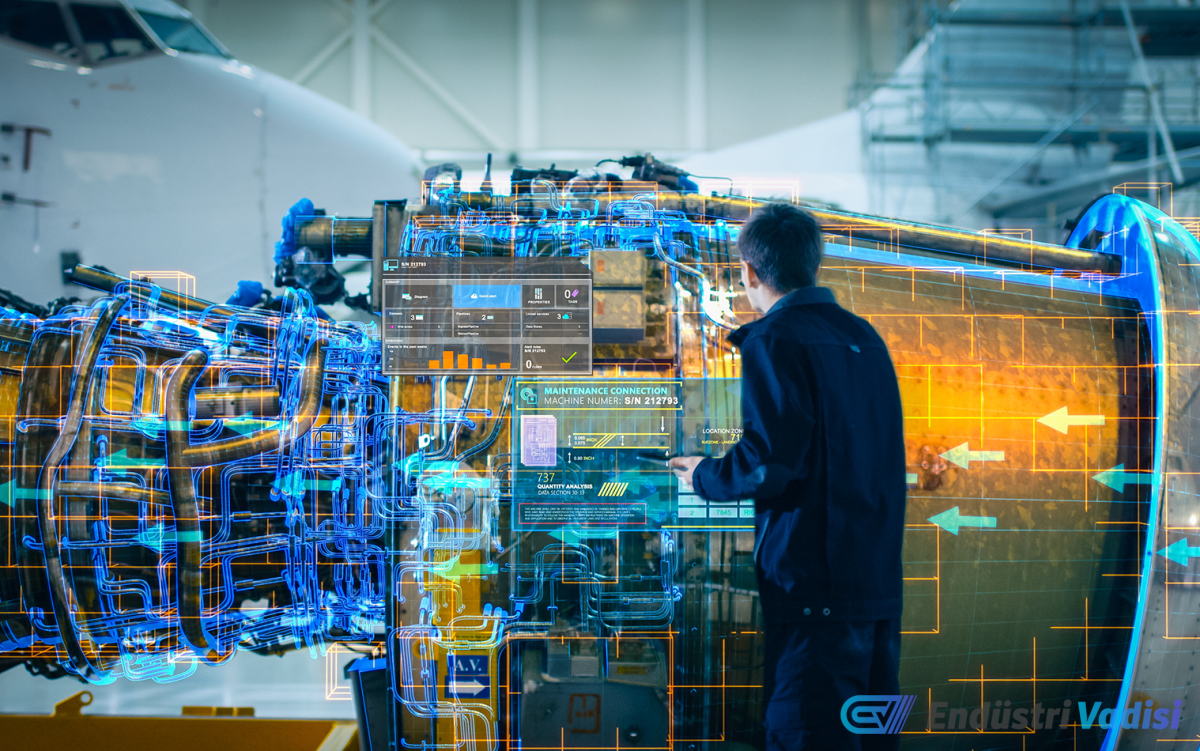
A better understanding of the design, implementation, and operation of digital twins, which are cyber-physical systems, provides significant optimizations in monitoring, controlling, and planning processes.
Digital twins have evolved from physical system mapping with the development of digital technologies. Technologies such as the Industrial Internet of Things (IIoT), industrial Ethernet, cloud computing, data analytics, and artificial intelligence (AI) have enabled the formation of cyber-physical systems (CPS) that connect with a virtual physical system, making digital twin applications possible across all industrial sectors. Digital twins provide organizations with insights, optimization, and predictive capabilities by establishing a connection between physical systems and virtual representations.
### Key Features of Digital Twins
- Use of IIoT, industrial Ethernet, cloud computing, data analytics, and AI
- Integration of physical system with virtual environment
- Reduction of process uncertainties
- Optimized process monitoring and control through the combination of human and machine intelligence
### The Role of Digital Twins in Industry
Digital twins are a type of CPS that specifically supports smart manufacturing. In the manufacturing domain, a digital twin establishes a data link between a physical asset and its virtual representation, using simulation and computational techniques to enhance the performance of the physical element. Initially emerging in the aerospace sector, this technology now supports the Industry 4.0 paradigm across many sectors and product/service life cycles.
### Smart Manufacturing and Industry 4.0
Industrial mechanization in the 1700s and early 1800s constituted the first industrial revolution. The internal combustion engine and electrification triggered the second revolution. In the 1900s, electronic technologies laid the groundwork for the digital revolution, and this digitalization paved the way for a new industrial phase called Industry 4.0, focusing on mass customization rather than mass production.
Smart manufacturing aims for high efficiency and flexibility in production through real-time data transmission, analysis, and model-based simulation throughout the product life cycle. Industry 4.0 enables large-scale automation and optimization with information transparency, connectivity, and distributed decisions.
### Technologies Powering Digital Twins
- Industrial Internet of Things (IIoT): Data flow from sensors and devices
- Industrial Ethernet: Integration and communication of different devices
- Cloud Computing: Scalable processing power remotely
- Data Analytics and Big Data: Analysis of large datasets
- Artificial Intelligence and Machine Learning: Process optimization and prediction
### Internet of Things (IoT) and Industrial Internet of Things (IIoT)
IoT is a network technology that enables everyday objects to send and receive data via the internet. Sensors are found on many devices, from household appliances to complex industrial tools. The number of IoT devices, which was 18.8 billion in 2024, is projected to reach 41.1 billion in 2030.
IIoT is the use of IoT technologies in industrial environments, enabling organizations to create value through data exchange in manufacturing processes.
### Industrial Ethernet
Industrial Ethernet is an Ethernet technology used to enable communication between devices and systems in factories. It is structured on TCP/IP protocol and industrial protocols like EtherNet/IP, facilitating horizontal and vertical integration.
### Cloud Computing
Cloud computing is the delivery of software and data services from remote servers over the internet. Digital twins use cloud or edge computing for high processing power. While cloud computing offers high scalability, security is a significant challenge.
### Big Data and Data Analytics
Big data refers to very large and unstructured datasets. Data analytics transforms this data into meaningful information and provides critical support for digital twins in conjunction with machine learning algorithms.
### Artificial Intelligence and Machine Learning
Artificial intelligence aims to develop systems that mimic human intelligence. Machine learning, a subfield of AI, optimizes processes by learning from data. Digital twins use hybrid intelligence by combining physical and probabilistic models.
### Cyber-Physical Systems (CPS)
CPS are systems used for monitoring, controlling, and optimizing physical systems by integrating them with software and communication technologies. Digital twins are a type of CPS that uses an extensible service-based architecture.
### Systems, Emergent Properties, and Variability
Systems consist of interconnected objects and processes. In complex systems, new and unpredictable characteristics (emergent properties) can be observed. Understanding these properties plays an important role in digital twins solving complex processes.
Variability creates uncertainty in systems and can differ in processes like manufacturing. Digital twin technologies can continuously predict and optimize these processes.
### Mass Customization and Smart Manufacturing
Thanks to Industry 4.0, customer-specific small batches can be produced quickly and economically. In this process, digital twins manage dynamic and random production variabilities, ensuring sustainable and flexible manufacturing processes.
### From Data to Information and Knowledge
Intelligence is formed by giving meaning to data. While data is raw information, it becomes meaningful information when placed in context, and further analysis turns it into knowledge. Human intelligence complements AI with unique abilities such as problem-solving and creativity.
### Conclusion
IIoT, industrial Ethernet, cloud computing, data analytics, and AI form the foundation of Industry 4.0. Digital twins enhance the visibility, optimization, and predictability of complex manufacturing systems. The hybrid use of human intelligence and AI maximizes the performance of digital twins. Understanding the core concepts and supporting technologies is essential for a deep understanding of the design, implementation, and operation of digital twins.