



Hasan S. Cemkan
Corporate
- Thread Author
- #1
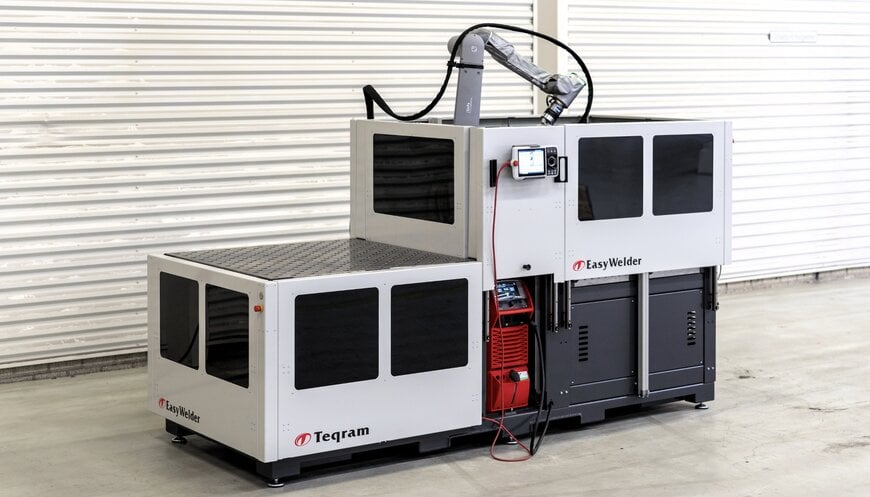
Great news for companies in the metalworking sector looking to increase welding capacity without sacrificing flexibility! Teqram has introduced its new welding cobot cell, the EasyWelder. This innovative solution minimizes downtime in your production processes, boosting efficiency to its peak.
─────────────────────────
⚙️ Automation and Operational Solutions
EasyWelder is specifically designed for companies with high production variety and those facing a shortage of skilled labor. Its modular structure significantly increases welding output while maintaining operational flexibility. The dual-station configuration and intuitive user interface allow you to easily manage variable product series and minimize changeover times.
─────────────────────────
🔄 Dual-Station Architecture: Seamless Flow
Traditional automated welding systems cause significant time losses during product changeovers and manual loading. EasyWelder eliminates this problem with its dual-station design, featuring two separate welding tables. While the robot welds on one side, the operator can safely load raw materials or unload finished parts on the other.
This continuous workflow prevents the robot from stopping during manual part changes and increases the cell's effective arc-on time by up to 80%. As a result, the overall equipment effectiveness (OEE) significantly increases compared to single-table systems.
─────────────────────────
🛡️ Adjustable Workspace and Protective Enclosure
The workspace is equipped with an automatically moving protective enclosure featuring ultraviolet (UV) filtered windows. This ensures that nearby workers are protected even when the robot operates at maximum speed, while providing a clear view of the welding area. Full access from three sides to both welding tables, measuring 1200 x 1200 mm, facilitates part clamping. For larger parts, the partition between the two stations can be retracted to transform into a single production area of 2900 x 1200 mm.
─────────────────────────
💡 Simplified Programming and Smart Templates
EasyWelder, thanks to its intuitive user interface and smart programming templates, allows experienced welders to utilize automation without needing specialized robotic knowledge or external offline programming tools. Common industrial welding procedures such as circular welds, spot welds, straight seams, and multi-pass joints can be configured in minutes.
To program a new part path, the operator manually guides the cobot arm along the weld seam and records waypoints via control buttons on the robot head or an integrated selector ring. The internal software automatically generates the execution code from these manual inputs, reducing total program development time by up to 70%. Operators can work independently with the cell after half a day of training.
─────────────────────────
🎯 Automatic Seam Tracking and Precise Components
The system ensures consistent weld quality by executing the same paths regardless of operator fatigue, reducing the need for manual rework and lowering rejection rates. To accommodate part variations, the cell features an automatic weld seam detection and tracking system. Based on 3D vision technology, this real-time system measures the exact position of the workpiece and joint geometry during execution, automatically modifying the active path to compensate for part tolerances or clamping misalignments.
The hardware consists of an ABB GoFa cobot arm and Fronius welding power sources. The cobot arm operates with a path accuracy of 0.03 mm and a maximum tool movement speed of up to 2.2 meters per second between positions to accelerate cycle times. The integrated power source provides arc stability to control spatter and thermal deformation when processing aluminum, stainless steel, and thin-gauge alloys.
─────────────────────────
📏 Compact Design and Plug-and-Play Integration
With a total footprint of 3100 x 1600 mm, the compact configuration requires minimal factory space and does not necessitate mechanical anchoring to the concrete floor. The standalone cell can be lifted and repositioned within the facility using a standard forklift to adapt to changing production demands. Commissioning relies on plug-and-play installation, requiring only structural positioning and connection to workshop electrical power, compressed air lines, and shielding gas supply.
─────────────────────────
📊 Technical Details and Efficiency Comparison
Collaborative robotic welding cells, designed for small and medium-sized enterprises (SMEs) and job shops, are categorized by their spatial arrangements, programming methods, and sensor integrations. These systems aim to bridge the gap between flexible manual welding and fixed, high-volume industrial automation.
Traditional entry-level cobot welding packages on the market typically use a single fixed table configuration, usually measuring 1500 x 1000 mm. In a single-station setup, the robot is forced to remain completely idle for several minutes while an operator manually unloads a finished part, cleans the fixture, and positions raw material. This structural limitation restricts the maximum arc-on time for single-station product lines to approximately 40% to 55% of the total shift duration.
Transitioning the cell topology to a dual-zone layout with twin 1200 x 1200 mm work areas offers parallel processing capability. The ability to combine these zones into a continuous 2900 x 1200 mm area provides an advantage over standard dual-zone rotary table indexers or fixed-enclosure dual-shuttle cells that have non-removable fixed central partitions, which cannot accommodate long structural frames or extended pipe assemblies.
Rotor and joint articulation tolerances determine the quality of precise gas metal arc welding (GMAW) and gas tungsten arc welding (GTAW). General market alternatives using lighter-duty collaborative arms typically offer a path repeatability envelope of approximately 0.05 mm to 0.1 mm. Reducing this path accuracy limit to 0.03 mm provides a distinct mechanical benefit when performing micro-welds on thin sheet metal or navigating narrow corner joints, where small deviations can lead to burn-through or insufficient throat thickness.
Furthermore, while basic cobot arms limit linear air-cut transfer speeds to 1.0 meter per second to meet default collaborative safety force limits, using a high-speed arm at 2.2 meters per second minimizes non-productive motion cycles. The inclusion of an automatically moving protective enclosure with integrated UV protection allows the arm to utilize these higher speeds safely, circumventing the strict speed limits mandated for fully fence-less or open-table collaborative setups under standard safety specifications.
EasyWelder is poised to transform welding processes in the metalworking industry by combining flexibility, efficiency, and ease of use. This cobot cell offers a powerful tool that will enable businesses to quickly adapt to changing market conditions and gain a competitive advantage.