








Cengiz Özemli
Academic
- Thread Author
- #1
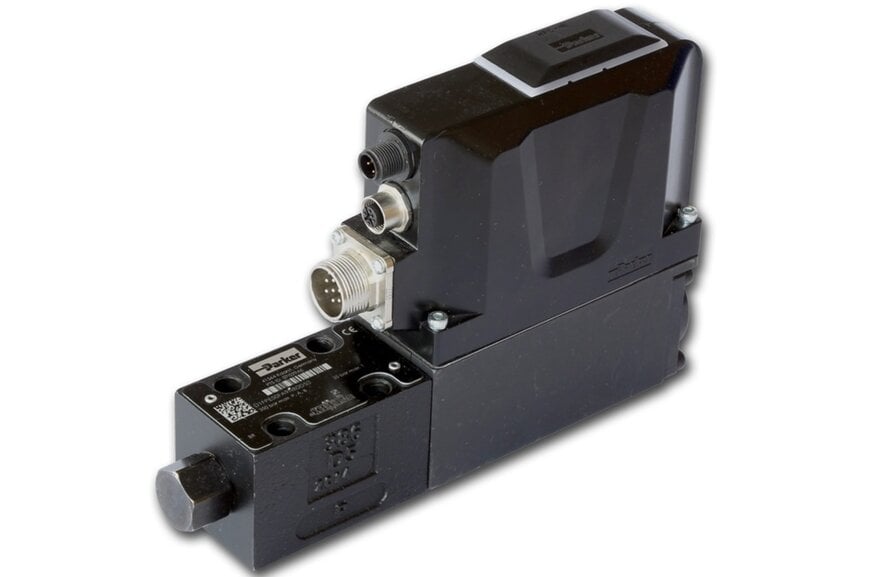
In the world of industrial automation, precision and dynamism are more crucial than ever. In response to this need, Parker Hannifin has expanded its electro-hydraulic control platform by introducing a new hydraulic valve with integrated sensor connectivity for pressure and position control applications. This innovation is poised to play a central role in the digital supply chain of industrial machinery.
─────────────────────────
💡 New Member of the DFplus Platform: The D-version Valve
Parker Hannifin's fourth-generation DFplus valve platform has been enhanced with the D-version variant. This direct-drive valve is designed to support customer-centric, closed-loop functions. Specifically developed for applications requiring high dynamic response and precise calibration, this hardware regulates variables such as pump volume flow and real-time pressure adjustments, placing it at the heart of industrial machinery.
It has been optimized for use in demanding production environments, particularly in pressure management systems in paper production machines and high-speed hydraulic presses.
─────────────────────────
🔬 Integrated Dual-Loop Architecture and Sensor Interfaces
Traditional proportional valves typically rely on a single internal control loop to manage spool position relative to an external command signal. However, the D-version changes this structure by offering a second freely parameterizable control loop directly integrated into the valve's electronics. This dual-loop topology allows the valve to simultaneously manage both its own internal mechanics and an external process variable, such as system pressure or cylinder displacement.
To facilitate the second loop, the valve electronics feature a high-resolution sensor signal interface accessible via an integrated M12 connection socket. Analog pressure or displacement measurement sensors can be connected directly to this port, drawing their operating power from the valve electronics. This setup eliminates the need for separate external sensor power supplies and reduces intermediate cabling, minimizing signal attenuation and electrical noise interference. The system supports selectable setpoint configurations, allowing analog setpoint signals to be input according to specific process requirements.
─────────────────────────
📊 Digital Configuration and Communication Protocols
The D-version option is available in the D1FP, D3FP, and D30FP proportional valve series. Configuration, parameterization, and diagnostics of the second control loop are performed via digital interfaces rather than manual hardware adjustments. Technicians can configure loop dynamics through Parker ProPXD parameterization software or a standard IO-Link digital interface.
The hardware uses an IO-Link Class A connection as standard for data transmission and power. For applications requiring advanced control flexibility, an optional IO-Link Class B variant is also available, providing a switchable controller architecture to change control strategies during operation based on real-time production demands.
According to Hydraulic Valve Systems Division Europe, these valves integrate control processing and sensor power distribution directly into the valve assembly, offering a cost-effective solution for high-dynamic, closed-loop controlled applications.
─────────────────────────
⚙️ Technical Differentiation and Competitive Advantage
The key technical differentiation of the D-version valve is its decentralized control architecture. Traditional high-dynamic valves (e.g., Bosch Rexroth 4RPWE or Moog D633) process secondary process loops (such as pressure or position) within a central Programmable Logic Controller (PLC) or an external motion controller. Processing the secondary loop within the valve electronics shortens the control loop cycle time, reduces propagation delay, and increases the dynamic stiffness of the system during rapid pressure drops or high-speed press cycles.
Furthermore, while competing models use industrial Ethernet protocols for high-speed fieldbus communication, they often treat the valve as an execution device rather than a sensor aggregator. The inclusion of automatic sensor power supply and an integrated feedback interface in an IO-Link Class B environment allows the D-version to act as an edge node, reducing the I/O footprint required in the main electrical cabinet.
─────────────────────────
This new generation of hydraulic valves represents a significant step towards higher precision, faster response times, and more integrated systems in industrial automation. Parker Hannifin's innovation opens the door to future smart factories by enhancing efficiency and control in manufacturing processes.






















