



Süeda Asil
Corporate
- Thread Author
- #1
The future of industrial automation is being shaped by the physical artificial intelligence (AI) solutions that Teradyne Robotics will showcase at Automate 2026. This powerhouse behind leading brands like Universal Robots (UR) and Mobile Industrial Robots (MiR) will introduce robotic applications for dynamic and unstructured environments in Chicago, from June 22-25, 2026.
─────────────────────────
💡 Next-Generation Software and PLC-Style Logic
The foundation of physical AI breakthroughs is UR's next-generation software platform, PolyScope X. While retaining the motion control infrastructure of previous UR systems, PolyScope X elevates the operator experience to a contemporary level with modern web technologies, containerized applications, and native ROS 2 (Robot Operating System) support.
One of the most significant features of the software is the introduction of Logic Programs. These continuously running, multi-threaded programs execute in parallel with the main robot program. This native, PLC-style background logic allows programmers to coordinate and control multiple work cell components, as well as exchange data independently of safety stops, program pauses, and primary robot power status.
Jean-Pierre Hathout, President of Teradyne Robotics Group, emphasizes that modern manufacturing requires an integrated and adaptable platform that can evolve beyond the capabilities of a standalone robot arm.
─────────────────────────
⚙️ Infrastructure Automation for Electronics and Data Centers
The exhibition highlights the company's strategic focus on infrastructure for electronics manufacturing and AI data centers with various technical demonstrations:
[]UR AI Trainer: Developed in collaboration with Scale AI, this imitation learning platform allows operators to physically guide a UR robot through assembly or packaging tasks. The system collects high-accuracy, force-aware data to train Vision-Language-Action (VLA) models for factory deployment.
[]Generalist: Two UR12e robots operating autonomously with Generalist's GEN-1 model are showcased. The setup demonstrates how general-purpose robotic foundation models provide physical world intelligence and dexterous manipulation at the speed and reliability levels required for practical factory deployment.
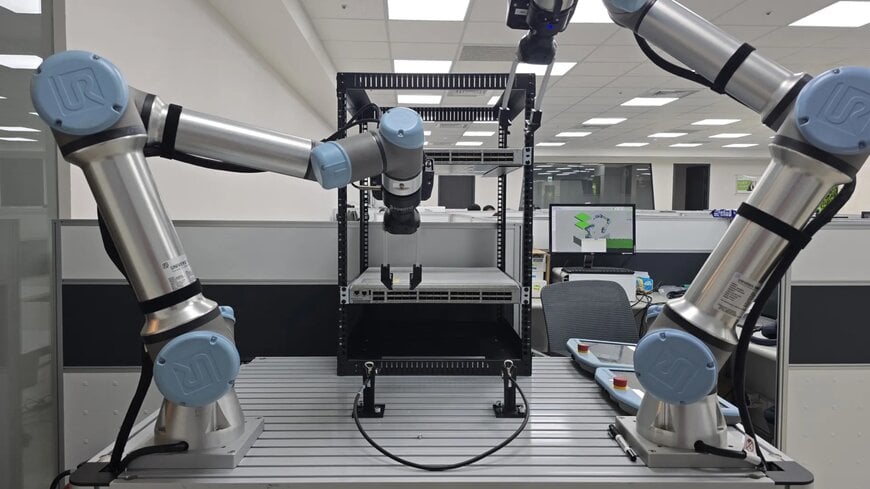
[]Cambrian: Developed to support the global construction of AI infrastructure, this application automatically identifies and places copper cables into high-density server racks using dual-arm UR7e robots paired with Cambrian's AI vision system.
─────────────────────────
🤝 Adaptive Material Handling and Ecosystem Integration
The exhibit includes a series of joint demonstrations with ecosystem partners, showcasing how robots and autonomous mobile robots (AMRs) adapt to unstructured environments:
[
- ]AICA: A UR7e robot applying trajectories learned from human demonstrations is showcased. Based on a single demonstration, the robot uses force sensing to pick up a metal part and rub it against a polishing wheel, adapting to the operator's speed and applied force.
[]beRobox (PALTZ) + MiR Mobility: The PALTZ palletizer instantly guides a UR20 robot using AI vision to pick up displaced boxes. The system works in conjunction with a MiR1200 Pallet Jack and a MiR600 AMR to retrieve pallets and coordinate material flow without fixed infrastructure.
[]Mobile Cobot + ROEQ: Demonstrates a MiR250 AMR equipped with a ROEQ top module transferring components to a fixed conveyor line, where an MC250 mobile cobot manages return transportation.
[]Maple Advanced Robotics Inc.: An Autonomous Spot Sanding Solution using a UR8L robot. The system requires no CAD models or manual path teaching; an operator marks defects, and the system automatically scans and applies the correct finishing recipe.
[]Trener Robotics: Showcases Acteris, an AI-native platform with a conversational interface. Operators can deploy robotic machine tending jobs through simple chat input in any language and set up new tasks for a UR7e robot in minutes.
[*]Vention: The Rapid Operator AI bin picking solution achieves a high first-pick success rate using a UR12e robot and 3D vision for real-time identification of unstructured parts.
─────────────────────────
🔬 Physical AI: A Deeper Look
Implementing physical AI in industrial robotics requires a shift from deterministic, pre-programmed path trajectories to real-time, sensor-driven reactive control. Traditional industrial robots operate on absolute joint coordinates, executing the same kinematic paths repeatedly. If a target object shifts a few millimeters or changes orientation, the robot cannot grasp it and often triggers a mechanical collision error.
Physical AI models, such as Vision-Language-Action (VLA) architectures, bypass fixed coordinate programming by directly mapping high-dimensional sensory inputs like 3D point clouds (from RGB-D cameras) and multi-axis force/torque data to low-level motor joint velocities.
This end-to-end control is optimized through imitation learning and foundation models like GEN-1. During the training phase, a human operator guides the manipulator through a task using a haptic feedback device or direct kinesthetic teaching. While the robot's internal encoders record precise joint positions, specialized strain gauge sensors measure torque vectors at the tool flange.
The resulting dataset combines spatial trajectory coordinates with applied physical forces. Neural networks process this multimodal data to generate a generalized execution policy. When deployed on a cutting-edge technology stack like PolyScope X with native ROS 2 communication nodes, the robot can compute dynamic path corrections mid-trajectory. This edge-based processing allows the arm to instantly modulate gripping force and approach angles, mimicking human dexterity when performing surface finishing, cable routing, or bin picking in unstructured environments.
These innovations that Teradyne Robotics will showcase at Automate 2026 are a clear indication that industrial automation is progressing towards a future that is not only more efficient but also smarter and more adaptable.