








Mucitler Elektrik
Corporate
- Thread Author
- #1
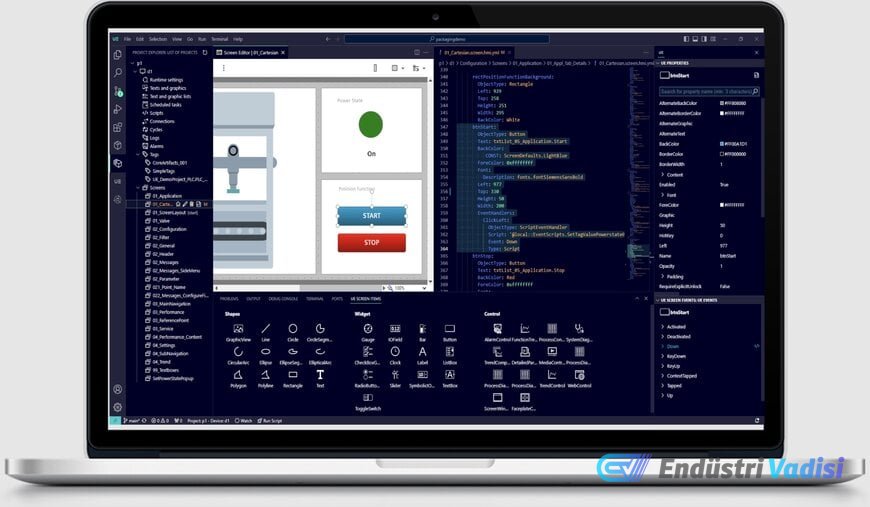
Siemens has introduced SIMATIC AX WinCC Unified Elements, an open-architecture engineering application that integrates software development workflows to accelerate deployment processes in industrial automation projects.
💻 Bridging IT and Industrial Automation
With shortening product development cycles in the manufacturing sector, industrial automation systems need to be commissioned faster. Traditional drag-and-drop engineering ecosystems can fall short in providing the flexibility required by modern, code-centric engineers. Siemens' new application offers an IT-compatible environment for the SIMATIC WinCC Unified system, bridging the gap between standard software development and factory automation. Initially launched for the US market, the software specifically supports WinCC Unified PC Runtime applications, allowing facilities to update their visualization and control systems using structured IT frameworks.
⚙️ System Architecture and Hybrid Workflows
The application operates within an extension-based integrated development environment (IDE) built on the Open VSX marketplace. This architecture enables developers to execute custom web controls natively without the need for external APIs. One of the core technical mechanisms of the software is its ability to generate complete visualization projects from human-readable YAML files. This allows for AI-generated code, text-based configurations, scripts, and reusable library packages to be combined into a deployable structure. Furthermore, embedded hybrid workflows enable engineers to work concurrently within graphical development interfaces and direct code editors, ensuring real-time synchronization between visual and textual environments.
🤝 Version Control and Deployment Integration
To support distributed engineering teams, the software features native Git integration. This structural addition provides full project history tracking, branching, and merge request workflows within the visualization project development cycle. Adrien Amar, Siemens' Global Business Development Manager for Software-Defined Automation, states that engineers can build, validate, and deploy projects using continuous integration and continuous deployment (CI/CD) pipelines. This IT-centric approach enhances process stability and facilitates rapid scaling in manufacturing facilities by allowing control logic and associated interfaces to be managed in a unified environment.
🔍 Position in the Industry
In the industrial automation sector, the shift towards IT-standard development environments is also seen in platforms like Rockwell Automation's FactoryTalk Optix and Beckhoff's TwinCAT HMI. While traditional SCADA platforms heavily rely on proprietary, graphical-only configuration tools, these modern systems incorporate standard software development methodologies. For example, Beckhoff integrates its engineering environment directly into Microsoft Visual Studio, allowing for native Git version control and high-level programming alongside standard PLCopen languages. Similarly, FactoryTalk Optix uses an open, object-oriented architecture that supports C# scripting and native GitHub integration for multi-user collaboration.
SIMATIC AX WinCC Unified Elements differentiates itself by creating complete automation projects entirely from declarative YAML files. This structural mechanism inherently supports automated testing and infrastructure-as-code deployments, allowing automation logic and visualization interfaces to be versioned, tested, and deployed using the same CI/CD pipelines that are standard in enterprise software development.






















