




Erkan Teskancan
Corporate
- Thread Author
- #1
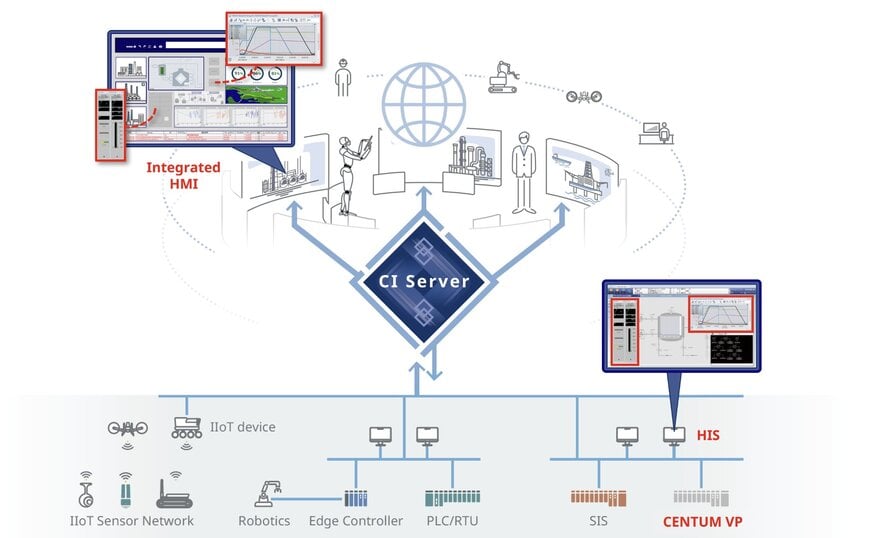
In the world of industrial automation, the complexity of distributed production environments makes operators' jobs increasingly difficult every day. However, Yokogawa Electric Corporation is taking a revolutionary step to overcome these challenges: with the latest version of its Collaborative Information Server, it offers an integrated human-machine interface (HMI) for the process industry.
This innovative system enables remote operational control by collecting and managing equipment information from distributed production facilities in a single center. So, what will this update bring to the industry?
─────────────────────────
💡 Seamless Interface Compatibility in Distributed Environments
Operators do not want to give up the familiar interfaces of existing control systems while fully supervising production facilities. Yokogawa's updated server addresses this need by providing direct access to the operation and monitoring windows of existing integrated production control systems. In particular, backward compatibility with proprietary human interface stations eliminates the need for additional engineering to recreate familiar screen configurations and guarantees operational continuity.
Moreover, the system supports remote desktop connections, allowing for centralized monitoring of geographically dispersed equipment and interconnected supplier systems.
─────────────────────────
⚙️ Interoperability with OPC UA Integration
Connecting equipment from different suppliers creates diversity in device data structures. To solve this interoperability problem, the platform enhances its OPC Unified Architecture (UA) server capabilities by supporting multiple information models. This platform-independent architecture, which falls under the IEC 62541 standard, facilitates data exchange and comprehensive information modeling.
By naturally accommodating various device configurations, the server reduces the application development workload required to integrate multi-vendor hardware into a unified digital infrastructure.
─────────────────────────
🔒 Platform Hardening and Security Configuration
Increased network connectivity across industrial automation networks requires strict access controls and system hardening. Yokogawa's collaborative server integrates a proprietary security configuration package based on Center for Internet Security (CIS) Benchmarks. This integration systematically reduces security vulnerabilities across the entire digital supply chain and operational platform by applying standardized security settings to underlying operating systems, thereby lowering IT security risks.
─────────────────────────
📊 Competitive Analysis and Technical Details
Similar distributed HMI and SCADA platforms such as AVEVA System Platform and Siemens SIMATIC WinCC Open Architecture also focus on large-scale, multi-site integration. These systems typically use an object-oriented, distributed architecture to collect data from heterogeneous programmable logic controllers (PLCs) and distributed control systems (DCS).
A key benchmark for modern collaborative servers is native OPC UA compliance (IEC 62541) for vendor-independent data modeling. While similar systems provide extensive multi-vendor driver libraries and object models, Yokogawa's integration aims for seamless backward compatibility with proprietary distributed control environments. Furthermore, adherence to CIS Benchmarks for underlying operating system hardening is a standard security baseline used in high-level industrial control system platforms to meet ISA/IEC 62443 security requirements.
─────────────────────────
This new version from Yokogawa is a significant milestone on the path to future smart factories, enhancing operational efficiency, security, and interoperability in the process industry.