







Erkan Teskancan
Corporate
- Thread Author
- #1
## The 100,000-Hour Myth: Analyzing Industrial LED Life Cycles
Why doesn't the "infinite" durability of LEDs come true? This technical guide discusses L70 standards, multi-voltage IC drivers, and a comparison of leading LED manufacturers.
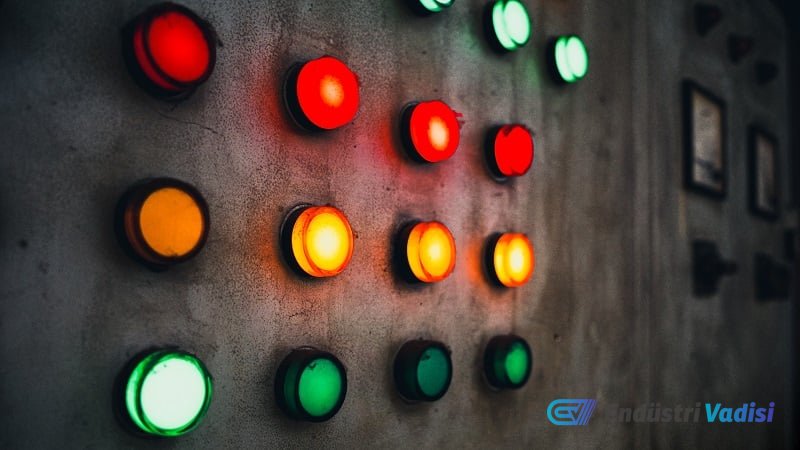
We sometimes replace 20,000-hour LED bulbs used in our homes within just six months. This naturally creates skepticism against the 100,000-hour lifespan claims for some industrial LED pilot lights. In industrial applications, failure is usually not the complete extinguishing of the light, but rather the reduction of light intensity over time, i.e., the decrease in lumen value. In practice, the 11-year lifespan of professional indicators is understood by a detailed examination not only of the bulb but also of the driver electronics.
### Key Differences Between LED and Incandescent Bulbs
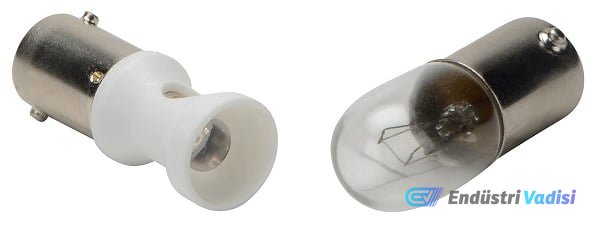
Classic incandescent bulbs produce light and heat by the filament inside resisting and heating up. The filament expands and contracts with the effect of heat as it turns on and off; this leads to material fatigue and eventually breakage.
LEDs, on the other hand, are based on semiconductor physics principles and have no moving parts. When voltage is applied, electrons pass through the semiconductor junction, and excess energy is emitted as light. Theoretically, the lifespan of an LED is infinite, but factors such as temperature changes, material impurities, and supply voltage fluctuations limit its life.
### Industrial LED Driver Systems
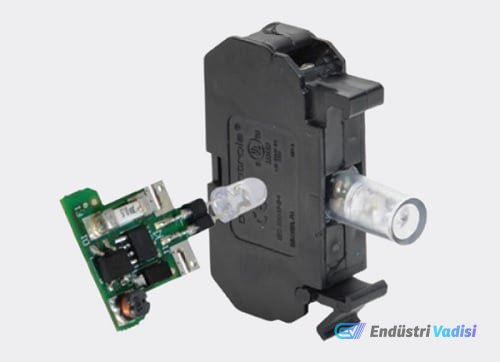
Simple LEDs instantly fail if twice the directly applied voltage is supplied. Therefore, most LED modules are protected by special resistors according to the supply voltage. However, industrial LED modules accept a wide voltage range between 20 VDC and 277 VAC.
In these highly equipped devices, manufacturers like c3controls use integrated circuit (IC) based current regulation. This internal driver system dynamically reduces the incoming voltage to the correct current required by the LED. This allows for multi-voltage acceptance without the need for large resistors that dissipate excess energy as heat. High temperature, however, is the most significant factor shortening LED life.
### LED Lifespan and Testing Methods
Manufacturers do not wait for tests that would take 11 years. Using a mathematical formula called the Arrhenius Model, LEDs are tested for 1000 hours at high temperatures like 85°C, then the L70 value (the point where the initial brightness drops to 70%) is calculated by projection.
### Advantages of Industrial LED Drivers
- Multi-voltage support (20 VDC - 277 VAC)
- Current control with integrated IC drivers
- Reduced heat-induced damage
- Inventory simplification and high reliability
### Selection Criteria
If your projects involve a wide range of types and special symbol requirements, some manufacturers offer advantages in customization. However, if you are looking for maintenance-free durability for a decade at high temperatures while simplifying spare parts inventory, universal electronic solutions like those from c3controls offer a better long-term guarantee.