Alper Aktaş
Endüstri Vadisi
- Thread Author
- #1
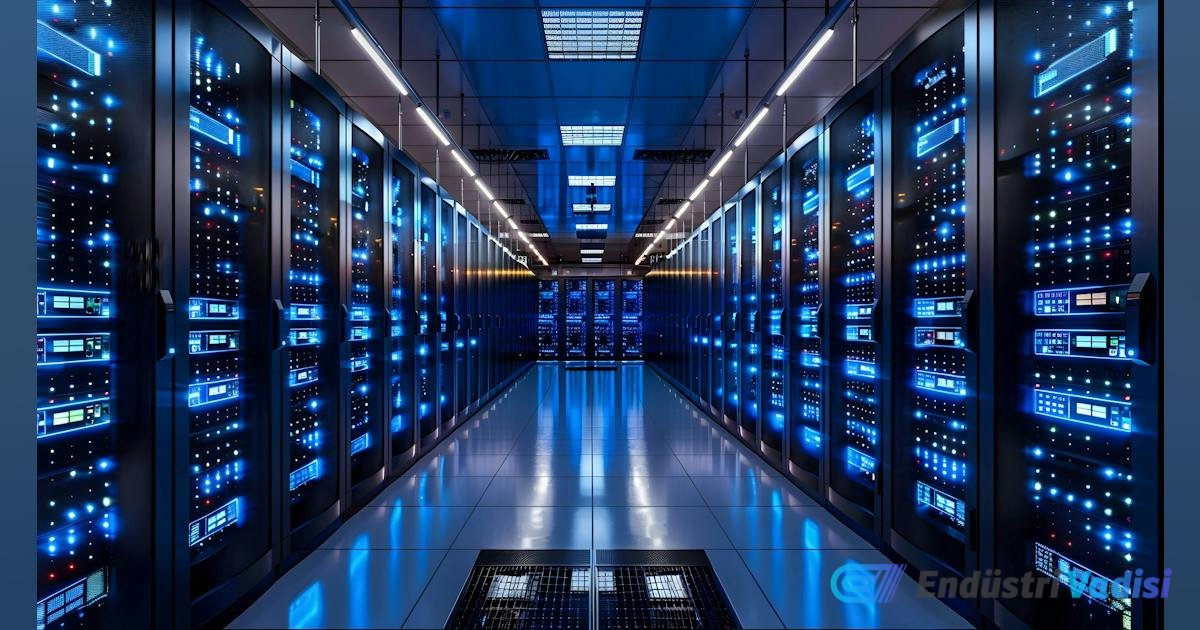
The rapid proliferation of global data centers has become a focal point for the media. And rightly so, as these new data centers are fundamentally changing technology and how people interact with data. However, the main focus of this interest, modern artificial intelligence (AI) factories, are radically different from previous enterprise and colocation data centers.
🏭 AI Factories: A New Operating Model
Traditional enterprise data centers were typically static facilities. Power loads were predictable, and cooling requirements were much more stable. For this reason, these facilities were often built and managed similarly to large commercial buildings.
AI factories, on the other hand, represent an entirely different operating model. These facilities have much higher rack densities, more dynamic workloads, greater power consumption, and more complex cooling systems compared to traditional enterprise and colocation data centers. While a traditional data hall operates at approximately 5 to 15 kilowatts (kW) per rack, rack-scale AI systems now draw 120 kW or more. This pushes beyond the practical limits of air cooling, necessitating a shift to direct-to-chip liquid cooling supported by coolant distribution units (CDUs) and facility water loops.
Furthermore, multi-year interconnection queues have increasingly pushed AI factories towards larger-scale behind-the-meter (BTM) power generation. This adds responsibilities for load shedding, black start, and load sequencing, where generation, cooling, and compute load become interlocked variables that must be controlled together rather than monitored separately.
🔄 The Nature of Control is Changing
This paradigm shift, the transition from data center facility to AI factory, requires an operational change. Operating a complex facility necessitates a move from siloed control architectures to integrated process control and automation strategies. Organizations that grasp this concept earliest and use it to improve both project execution and lifecycle operation will gain a competitive advantage in the years to come.
In AI factories, traditional approaches to both project execution and lifecycle operations have begun to change as teams explore new strategies. AI workloads are highly dynamic, so power consumption changes rapidly, and cooling demands fluctuate as workloads are assigned and executed.
To meet these challenges, operations teams need to be in a position to respond continuously and quickly. However, traditional architectures requiring mapping between databases – along with manual engineering to create graphics, trends, and alarms – were not designed for advanced coordination and dynamic optimization.
These and other challenges of traditional data silos lead to disproportionate effects as data centers scale from facilities to factories. Operators encounter alarm flood conditions, and manual maintenance and engineering efforts make it difficult to maintain competitive advantages.
To meet the challenges of the coming years, AI factories require not just more control, but a redesigned architecture specifically tailored for AI factories.
🏗️ The New Reality of AI Infrastructure Projects
New AI factories face a wide range of project execution pressures. Today's AI projects are being executed at an unprecedented pace. Investments are high, and the rewards for being first to market are even higher. As a result, owners often begin construction projects with only a fraction of the final design, allowing remaining requirements to evolve throughout project execution.

In many cases, the process of completing the design in parallel with construction has become a necessity. Equipment availability is constantly changing, and supply chain challenges can force design changes mid-project. Successful project teams will be those that can adapt to changes at every stage of execution.
However, traditional automation systems often struggle with project changes – especially late-stage changes. Project teams need a flexible automation architecture that can absorb project uncertainty rather than magnify it.
Consider a modern AI factory project. Modular construction, multiple execution phases as the project expands across a campus, "build-as-you-go" execution models, and even the potential for on-site power generation are becoming increasingly common. These strategies create a need for automation systems that accommodate change without requiring extensive redesign at each stage.
⚙️ The Modern Automation Platform Steps In
As flexibility becomes key to competitive advantage, modern automation platforms have become one of an AI factory's primary project risk mitigation tools. With built-in flexibility features, today's advanced automation platforms allow project teams to adapt instantly to changing objectives or supply chain availability.
Today's most successful organizations rely heavily on the flexible I/O architectures offered by advanced automation systems. The electronic marshalling capability in modern automation platforms provides the flexibility to add I/O anywhere in the facility without impacting control room cabinets. This allows teams to complete and order cabinets before every detail is known, resulting in less rewiring, less redesign, faster commissioning, and easier future expansion. Additionally, electronic marshalling provides the ability to repeat core designs across multiple AI factory areas or even multiple sites, while also accommodating differences between projects.
The projects that finish fastest are often those that can absorb change with minimal disruption. Planning to leverage the flexibility benefits of a modern automation platform from the earliest stages can provide this capability.
💸 The Hidden Costs of Traditional Architecture
One of the main reasons why architectures designed for enterprise data centers are inadequate for AI factories is that what works for individual equipment and small facilities does not scale well to multi-building campuses and gigawatt-scale power demands. Even if the lack of flexibility in project execution can be overcome, many limitations of traditional architectures will emerge in long-term AI factory operations.
The traditional model consists of many programmable logic controllers (PLCs). These are custom integrated and monitored via a supervisory control and data acquisition (SCADA) system, along with a building management system (BMS) for mechanical equipment, an electrical power monitoring system (EPMS) for power, and data center infrastructure management (DCIM) tools for asset and capacity data. This often leads to suboptimal configurations with flat control networks, numerous manually integrated PLCs, and a significant engineering burden – problems that will become even more complex as systems evolve and new solutions are added to the network.
Furthermore, the fragile, manual integration of PLCs often leads to fragmented, siloed data and multiple databases across the network. As teams add more solutions, such as layered remote access, to the mix, operational complexity continues to increase.
✨ Modern Automation Architecture is Designed Differently
The importance of modern automation architecture in AI factories does not mean that PLCs and SCADA no longer play a role. PLCs will remain critical elements of the AI factory architecture for original equipment manufacturer packages, local control, and high-speed applications. Similarly...