Erkan Teskancan
Corporate
- Thread Author
- #1

At industrial automation trade shows, you hear the same word at every booth: Open. Open platform, open architecture, open ecosystem… The word has become a default adjective for everything in industrial automation, and that’s precisely the problem. When a word describes everything, it tells the buyer almost nothing.
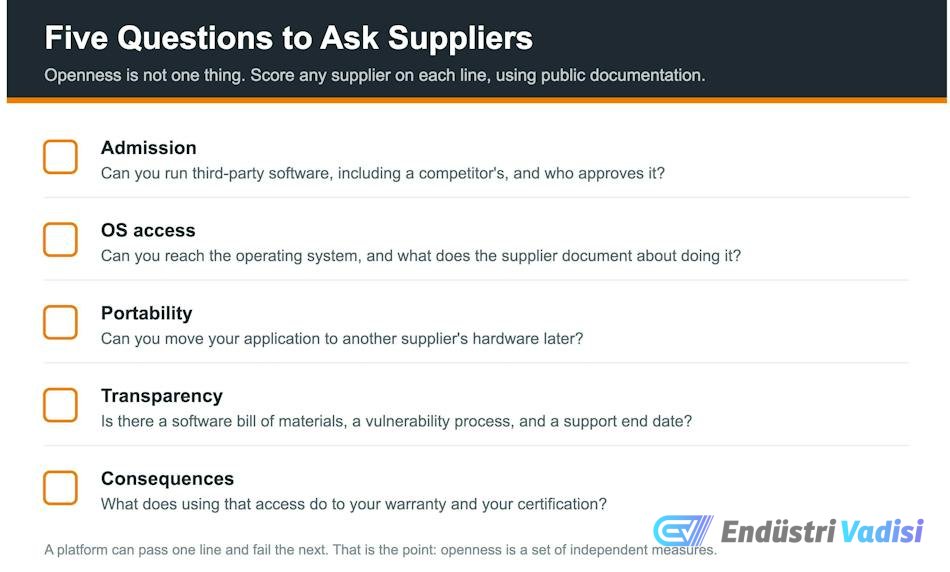
🤔 5 Critical Questions to Ask Vendors
So, what does “Open” mean? Openness isn’t one thing. A vendor can be open on one count and closed on another. The quickest way to cut through the marketing language is a short, concrete list of questions you can ask anyone using the term “Open”:
- Can you run third-party software on the device, even software that competes with the vendor’s own, and with whose approval?
- Can you access the operating system, and what documentation does the vendor provide on that?
- Can you move your application to another vendor’s hardware later, or are you locked in once you install it?
- Does the vendor publish a software bill of materials, a vulnerability process, and an end-of-support date?
- How does using this open access affect your warranty and certification?
A platform might pass one test and fail another. A controller might host any container you want and still trap your application when you try to leave. A vendor might publish high-quality APIs and say nothing about what happens to support when someone opens a shell.
Openness is not a single toggle switch but a set of independent measures, and honest vendors let buyers check each one.
🔄 How the Definition Has Changed
Open Automation 1.0 meant interoperability. Could a controller communicate with another vendor’s I/O or SCADA without a custom driver? That battle has largely been won. Open communication standards like OPC UA and MQTT are now commonplace.
Open and open source are not the same thing. Open source describes software whose code users can inspect, modify, and redistribute. For our purposes, open describes the freedom for buyers to run third-party software and to move applications to other hardware.
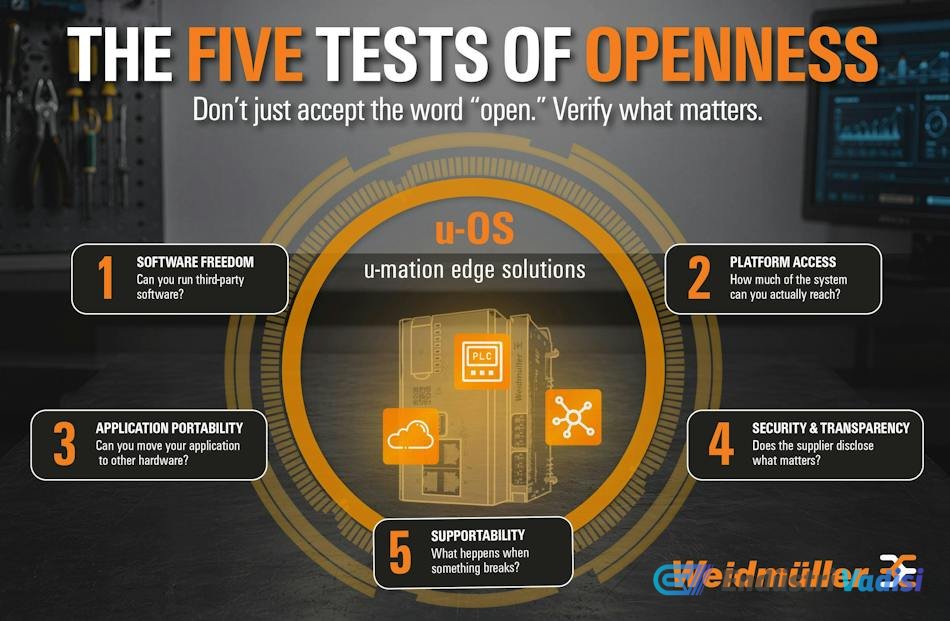
Open Automation 2.0 means application freedom.
The litmus test is: Can you run someone else’s software on the control or edge device itself? Imagine a single controller running a PLC runtime from one vendor, a data logging application from a second, and an HMI panel from a third, all at the same time. These pieces share data via a common protocol rather than custom glue code.
The payoff is practical: less forced purchasing, fewer custom integrations, and the freedom to pick the best tool for each job.
💸 The Cost of Openness
Openness is a cost a vendor chooses to pay, not a cost-free virtue. Allowing a competitor’s application onto a platform means giving up some exclusivity. A buyer should view every open decision as a trade-off and ask what the vendor gave up.
For those resisting a truly open system, security is the objection vendors hear most often. True: opening a system increases the surface area and shifts some decisions to the customer. Openness and security are not antithetical, but the tension is real.
However, the relevant standard, ISA/IEC 62443, already accounts for host devices running general-purpose operating systems. What matters is discipline: signed software, segmented networks, role-based access, and a functioning vulnerability process. Managed openness does not mean disabling integrity checks that block unsigned code. It means offering customers a documented path to sign and run their own software while preserving those controls.
Serviceability is the part people forget. If a team modifies an open system and it breaks at 2 AM, whose problem is it? Most vendors won’t answer that in writing. A buyer needs specific information: what changes invalidate support, what doesn’t, and what it takes to return to a supported state. Vendors should publish this position explicitly as an industry standard.
⚖️ Balancing OT and IT Demands
Open systems sit at the boundary between OT and IT. IT teams expect containers, fleet management, and observability. OT teams need deterministic timing, safety certification, and change control that resists casual modification. Both are right, and the requirements can genuinely conflict. An open platform doesn’t eliminate this tension. It gives both sides room to operate on the same hardware.
How industries balance these demands helps explain their uneven progress. Process industries have done the most visible standards work through NAMUR and The Open Group’s Open Process Automation Forum, but large-scale deployment still lags. Discrete manufacturing and OEM machine builders often move faster in practice because the payoff of flexible, multi-vendor systems quickly becomes apparent. Look at what’s actually running in plants, not just what’s specified in committees.
🔬 Put Openness to a Stress Test
The next standard of openness is shaped as much by regulations as by technology. The EU Cyber Resilience Act makes vulnerability management, security documentation, and a stated support period a baseline for everything sold into that market. Reporting obligations come first, with full requirements following in 2027. Once that floor is in place, security disclosure ceases to be a differentiator and becomes the price of admission.
The vendors who win on openness won’t be the ones who say the word most often. They’ll be the ones who let a buyer verify it on the bench, in an afternoon. So, the next time a datasheet says “open,” put your vendor to the test.