Erkan Teskancan
Corporate
- Thread Author
- #1
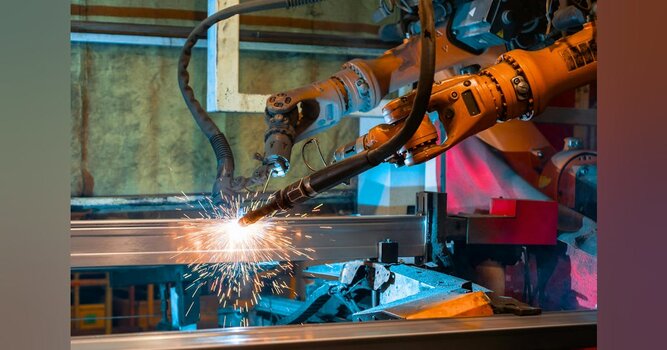
In a time when your business struggles to meet demands and quality expectations are rising, robotic welding cells can be your savior. But remember, robotic welding is not just about a robot arm; the harmony of the entire system is key to success.
─────────────────────────
🔧 What is a Robotic Welding Cell?
A robotic welding cell is an integrated automation system that combines a robot arm, welding equipment, safety infrastructure, and control software to perform welding operations with minimal human intervention. This cell creates a controlled environment where the robot can repeatedly execute programmed welding paths. While the robot arm is important, its automation capabilities depend on all other system components.
─────────────────────────
⚙️ Key Components: More Than Just a Robot Arm
Every functional welding cell includes several key components that must work seamlessly:
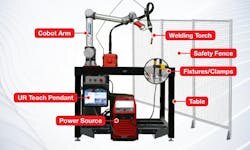
[]Robot Arm: Offers six-axis movement and sub-millimeter repeatability.
[]Welding Power Source: Determines the welding process and characteristics.
[]Welding Torch: A MIG/TIG/laser/plasma torch designed for heavy-duty robotic welding, providing adequate access for deposition.
[]Wire Feeder: Delivers filler metal in sync with robot movement.
[]Welding Table: Supports welded parts and fixtures.
[]Fixtures and Positioners: Hold and orient workpieces during welding.
[]Safety System: Includes physical guards, emergency stops, and interlocked gates.
[]Control Software: Manages movement, parameters, and quality monitoring.
─────────────────────────
🎯 Critical Components Beyond the Robot
Many manufacturers, when researching robotic welding, focus almost entirely on the robot itself. However, the robot brand, payload capacity, and reach are not as important for robotic welding as the power source.
The robot arm is the most commoditized part of the cell. When you put a robot on a table with a basic MIG system, you haven't actually achieved automation. You'll have an expensive sculpture that looks good in presentations but fails in the real world.
What makes or breaks welding automation is the quality of integration. Here are some critical questions you should ask yourself:
[]Does your power source communicate effectively with the robot controller?
[]Can your fixtures maintain tight enough tolerances for the robot to find the joint where the program expects it?
[]Can the robotic system automatically update the program if fixtures cannot maintain tight tolerances in specific situations?
[]Does your wire feeder provide consistent feeding during rapid torch movements?
[[/I]]Is your programming sophisticated enough to handle real-world part variations?
[[/I]]Can your robotic system communicate with a positioner to work in coordinated motion?
─────────────────────────
🤝 Traditional or Collaborative?
While robot applications vary, there are two main branches of robotic welding applications:
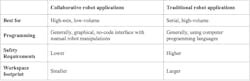
[]Traditional Robotic Cells: Use large industrial robots and operate at speeds high enough to require safety fences to prevent human injury. They are generally more difficult to program and require a large footprint. Ideal for large-scale, mass production.
[]Collaborative Robotic Cells (Cobots): Use collaborative robots (cobots) and create a human-robot collaborative environment when meeting ISO 10218-2:2025 robotic safety requirements. This eliminates the need for safety fencing and allows for safe human presence while the cobot is welding. Cobot welding systems are much easier and more intuitive to program. Best suited for frequent part design changes and the daily realities of small to medium-sized workshops.
─────────────────────────
💰 Robotic Welding Cell Costs
The cost of a complete robotic welding cell can range from $120,000 to $500,000 or more, depending on the robot type (traditional or collaborative) and integration costs. The initial hardware cost is only one part of the equation. Integration quality determines long-term value. A poorly integrated $150,000 cell that requires constant troubleshooting, produces inconsistent welds, and cannot adapt to future cell changes will ultimately cost much more than a well-designed $200,000 system that works reliably from day one.
Well-designed robotic welding cells have fewer unpredictable long-term costs and are much less likely to gather dust in a real production environment.
You should also consider long-term costs such as setup time, operator training, the time it takes for the team to gain full confidence, and system expansion, repairs, and maintenance.