






Ahmet Ö.
Corporate
- Thread Author
- #1
✨ Next-Gen 3D Vision and AI Integration from SICK
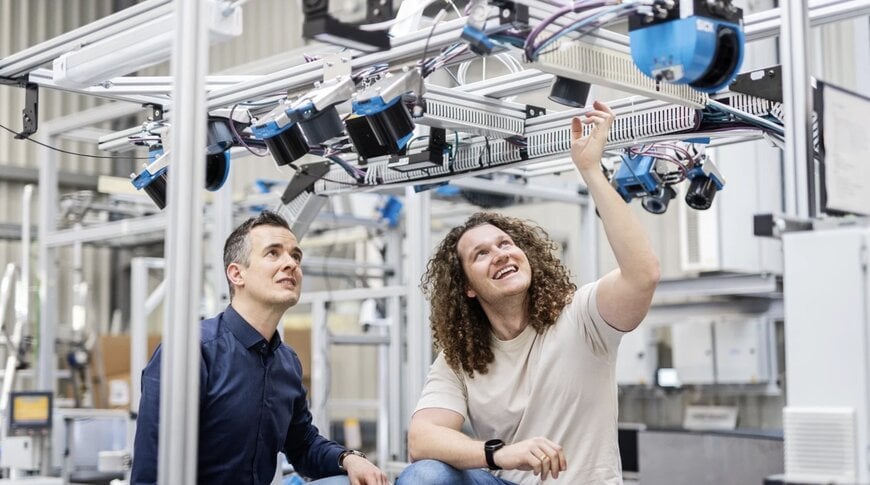
SICK has launched its updated configurable software and next-generation 3D cameras to automate quality control and process monitoring in industrial manufacturing. These innovations integrate artificial intelligence directly into three-dimensional data evaluation, catering to industries requiring precise defect analysis, sorting, and dimensional inspection.
🧠 A New Era in 3D Data Analysis with AI
With version 2.17 of the NOVA platform, AI algorithms are applied to 3D image analysis. This system utilizes the 3D Anomaly Detection tool to identify topographical deviations, the Object Detection module for counting tasks, and 3D AI Classification to categorize products. Operators can configure inspections using example images instead of complex rules. These AI models can be trained and run on-device via smart sensors, or the D-Studio web service can be used for large datasets.
🏭 Broad Industrial Application Areas
These analytical tools support a wide range of industrial manufacturing use cases, including volume, shape, and dimensional completeness inspections. They also perform functions such as breakage detection, color verification, print contrast analysis, label readability checks, and decoding of 1D/2D matrix codes. Thanks to the SICK AppSpace and AppStudio development environments, operators can extend the software's functionality with their own developed or pre-configured plugins.
🔍 Pixel-Based Object Separation and Defect Analysis
The system includes the AI Blob Finder image processing tool to support continuous software development. Powered by a trained neural network, this feature detects, counts, and measures objects within a specified area. The algorithm separates objects pixel by pixel, calculating precise dimensional measurements such as length, width, and total area. This pixel-level separation enables reliable detection of microscopic cracks and surface deviations in highly reflective or structurally complex materials.
⚡ Next-Gen CMOS Sensor Hardware Features
The hardware backbone of these software capabilities is the Ranger NextGen 3D camera, built upon the existing Ranger3 architecture. Utilizing updated CMOS image sensor technology and advanced semiconductor manufacturing processes, the camera simultaneously produces high-resolution 2D images, precise 3D height maps, and true color data. This hardware offers higher measurement accuracy and faster acquisition speeds, increasing throughput per part per minute without reducing spatial resolution. Additionally, integrated image data pre-processing ensures the hardware operates reliably in outdoor environments or under highly variable ambient lighting conditions.
🌐 Industry Comparison and Competitive Advantage
In the industrial image processing market, the integration of AI with 3D CMOS profile sensors has become a standard benchmark for comparing advanced machine vision systems. SICK's Ranger NextGen and NOVA platform directly compete with systems like the LMI Technologies Gocator series and Cognex In-Sight 3D-L4000. SICK's architecture, similar to Cognex's ViDi software and LMI's GoPxL, allows for the direct deployment of AI models to smart sensors, reducing latency compared to cloud-based processing. The shift from traditional rule-based machine vision programming to example image dataset training has become the industry standard for evaluating setup efficiency and hardware scalability in 3D anomaly detection.