

Cengiz Özemli
Academic
- Thread Author
- #1
🌟 Siemens Unveils Industrial AI and Goal-Oriented Automation at SPS 2026
Siemens drew attention at the SPS 2026 exhibition with innovations added to its automation portfolio. The company is integrating Industrial Artificial Intelligence (AI) into all stages of production. While AI agents are used in planning and engineering processes, physical AI is applied directly in production processes. At the heart of this approach is a goal-oriented automation concept where manufacturers define the results they want to achieve, and Industrial AI determines how to reach these goals or directly performs the necessary tasks through AI agents.
🤖 The Future of Autonomous Production: AI Agents and Physical AI
Rainer Brehm, CEO of Siemens Automation, stated, "The next frontier of productivity lies in automating tasks that have so far been unautomatable." The company is accelerating the transition to AI-based autonomous production, strengthening its existing automation portfolio with agent-based AI and physical AI technologies. As Industrial AI becomes more widespread in production, cybersecurity is also becoming increasingly central.
📦 Physical AI for Autonomous Unloading of Incoming Goods
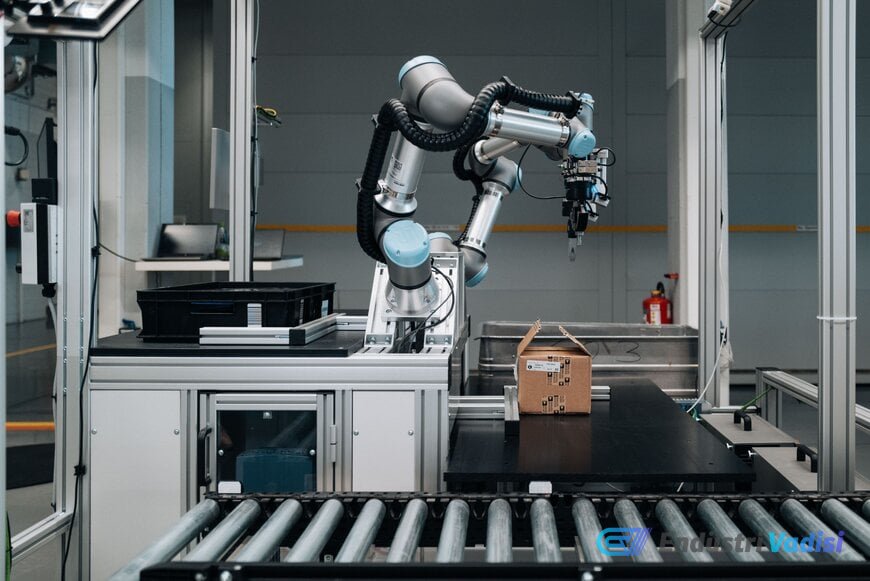
In electronics manufacturing, the high variability in packaging types and sizes of incoming goods makes unloading with predefined robot programs challenging. At its electronics plant in Erlangen, Siemens is developing an AI-based solution that captures environmental information in real-time using cameras. Utilizing AI-based foundational models for robotics, the system interprets the operational context and autonomously determines the necessary actions: the robot opens the packaging and removes component reels for subsequent processing steps.
📊 AI Agents in Production Planning
Siemens introduced the Autonomous Production Planner, a new solution integrated into Intelligence Center X, its software platform for orchestrating Industrial AI for production planning. Several AI agents work together to create production schedules and automatically optimize them based on predefined key performance indicators. Siemens estimates that this solution can reduce manual planning effort by up to 70% and costs by up to 20%.
⚙️ Engineering Agent Expanding to the Process Industry
The AI-based Eigen Engineering Agent, integrated with the TIA Portal engineering software, is expanding its functions to help engineers adapt automation code. The agent can verify code through simulation, and planned new functionalities include the creation of functional safety configurations. Thanks to integration with SIMATIC PCS 7, the agent also becomes available for the process industry.
🔄 Closed-Loop AI in Production Operations
During production, the Industrial AI Suite integrates AI directly into automation systems. AI models running on Industrial Edge can connect to SIMATIC S7 controllers via PROFINET. This enables new applications such as real-time AI inference and AI-based motion control in machine automation processes. Production data can also be used to retrain, validate, and redeploy AI models locally.
⚡ New Controllers, Drives, and DC Switching Technology
The SIMATIC S7-1200 G2 basic controller enhances motion control functionality and performance, supporting up to 32 axes, while the advanced SIMATIC S7-1500 controller offers higher system performance and extended connectivity. Siemens is expanding the new generation of SINAMICS G frequency converters with four new drives, featuring standardized device data and a "Security by Design" approach.
🔒 Cybersecurity and Preparation for the Cyber Resilience Act
The use of AI in production requires secure industrial facilities. Leveraging nearly 40 years of experience in industrial cybersecurity, Siemens adopts an approach that covers the entire production lifecycle, from design and engineering to operations and services, and also uses AI to strengthen cybersecurity. Siemens is preparing products in its industrial portfolio affected by the EU Cyber Resilience Act to comply with the provisions that will be effective from December 11, 2027.