






Hasan S. Cemkan
Corporate
- Thread Author
- #1
The New Address for Safe Motion in Robots
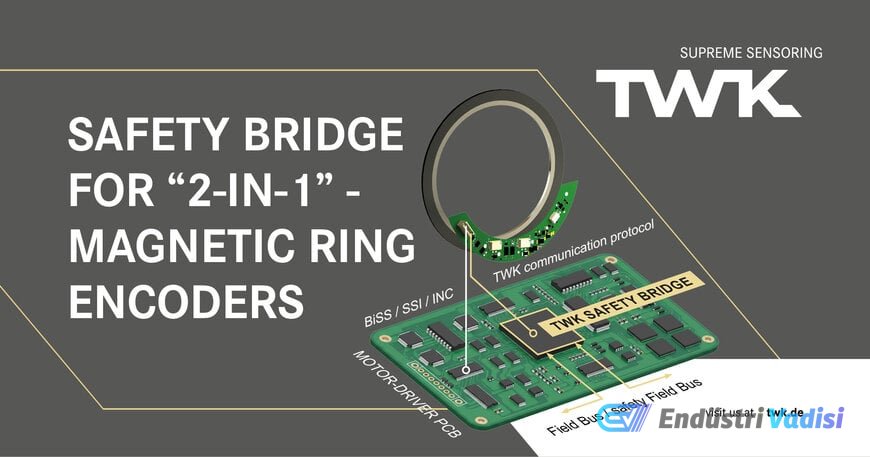
Industrial robots must perform precise movements across a wide range of speeds while adhering to strict functional safety standards. The ISO 10218-1/2:2025 standard requires robot designs to include safety functions such as safe limited position, safe limited speed, and safe stop. To meet these requirements and reduce system complexity, sensor specialist TWK has introduced the Safety Bridge concept along with its new series of ring encoders.
Advantages of Modular Design
TWK's modular approach separates specialized functions through clearly defined mechanical and electronic interfaces. While robot manufacturers focus on motion control software and artificial intelligence models, TWK provides certified functional safety position sensing solutions. This modular structure allows for individual component upgrades, shortening development cycles and reducing system costs.
Key Features of TWK's New Ring Encoders
- Separate Rotor-Stator Structure: Consists of separate rotor and stator elements with an inner diameter of up to 200 mm.
- Multiple Interface Output and Configurable Resolution: Supports multiple interfaces simultaneously with a resolution of up to 21 bits, independently configurable for each interface.
- Flexible Mechanical Form Factors: Available in various designs, either housed or as bare board mounting, with a slim profile for easy mechanical integration.
- High Temperature Capability: Depending on the design variant, the encoders can operate in ambient temperatures up to 125 °C.
No Additional Cabling with TWK Safety Bridge!
Designed for the limited spaces in robot joints, the Safety Bridge utilizes a specific section of the motor control board. TWK designs the necessary components for the safe fieldbus interface (EtherCAT FSoE, PROFIsafe, or CANopen Safety) in collaboration with the customer.
At the measurement point of the joint, only the compact, customizable ring encoder is present. This encoder transmits standard real-time motor control feedback (via BiSS-C, SSI, SIN/COS, or incremental signals) directly to the adjacent motor control board, while simultaneously sending safety-related data to the integrated safety module via the TWK Communication Protocol. Since the robot arm's standard daisy-chained fieldbus already runs sequentially from one motor board to the next, safety data related to axis position and speed is transmitted over the existing network without requiring additional cabling.
By combining high-speed motor control with certified position sensing technology according to IEC 61508 and ISO 13849-1, the Safety Bridge offers robot manufacturers a documented safety component ready for modular integration and verification under ISO 10218-1/2:2025, helping to significantly reduce development and system costs.