




Alper Aktaş
Endüstri Vadisi
- Thread Author
- #1
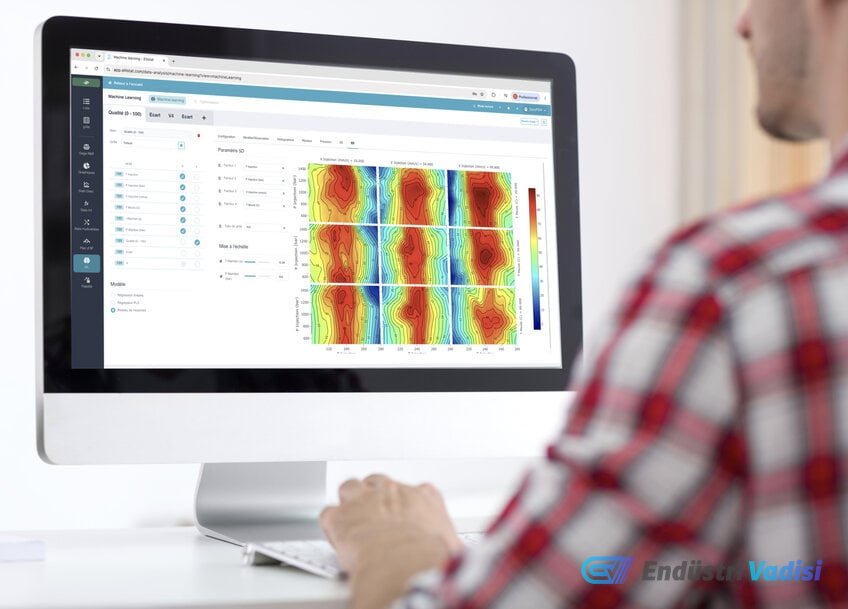
💡 Next-Generation Data Analysis Module from Ellistat
Ellistat has enhanced its Data Analysis module with neural networks to deeply understand and optimize production processes. Now, modeling complex industrial behaviors and gaining full control over production processes is much easier!
⚙️ Smart Solutions for Production Challenges
In production processes, many parameters such as temperature, tools, materials, machinery, and operators interact with each other. When a deviation or error occurs, finding the root cause is often done through trial and error. This leads to scrap, delays, and incorrect adjustments. Ellistat's new module eliminates such problems with AI-powered analyses.
📊 The Bridge Between Data Science and Production
Modern engineering requires tools that can handle multi-factor interactions without getting bogged down in complex mathematical equations. Ellistat bridges the gap between the complexity of data science algorithms and the operational reality of production workshops.
🧠 Architecture and Operation of the Data Analysis Module
The Data Analysis module combines various statistical and analytical methods in a single software environment. While classical statistics form its foundation, the new version enriches this architecture by integrating machine learning models, unsupervised classification, and neural networks. These algorithms process phenomena where multiple parameters interact simultaneously, establishing a link between production conditions and the results obtained, and revealing clusters invisible to the human eye.
Thanks to its user-friendly interface, even non-expert users can perform analyses with a step-by-step guided approach. For expert users, advanced settings are offered, such as configuring the structure of neural networks, selecting the training mode, and adjusting learning.
🔗 Integrated Solutions and Industrial Use Cases
Data Analysis is at the heart of the Ellistat Quality Suite, a fully web-based platform dedicated to industrial quality. The module uses data from other software blocks, such as statistical process control (SPC) for real-time production monitoring and incoming quality control (IQC) for analyzing the quality of incoming batches.
This integration allows methods, production, and quality technicians to collect, monitor, analyze, and control processes based on measurable facts. This reduces analysis time and ensures production diagnostics.
🚀 A New Era in Quality Control with Artificial Intelligence
The integration of artificial intelligence and neural networks into quality control software reflects a broad transition in production from univariate statistical process control to predictive multivariate approaches. Unlike traditional linear regression methods or control charts, neural network architectures applied to industrial time series capture complex non-linear relationships in processing and assembly processes.
These architectures are compatible with the traceability and continuous improvement requirements of quality management standards, facilitating the use of data collected by workshop sensors without requiring heavy cloud infrastructure or expert programming skills.