








Süeda Asil
Corporate
- Thread Author
- #1
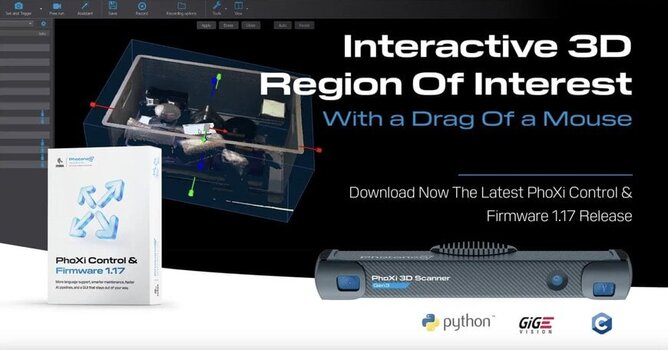
In the world of industrial automation, speed and efficiency are everything. Photoneo has embraced this principle by introducing its new software suite, PhoXi Control 1.17, which radically changes 3D sensor setup processes. Now, deploying complex 3D vision applications is much easier and faster!
─────────────────────────
🔧 Next-Gen ROI Adjustment: Interactive 3D Bounding Box
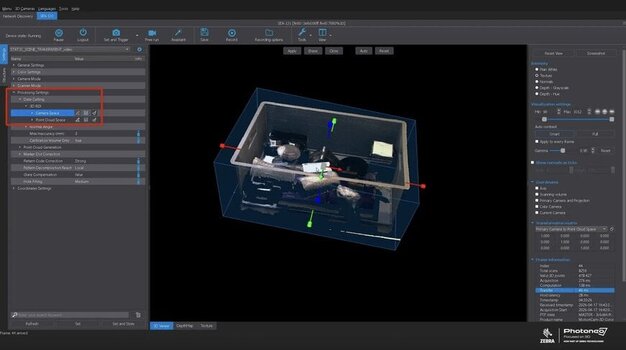
In traditional sensor setups, defining the Region of Interest (ROI) required manual entry of coordinates. This was a time-consuming and error-prone process. With PhoXi Control 1.17, this changes completely! Photoneo introduces a fully interactive 3D bounding box integrated into the sensor's point cloud visualization interface.
[]Accelerated Deployment: Setup times are significantly reduced.
[]High-Precision Cropping: Unnecessary data in the scene is easily eliminated.
[]Reduced Processing Latency: Data processing becomes more efficient.
─────────────────────────
📊 Point Cloud Volume Pruning in the Digital Supply Chain
In robotic work cells, sensors scan the workspace and also capture irrelevant background noise such as conveyor belts, safety barriers, or the floor. Transferring this data to the digital supply chain leads to unnecessary load and processing delays. Photoneo's new approach comes into play precisely at this point.
Thanks to the defined ROI, only critical coordinate points within the sensor's field of view are processed. This ensures that downstream localization, grasp planning, and quality control algorithms work only with relevant data, thereby:
[
- ]Reduces local processing load.
[]Optimizes data exchange.
[]Offers efficiency similar to the automotive data ecosystem.
─────────────────────────
✨ Dynamic Geometric Interaction and Software Translation Mechanisms
The most significant innovation of PhoXi Control 1.17 is the radical change in the human-machine interface (HMI). System integrators can now use directly manipulable geometric handles on a live point cloud, instead of manually calculating and entering minimum and maximum thresholds for the X, Y, and Z axes.
Operators can drag, extend, and rotate the faces, edges, or corners of the box. This real-time spatial feedback eliminates traditional trial-and-error scanning cycles, making setup much more intuitive.
─────────────────────────
🏭 Deployment Topologies and Quality of Life Optimization
This interactive boundary tracking mechanism offers measurable advantages in variable and non-standard industrial environments:
[]New Cell Deployment: Shortens setup time for complex bin picking or object sorting applications.
[]Field Maintenance Adjustment: Provides quick recovery and adjustment in case of sensor bracket displacement or production fixture shift.
- Partial Scene Isolation: Allows engineers to isolate a specific pallet location, disregarding surrounding reflections.
─────────────────────────
🔬 Technical Deep Dive and Competitive Analysis
Photoneo's innovation stands out when compared to standard 3D camera software packages from competitors such as IDS Imaging Development Systems (IDS peak platform) or Zivid. Photoneo's native point cloud manipulation tool brings functionality typically reserved for standalone analytical software like CloudCompare directly to the device control layer.
While traditional vision controllers often require large data buffers when processing uncropped arrays, Photoneo's approach isolates point geometry at the device boundary, reducing transmission load and post-processing latency.
Technical benchmarks show that restricting algorithm inputs to a tightly adjusted volumetric area can reduce localization processing times by up to 40%, depending on the complexity of the part geometry. This proves that the transition from blind numerical parameterization to data-validated, interactive scene mapping offers a highly scalable standard for advanced industrial vision modernization, reducing potential deployment error rates by approximately 15%.





















