

Süeda Asil
Corporate
- Thread Author
- #1
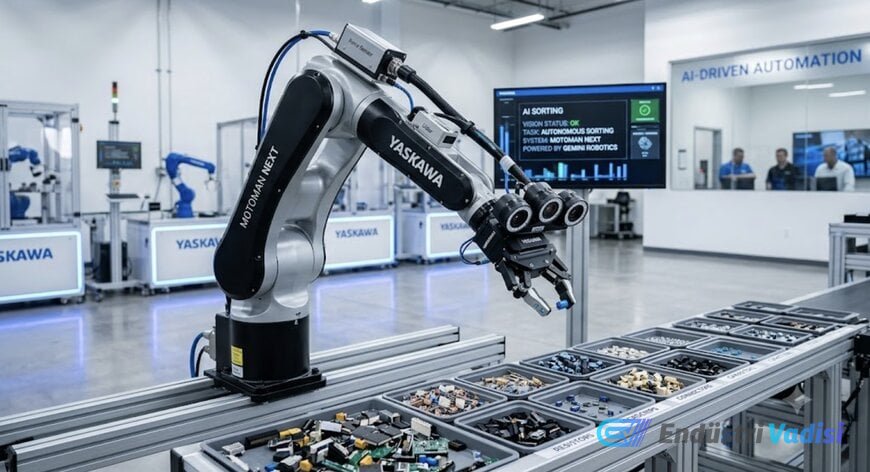
Yaskawa Electric Develops Agent Robot System with Google DeepMind's Gemini Integration
Yaskawa Electric Corporation has developed a groundbreaking agent robot system that integrates its autonomous artificial intelligence (AI) robot, MOTOMAN NEXT, with Google DeepMind's advanced generative AI model, Gemini Robotics ER 1.6. This integrated framework enables the automation system to independently analyze field conditions, compile structured work procedures, and execute operational tasks without the need for manual, step-by-step programming. With high-level commands such as "sort unsorted parts," the system evaluates the target workspace and performs the necessary material manipulation routines to address industrial labor shortages.
Functional Separation of Decision-Making and Kinematic Execution
This architecture provides a clear separation of operational tasks between the cloud or edge computing brain and the physical robot body. The generative AI model is responsible for semantic reasoning and workflow synthesis (determining what tasks need to be done), while the MOTOMAN NEXT hardware platform translates these logical steps into precise field movements.
To bridge the gap between high-level generative decisions and real-world execution, the MOTOMAN NEXT robot is equipped with three core factory automation service layers:
- Machine Vision Service: This sensing layer identifies workspace conditions, structural shapes, and the exact physical locations of target objects. It converts visual observations into raw spatial data to feed the generative AI's decision-making loops.
- Path Planning Service: Operating in response to high-level target vectors from the generative AI, this service calculates safe, collision-free movement paths in busy or changing factory environments.
- Force Feedback Service: This physical monitoring loop tracks real-time contact forces and tactile grip pressure to verify parts are securely held, preventing object damage or structural shifts.
Autonomous Error Recovery and Enterprise Connectivity
The agent robot platform incorporates software features designed to stabilize manufacturing uptime and simplify integration with existing enterprise control networks. Traditional industrial robotics requires rigid, continuously sequential programming that breaks down if an unexpected part anomaly occurs.
The integrated generative AI layer enables autonomous error recovery by continuously monitoring execution states; if a part is dropped or misplaced during handling, the robot independently detects the situational change and recalculates a recovery sequence to restart the task without human intervention. Furthermore, the control platform can directly connect to internal manufacturing management networks and enterprise software systems, allowing the robot to programmatically query inventory databases or even automatically send part shortage alerts and order updates when it detects an insufficient component supply.
Additional Information
Unlike traditional industrial controllers that rely on external inference PCs (creating communication latency across the interface), MOTOMAN NEXT features an embedded edge computing graphics module that processes vision and path algorithms locally within the cabinet. Additionally, standard vision-guided setups use static programming templates that trigger error halts if components are displaced. The integrated foundation model provides continuous spatial reasoning for autonomous error recovery and transfers learned manipulation procedures to various arm shapes without manual code retraining.