





Hasan S. Cemkan
Corporate
- Thread Author
- #1
A New Breath in Industrial Automation: Neuron AI
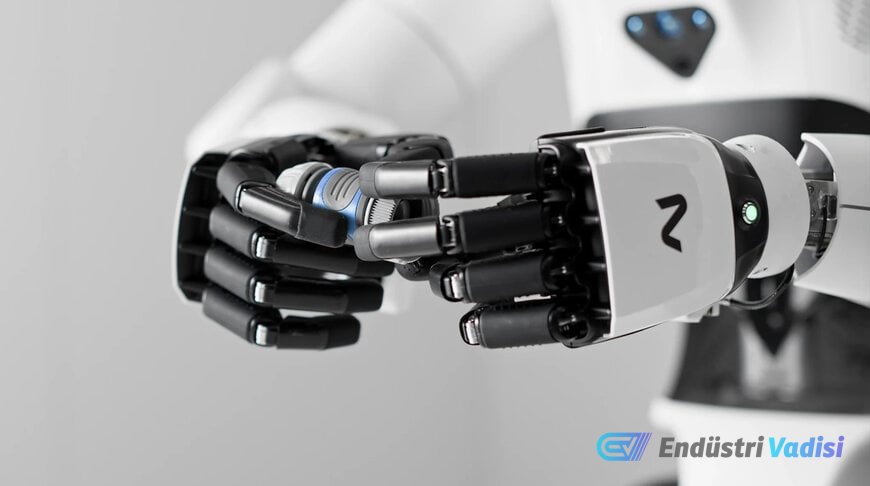
In industrial automation and complex manufacturing environments, robotic systems often fall short in tasks requiring precise contact or facing visual obstructions. To overcome these challenges, NEURA Robotics has introduced Neuron AI, which utilizes multi-sensory feedback and temporal memory architectures. This innovative multimodal foundation model is designed to manage physical AI in industrial and humanoid robotics applications.
Engineering Challenges in Contact-Rich Manipulation
Traditional robotic sensing often relies on two- and three-dimensional visual inputs. However, this method cannot provide critical physical state data during moments of contact, such as mechanical alignment, insertion resistance, or fastener seating. Especially in complex manufacturing processes like screw insertion, latch locking, or welding, immediate verification of mechanical states that cameras cannot perceive is required. Optical obstructions create severe operational bottlenecks when the robot blocks its own sensors or when assembly requires reaching into dark areas. Without tactile and acoustic verification, traditional robotic systems can apply excessive force, leading to mechanical damage. Furthermore, standard vision-language-action architectures often lack temporal memory, losing component states when parts move out of the sensor's field of view.
Architecture of the Perception-Language-Action Model
Neuron AI solves these limitations with a unified Perception-Language-Action framework. This framework encodes multiple sensor modalities into a synchronized temporal representation. The architecture continuously integrates:
- 3D Vision: Volumetric point clouds and depth measurements capturing real-time environmental geometry.
- Tactile and Force Sensing: Continuous force-torque feedback and contact telemetry from robotic hands and end-effectors.
- Acoustic Sensing: Auditory feedback capturing process-specific acoustic signatures, such as fastener clicks or welding arc stability.
- Proprioception: Robot kinematic state, joint angles, and velocity vectors.
- Natural Language: Task prompts and semantic instructions mapped to physical parameters.
Instead of processing each sensor stream in isolated subroutines, the model aligns these heterogeneous data streams into a single temporal latent space to generate unified motor trajectories. To maintain state consistency during operational blind spots, the model incorporates a specialized memory architecture that preserves object permanence. This mechanism allows the robot to track the position and state of hidden parts, linking previous actions to predicted subsequent effects.
Training Methodology and Fleet Deployment
The model has been trained on five different NEURA robotic bodies, accommodating various multi-fingered robotic hands and custom industrial grippers. The training pipelines leverage three structured physical data streams:
- Real-World Interaction: Synchronized empirical datasets captured across robotic platforms operating in NEURA Gyms and partner industrial facilities.
- Simulation-Aided Data: Synthetic datasets generated via custom simulation stacks to introduce environmental variance and corner case perturbations.
- Human Kinematic Demonstrations: Full-body motion capture and task demonstrations recorded using instrumented data suits.
Deployment and model expertise occur via the Neuraverse software platform. Industrial users can fine-tune foundation model weights to proprietary process requirements to minimize "Time to Skill" metrics across their production fleets. To ensure industrial data governance and compliance with European privacy standards, the architecture supports fully on-device execution without requiring continuous external cloud connectivity. Data partnerships with industrial manufacturers, including Schaeffler and Bosch, ensure validation in active production environments.
Validation at NVIDIA GTC Berlin 2026
At the NVIDIA GTC Berlin event, taking place from October 20-22 at Station-Berlin (Hall 3, Booth #3031), the platform will showcase its autonomous capability on the 4NE1 humanoid platform. The system will perform an unscripted, eleven-minute autonomous textile handling sequence, including sorting, machine loading, opening a door, unloading, and transferring to a dryer. The deployment will test multi-sensory state transitions, spatial planning, and temporal tracking during deformable object manipulation.
Additional Information:
Industrial foundation models for physical AI are transitioning from standard Vision-Language-Action (VLA) architectures to embodied Perception-Language-Action (PLA) frameworks. Comparative robotic models like Google DeepMind RT-2 and Covariant RFM-1 pair tokenized visual representations with natural language reasoning to predict end-effector pose adjustments. While effective in planar logistics and desktop sorting, purely visual-linguistic models exhibit latency and precision limitations in contact-intensive tasks due to the absence of direct force-torque and acoustic conditioning.
Neuron AI targets physical contact verification directly at the model layer by integrating continuous tactile and acoustic feedback with specialized temporal memory layers. Furthermore, while large cloud-based foundation models present deterministic latency challenges and regulatory constraints under European data residency frameworks, local on-device inference architectures meet deterministic cycle time requirements in industrial assembly by eliminating off-site telemetry dependencies.