







Süeda Asil
Corporate
- Thread Author
- #1
🛠️ The Future of Press Brakes: Smarter, More Efficient
In the world of sheet metal processing, hydraulic press brakes are indispensable due to their high force density and precise bending control. However, traditional systems often faced issues such as pipe clutter, wasted energy during idle times, and space constraints. Bosch Rexroth is challenging these difficulties with new drive and control solutions introduced at the EuroBLECH exhibition.
💡 Compact Design, Maximum Efficiency
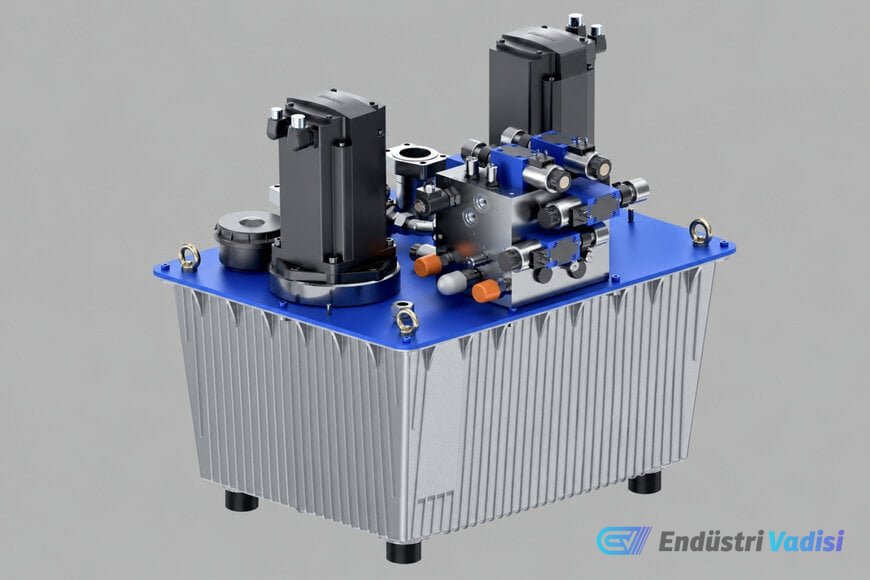
Bosch Rexroth's new ABKAG twin power unit combines two separate units into a single compact system. Thanks to a single fluid tank and a central manifold architecture, pipe and valve clutter are eliminated. Since the unit is delivered ready-to-use, it significantly reduces assembly time and cost. This compact structure can be easily integrated into press machines with limited space.
⚡ Dynamic Energy Management with Servo-Pump Technology
The ABKAG series achieves peak energy efficiency with its intelligent "power on demand" control strategy. High-performance MS2N servomotors, combined with proven A10FZG axial piston pumps, provide hydraulic energy only when required by the bending cycle. This minimizes power losses during idle operation, reduces overall energy consumption, and lowers operating costs.
⚙️ Expanding Capabilities in a Single Power Unit
The ABKAG single power unit portfolio has been expanded with higher-performance options to accommodate different tonnage classes. These units are now offered with integrated manifolds. This versatile single-unit design can be easily mounted on either the left or right side of the press brake. This standardization reduces part variety, simplifying inventory management and spare parts logistics.
🎯 Integrated Cylinder Manifolds for Precise Control
Bosch Rexroth also offers innovations for valve-controlled press brakes. The new function-integrated cylinder manifold, mounted directly on the hydraulic cylinder, minimizes the fluid volume under compression, reduces pressure drops in the circuit, and increases dynamic response. Proximity to the actuator allows for tighter closed-loop control of the bending stroke, delivering maximum angular accuracy and repeatable part quality.
📈 Part of the Industrial Transformation
These advancements in press brake hydraulics reflect a broader shift in the industry: the transition from traditional fixed-displacement, throttle-regulated circuits to servo-controlled, variable-displacement architectures. The electro-hydraulic servo drives implemented in the ABKAG series directly control axis speed and force through variable motor speeds. This architecture complies with ISO 4413 hydraulic fluid power safety standards. Such technologies are also used in other areas, such as servo-hydraulic injection molding machines and high-speed metal stamping presses, to improve energy efficiency and positional repeatability.