




Süeda Asil
Corporate
- Thread Author
- #1
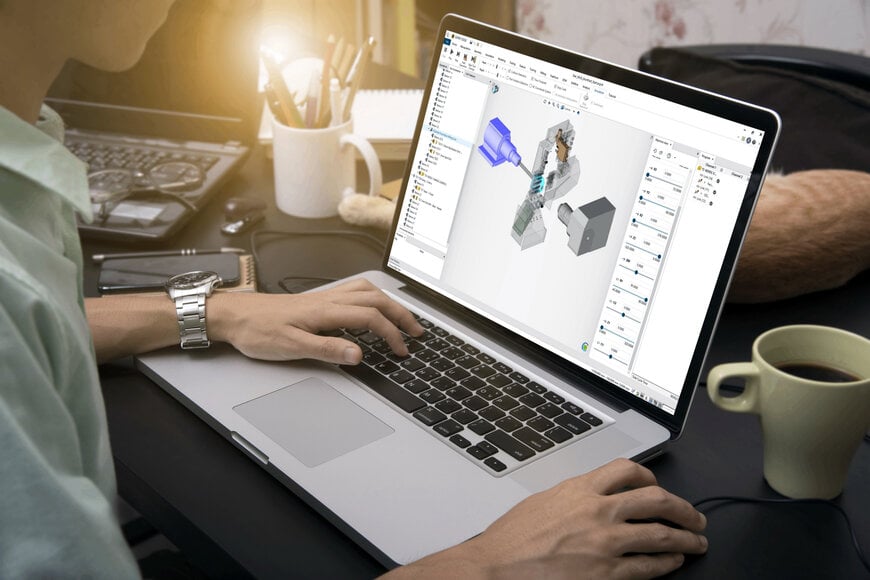
In industrial production, precision and efficiency are more critical than ever. Especially in multi-axis and multi-channel machining processes, programming errors and time losses can lead to significant costs. So, how can we simplify these complex processes? The collaboration between Hexagon and Edwards Vacuum offers an innovative solution to this problem through the integration of digital infrastructure and computer-aided manufacturing (CAM) software.
─────────────────────────
💡 Industrial Challenges in Complex Machining
Today's advanced machine capabilities require significant engineering effort and validation time for programming multi-axis and multi-channel equipment. Especially in high-precision R&D environments like Edwards Vacuum, which deals with semiconductor and turbomolecular vacuum solutions, components often have complex geometries and micron-level tolerances.
Engineers face technical challenges such as managing frequent design changes without restarting the programming lifecycle from scratch. Manual toolpath verification for multi-channel mill-turn machines increases the risk of human error, leading to machine crashes, component damage, and prolonged operational downtime.
─────────────────────────
🛠️ Technical Solution and Automated Workflows
At the heart of this collaboration is Hexagon's ESPRIT EDGE software, featuring ProPlanAI for automated turning, mill-turn, and Swiss-type programming. The system defines precise machining processes using automated logic that evaluates material removal and historical machining strategies, reducing manual input parameters.
─────────────────────────
🛡️ System Architecture and Toolpath Safety
[]Kinematic Flexibility: Support for multiple guide bushing configurations is directly integrated into digital machine models. This allows for configuration changes (e.g., chucker mode) without the need to recreate fundamental machine definitions.
[]Collision Detection: Advanced three-axis turning algorithms include tool holder awareness. The system dynamically accounts for non-cutting elements when the tool orientation changes via B-axis movement or Y-axis control.
[]Multi-Axis Movement: Five-axis composite machining functions eliminate the need for external drive surfaces, automating tool motion generation and reducing geometric preparation time.
[]U-Axis Turning: The architecture offers a programmable linear axis that controls tool rotation while the component remains stationary. This enables turning operations for large-scale components in traditional milling centers.
─────────────────────────
🌐 Application and Infrastructure Integration
Edwards Vacuum has integrated the system into its advanced manufacturing workflows to program complex, low-volume components. To ensure full hardware compatibility, Hexagon designed a custom post-processor tailored to Edwards Vacuum's specific multi-channel mill-turn assets.
The digital infrastructure is supported by a central cloud connector that links programming teams to documentation, software extensions, and standardized knowledge-based machining libraries. This connection ensures uniform feed definitions in drilling cycles and consistent tooling strategies across different engineering teams.
─────────────────────────
📊 Operational Outcomes
The integration of the software system reduces the time to adapt to design variations, allowing engineering recalculations to be completed in minutes rather than days. The inclusion of automated tool holder awareness and multi-channel synchronization eliminates reliance on physical trial cuts and mitigates risks associated with manual programming errors. This systematic approach ensures process stability, protects high-capital production machines, and maintains component accuracy even in complex manufacturing processes.