





Mucitler Elektrik
Corporate
- Thread Author
- #1
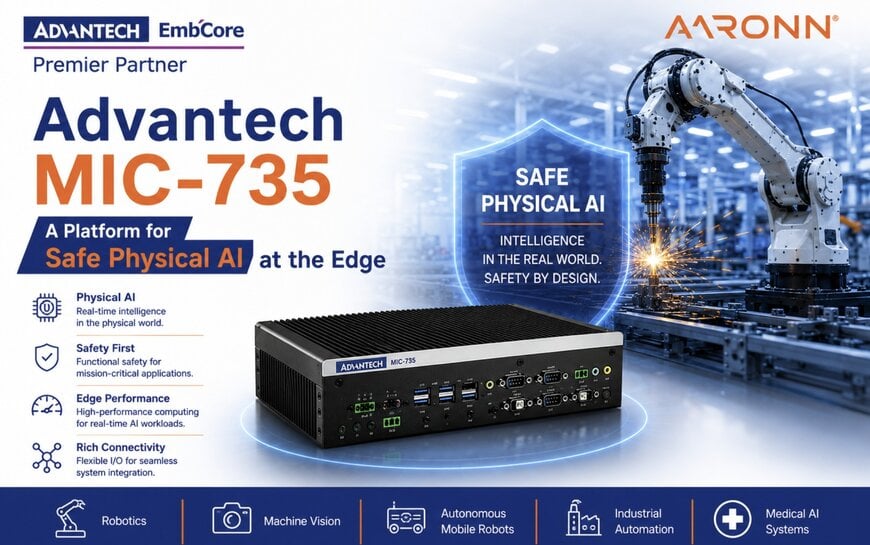
A groundbreaking development is unfolding in the world of industrial automation and artificial intelligence! The new generation industrial hardware architecture, developed in collaboration with Aaronn and Advantech, processes sensor data locally to manage critical robotic workloads in real-time. This is a game-changing innovation, especially for safety-critical applications.
─────────────────────────
💡 The Era of Physical AI Begins
While AI in the past focused more on cloud-based, generative models, physical AI systems are now making autonomous decisions in real-world environments. Sensors collect environmental data, machine learning models analyze these inputs, and hardware systems provide immediate mechanical responses. In areas such as autonomous transportation or machine vision, a processing error can directly affect physical processes, equipment, or personnel. This is where embedded platforms like the Advantech MIC-735 support safety-oriented system architectures specifically designed for critical tasks, prioritizing functional safety, continuous system stability, and real-time behavioral consistency.
─────────────────────────
⚡ Local Processing and Edge Architecture
To support high-speed robotics and automated production lines, hardware processes large volumes of telemetry data directly at the machine level, rather than transmitting it to central data centers. This edge computing approach minimizes network latency, allowing autonomous systems to adapt instantly to changing physical variables. Keeping production metrics on-site secures the industrial data ecosystem while ensuring continuous efficiency in the digital supply chain by keeping automation nodes operational even during network outages.
─────────────────────────
🏭 Industrial Applications and System Integration
This hardware platform provides a robust foundation for various safety-critical workloads. In industrial environments, it enables autonomous mobile robots to navigate dynamic factory floors and supports high-throughput image processing for instant fault detection. In the medical sector, it powers image-guided diagnostic tools and intelligent assistance systems that require stringent reliability standards. Scaling these physical deployments necessitates aligning hardware capabilities with complex software environments, so solution providers evaluate technical requirements, design system architectures, and manage the ultimate integration of embedded controllers into long-term production environments.
─────────────────────────
🔬 A Closer Look at Technical Details
In the industrial edge computing market, devices like the Advantech MIC-735 are often compared with ruggedized edge controllers such as the Siemens SIMATIC IPC series and the OnLogic Karbon series. Objective benchmarking criteria focus on thermal dissipation efficiency, inference latency, and the volume of concurrent video streams supported, requiring continuous operation without active fan cooling in environments ranging from -20°C to 60°C. These industrial PCs integrate scalable neural processing units (NPUs) or discrete graphics accelerators to perform parallel processing tasks. These physical metrics determine the viability of a platform for safety-critical edge deployments where data processing delays exceeding a few milliseconds can jeopardize automated workflows or lead to mechanical failures.
─────────────────────────
As seen, the integration of edge computing and physical AI is shaping the future of industrial automation. These innovations open the doors to safer, more efficient, and more autonomous production processes.