

Mucitler Elektrik
Corporate
- Thread Author
- #1
🚀 Universal Robots Brings AI to Factories!
Universal Robots has introduced Gen 7, its seventh-generation robotic architecture designed to integrate artificial intelligence and physical automation into factory production environments. Supported by the PolyScope X operating system, this platform offers an end-to-end redesign encompassing new robot arms, a re-engineered control cabinet, an ergonomic teach pendant, and an integrated tool flange interface.
🦾 g-Series Manipulators and AI-Powered Flange Architecture
The platform offers three manipulators, dubbed the g-Series: UR10g-1750, UR17g-1300, and UR18g-950. These names denote payload capacity in kilograms and reach in millimeters. The arms feature an AI-powered tool flange that routes power, data lines, and safety circuits directly to the tool center point. This eliminates the need for external cabling for cameras, high-bandwidth sensors, and end-effectors.
Integrated six-axis force-torque sensing, compliance impedance control, and Real-Time Data Exchange (RTDE) provide contact sensing to support precise physical AI applications, such as dexterous component manipulation and force-sensitive assembly tasks.
🧠 Controller Performance and Programming Interfaces
Computational execution is provided by the CB7 Core controller, which offers 40% more processing capability in a 30% smaller footprint compared to previous hardware revisions. The controller supports multi-network switching to directly interface with programmable logic controllers (PLCs), human-machine interfaces (HMIs), manufacturing execution systems (MES), industrial PCs (IPCs), and machine vision systems. The CB7 Core is available in standalone and cabinet-mountable compact formats, maintaining backward hardware compatibility with existing e-Series and UR Series arms.
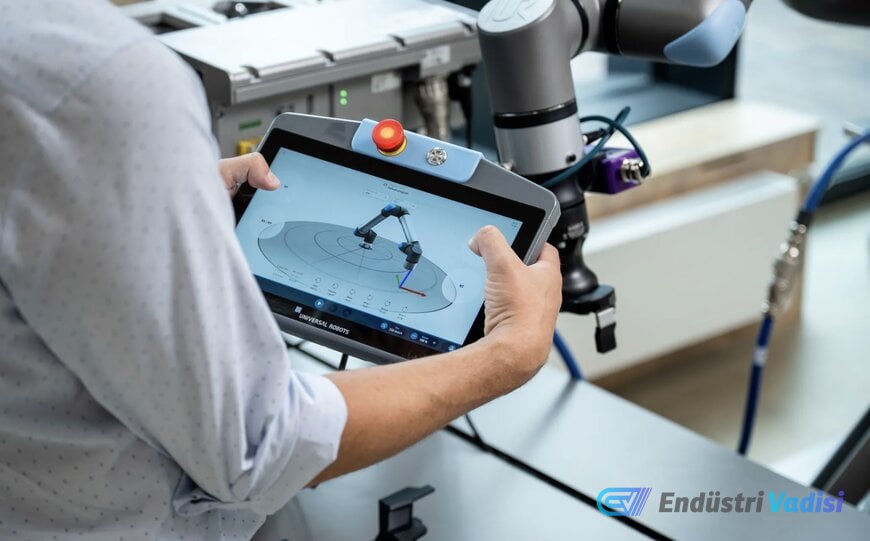
The operating software is built on PolyScope X, which includes ROS2 communication nodes, open APIs, ISO 10218-1 safety integration, and support for third-party extensions including ProfiSafe and OPC UA. Handheld parametrization is performed using the TP7 Core teach pendant, which is more than 20% lighter than previous units and features a full HD touchscreen, ergonomic multi-grip contours, user-configurable smart buttons, and a virtual jog stick.
Direct teaching at the tool tip is managed via the SP7 Smart Panel, an interface mounted on the tool flange. This panel includes safety-rated free-drive activation, visual status LEDs, and three assignable input buttons configured to trigger PolyScope X Smart Skills without requiring teach pendant interaction.
🔒 Safety Architecture and Cybersecurity Certification
System safety meets Performance Level d (PLd), Category 3 functional safety certification in accordance with ISO 13849-1. g-Series arms have TÜV certifications against ISO 10218-1 standards and UL 1740 specifications. Teradyne Robotics maintains IEC 62443-4-1 Maturity Level 3 (ML3) certified cybersecurity compliance, covering secure software development lifecycles across embedded and edge-level software releases.
💡 Additional Information
Standard collaborative robots route camera power and vision lines through external corrugated channels along the arm links, which poses risks of mechanical snagging and limits continuous wrist rotation during complex manipulation. Internally routing high-speed data, power, and safety circuits directly to the tool flange via slip rings eliminates external cable harness wear and snag points during rapid motion cycles.
Furthermore, traditional controllers rely on closed, proprietary architectures that require protocol gateways to interface with external processors. Native Robot Operating System 2 (ROS2) support and high-speed data stream integration eliminate hardware conversion layers, reducing communication latency between external AI models and low-level servo drives for responsive visual-servoing and force adjustments.