








Erkan Teskancan
Corporate
- Thread Author
- #1
💡 Revolution in Energy Efficiency
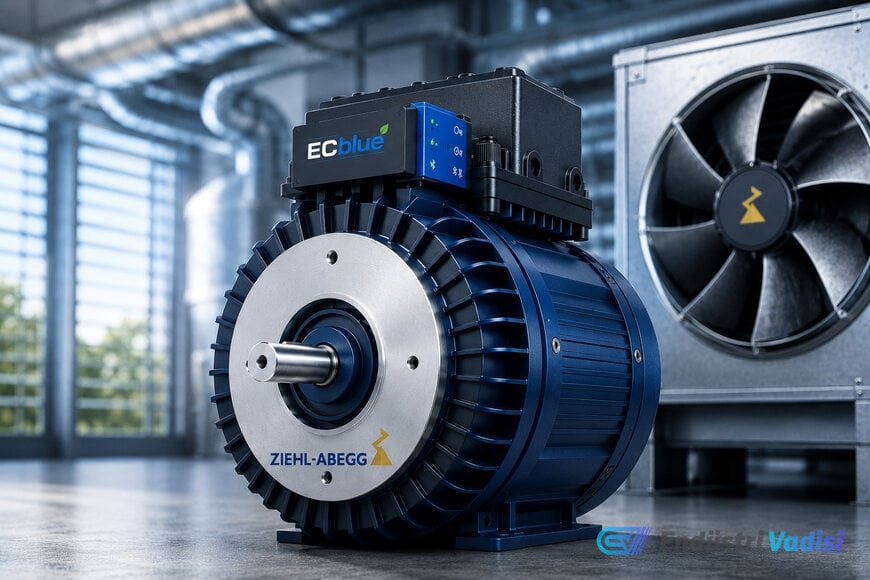
In today's world, energy saving and compliance with environmental regulations are among the priorities of industries. Especially continuously operating ventilation systems in commercial buildings, industrial facilities, healthcare institutions, and data centers account for a significant share of total electricity consumption. It is precisely at this point that ZIEHL-ABEGG introduces its new IE5 EC external rotor motor platform, equipped with integrated control, smart connectivity, and modular design. These motors aim to simplify system integration with high efficiency while increasing long-term performance.
⚙️ Integrated Motor and Control Platform
ZIEHL-ABEGG's EC external rotor motors combine the electronically commutated motor and the ECblue control unit in a single structure. This integration eliminates the need for separate drive electronics, simplifying installation, streamlining wiring, and allowing for more compact equipment arrangements. For OEMs, this architecture reduces engineering effort while providing greater flexibility in the design of ventilation equipment such as fans, air handling units, and cooling systems. The external rotor design offers high power density even in limited spaces, without compromising performance.
⚡ High Efficiency for Low Energy Consumption
Designed to meet IE5 efficiency requirements according to the IEC 60034-30-2 standard, this motor platform exceeds the minimum efficiency levels of IE4 motors. Higher efficiency reduces electrical losses throughout the operating range, lowering energy consumption and operating costs over the equipment's lifespan. Especially in continuously operating applications, even small improvements in motor efficiency can lead to measurable reductions in electricity usage. Data centers, HVAC systems, industrial ventilation, and medical facilities can thus benefit from lower life cycle costs while contributing to sustainability goals.
🌍 Global Compatibility and Flexible Design
The EC external rotor motor platform is available in power ratings from approximately 0.09 kW to 6 kW, and can be used in both compact ventilation equipment and larger industrial installations. Supporting single-phase (100–177 V and 200–277 V) and three-phase (200–240 V and 380–480 V) international voltage configurations, these motors are compatible with 50 Hz and 60 Hz electrical systems. This broad electrical compatibility allows manufacturers to standardize their equipment for different international markets, simplifying inventory management and reducing product development complexity. With protection classes ranging from IP20 to IP55+, they can be used in both protected indoor environments and outdoor areas exposed to dust and moisture.
🔒 Reliability and Smart Connectivity
Operational reliability is enhanced through integrated motor protection and active temperature management. These features protect the motor against overload conditions and excessive thermal stress, ensuring a longer service life and reducing unplanned downtime in continuously operating ventilation systems. Compliance with EN IEC 61000-6-3 (electromagnetic interference emissions) and EN IEC 61000-6-2 (electromagnetic immunity) standards supports stable operation in industrial environments. Optional Bluetooth functionality provides wireless commissioning and diagnostic access, shortening installation time and simplifying maintenance procedures. The ZAcode interface, configurable customer interfaces, and expansion options enable integration with building automation systems and industrial control platforms.
🌬️ Optimized for Complete Ventilation Solutions
The EC external rotor platform is designed to work as a coordinated ventilation package with ZIEHL-ABEGG's axial and radial impellers. Matching the motor and impeller during product development allows manufacturers to optimize airflow performance, acoustic characteristics, and overall energy efficiency. This coordinated approach offers an ideal solution for ventilation equipment used in commercial buildings, industrial facilities, healthcare institutions, clean rooms, process industries, and data centers, where efficient airflow and reliable cooling are critical.






















