







Süeda Asil
Corporate
- Thread Author
- #1
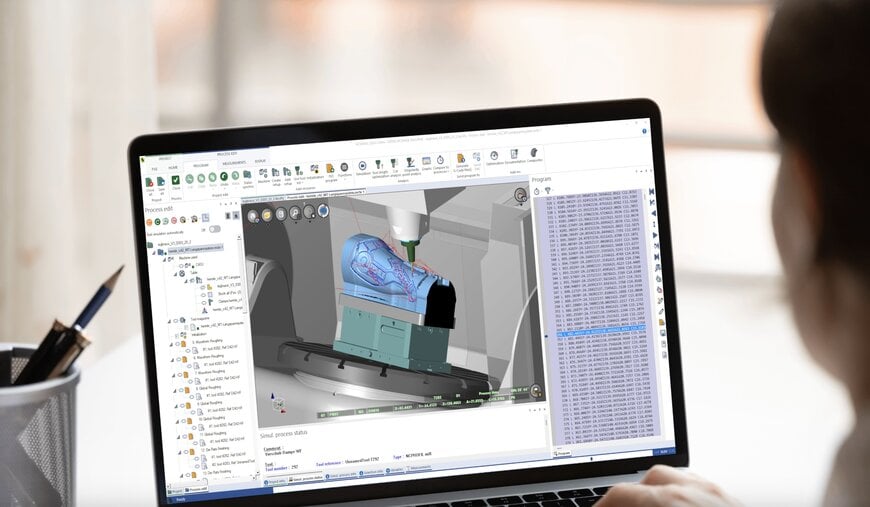
Hexagon's latest innovations in NCSIMUL software are taking integrated NC program verification and optimization to the next level within a single digital twin environment. This update aims to increase efficiency and reliability in manufacturing processes.
─────────────────────────
💡 A New Era in G-Code Verification and CNC Simulation
Hexagon's Manufacturing Software Division is optimizing G-code verification and CNC machine tool simulation with the selective simulation feature integrated into its NCSIMUL platforms. This allows manufacturers to verify numerical control (NC) programs, maximize machining efficiency, and minimize physical trial processes.
─────────────────────────
🛡️ Reducing Production Risk in High-Value Machining
As manufacturing and programming processes accelerate, software-based verification allows operators to increase throughput while reducing operational risks. This process verification is critical, especially in high-value production environments involving multi-hour machine cycles, multi-axis operations, and complex machining stages requiring precision engineering.
─────────────────────────
⚡ Accelerating Long-Cycle Program Navigation
The integrated software introduces Selective Simulation, a patent-pending capability designed to accelerate how programmers navigate extensive NC files. This architecture uses graphics processing unit (GPU) acceleration to calculate intermediate Remaining Stock Previews during the initial NC code decoding phase, visualizing the geometric evolution of the part before running a linear simulation sequence.
In a technical field evaluation by an American athletic footwear company on a long-cycle mold application, an NC program with a 47-hour machine cycle required 48 minutes of traditional sequential simulation for the operator to analyze the targeted mid-program operation. Using the Selective Simulation feature, the system generated intermediate Remaining Stock Previews in less than two minutes.
─────────────────────────
📊 Operational Workflow and Final Verification
Using these intermediate previews, programmers can examine geometric evolution at separate production stages, isolate visual defects early in the iteration cycle, and go directly to critical toolpath operations. Remaining Stock Previews are designed to support early-stage inspection and rapid iteration. Comprehensive NC code simulation, including full machine tool kinematics, extensive collision detection, and material removal verification, remains the fundamental requirement for final operational approval before programs are sent to the production floor.
─────────────────────────
🔬 Comparative Technology Analysis
Computer-aided manufacturing (CAM) verification software traditionally decodes numerical control (NC) bidirectional text files, i.e., G-code, through a linear, sequential processor. In traditional software environments, the system must calculate every line of text from the beginning of the program to the desired control point. This means that the time required to view an operation near the end of a file is directly proportional to the total length of the toolpath, creating significant processing bottlenecks for long-cycle multi-axis machining.
To address these computational delays, standard industry platforms rely on central processing unit (CPU) instruction speeds combined with step-skipping algorithms or cut history recording mechanisms. While these methods allow users to jump forward, they remain tied to sequential step processing or require large computer memory storage to save separate file checkpoints. The shift to a dedicated GPU-accelerated decoding architecture, decoupled from linear time constraints, is a technical game-changer; it calculates sectional remaining stock geometry models on the graphics processor in parallel with text parsing.
─────────────────────────
📈 Criteria and Technical Specifications
Evaluating industrial G-code verification and simulation software relies on key performance criteria such as decoding architecture, review access time for long-cycle programs, collision detection accuracy, and host hardware utilization.
In terms of processing architecture, traditional industry standards rely on sequential CPU processing, which requires linear calculation of the entire toolpath sequence. For long-cycle programs, such as a 47-hour machining block, traditional sequential software requires up to 48 minutes of continuous calculation to reach mid-program operations. In contrast, the NCSIMUL application uses non-linear, GPU-accelerated decoding to compress this state generation interval to under two minutes for the same file lengths.
Regarding verification scope, standard CAM embedded tools typically check basic toolpath geometry but lack full kinematic machine cell simulation; whereas specialized high-end verification platforms offer full digital twin collision detection between machine components, workholding fixtures, tools, and stock. The updated NCSIMUL framework establishes a two-stage workflow: it provides fast, non-linear geometric previews for early iteration while maintaining full kinematic component verification and comprehensive collision detection for final shop floor approval.