





Cengiz Özemli
Academic
- Thread Author
- #1
🚀 Robotic Revolution: AMD and Analog Devices Join Forces!
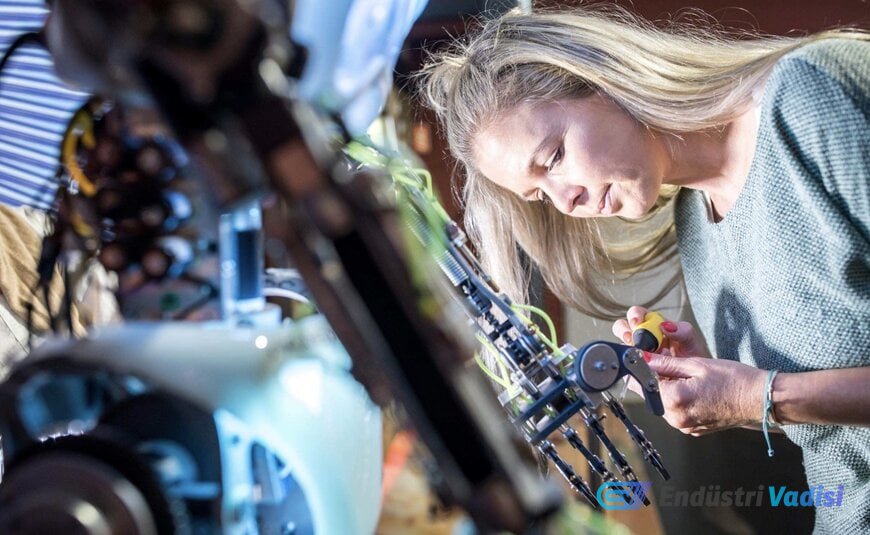
AMD and Analog Devices (ADI) have teamed up to introduce an integrated hardware and software ecosystem aimed at accelerating the development of industrial and mobile robots. This collaboration seeks to eliminate hardware and software integration bottlenecks in autonomous mobile robots (AMRs), industrial manipulators, and humanoid systems.
🧠 Kria AI Robotic Development Platform: Power on a Single Chip!
AMD's Kria AI Robotic Development Platform offers an integrated system-on-module (SOM) that combines processing capabilities with physical sensor interfaces. This system simplifies the deployment of robotic systems by providing a pre-validated, centralized architecture for sensing, navigation, and motion control workflows.
💡 Transition to Centralized Architecture: AI on a Single Chip!
Autonomous robotic architectures are shifting from distributed microcontrollers to centralized, AI-powered computing systems. The Kria AI SOM brings this consolidated approach to life by combining an x86 CPU, an integrated GPU (iGPU), and a Neural Processing Unit (NPU) with unified memory resources on a single device. This architecture can manage various workloads, from low-precision transformer-based inference models to high-precision classical algorithms.
💻 Software Environment: Open Source and Flexible!
The platform is built upon the AMD Robotic Software Stack and the ROCm framework. Running on an x86 Linux base, the system natively supports standard development environments such as ROS 2, PyTorch, TensorFlow, and Docker. This eliminates the need for developers to port their code to custom operating systems.
👁️ Multi-Sensor Synchronization: End to Complexity!
Managing sensor arrays in vision-based robots creates significant electrical routing and synchronization challenges. The carrier board utilizes Gigabit Multimedia Serial Link (GMSL) technology to reduce the wiring complexity of four to six camera systems. Additionally, the platform leverages hardware-accelerated processing pipelines to handle the dense 3D data generated by depth sensors.
🧭 High-Stability Positioning: Reliable in Any Environment!
In environments where camera and LiDAR feedback is weak (e.g., dimly lit warehouses or reflective manufacturing areas), reliable positioning heavily depends on inertial sensing. The platform integrates ADI's ADIS16607 Inertial Measurement Unit (IMU), offering a secondary sensing method. Through advanced sensor fusion, the system provides accurate time stamping and spatial awareness, reducing positioning errors in featureless environments.
⚙️ Precise Motion Control and Hardware Integration: Industrial Power!
Precise actuation requires robust physical interfaces that can withstand industrial vibrations and temperature variations. ADI provides the physical connectivity infrastructure through a COM-HPC style carrier board equipped with a Field Programmable Gate Array (FPGA). This board integrates isolated fieldbus connections, motor control interfaces, encoder feedback mechanisms, and current sensing capabilities.
🆚 Competition and Modularity: The AMD Difference!
In the autonomous robotic processing sector, the AMD Kria AI SOM directly competes with ARM-based architectures, particularly NVIDIA's Jetson Orin module family. While NVIDIA uses ARM Cortex CPUs and Ampere architecture GPUs, AMD's platform stands out with a native x86 architecture. This architectural decision allows developers to natively run standard desktop-level Linux and x86 compiled binaries without the need for cross-compilation.
The Kria AI platform uses a COM-HPC style form factor, an open standard for high-performance computing modules. This standard allows developers to separate the compute module from the carrier board, enabling subsequent processing upgrades without requiring a complete redesign of mechanical routing, motor control arrays, or sensor interface layers.