







Ahmet Ö.
Corporate
- Thread Author
- #1
Groundbreaking Collaboration Between Volvo Cars and Hexagon Robotics
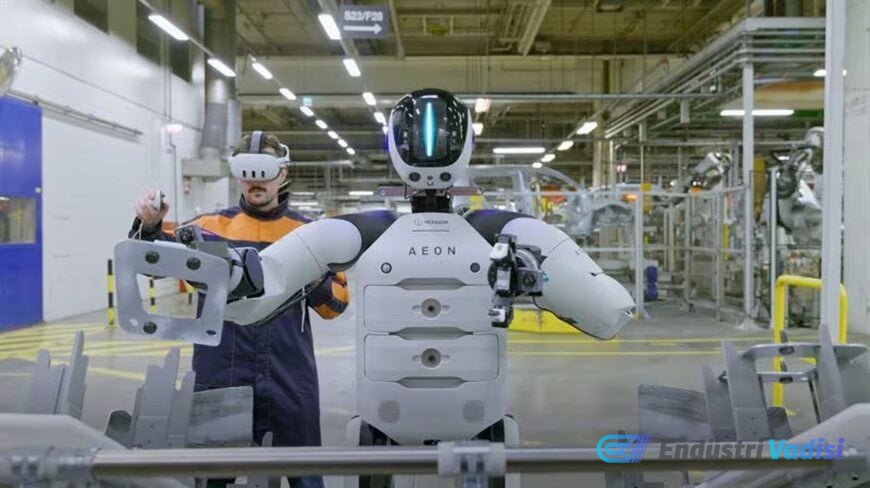
Volvo Cars and Hexagon Robotics have initiated a technical collaboration to deploy, train, and validate humanoid robot systems in automotive manufacturing. This engineering program has been launched at Volvo Cars' Ghent production facility in Belgium. The program aims to execute repetitive and ergonomically challenging assembly workflows by integrating multi-purpose wheeled humanoid robots with human operators and existing fixed automation.
Current Challenges in Automotive Assembly Lines
Traditional automotive manufacturing relies on fixed articulated robot arms designed for deterministic, high-repeatability operations in fixed work cells. However, dynamic assembly zones often involve human-centric spatial arrangements, irregular part presentation, and complex manual handling requirements that cannot be automated with fixed tooling without extensive facility reconfiguration. Maintaining production flexibility while addressing ergonomic strain risks for line personnel requires mobile robot platforms that can navigate existing factory aisles and adapt to diverse manipulation tasks.
Robotic Architecture and Imitation Learning Framework
This technical collaboration combines Volvo Cars' automotive manufacturing environment and process engineering with Hexagon Robotics' AEON humanoid platform. The AEON system, standing 1.65 meters tall and weighing 60 kilograms, features a wheeled mobility base capable of moving at speeds up to 2.4 meters/second and carrying a 10-kilogram payload. Onboard optical cameras and environmental sensors perceive the surroundings to guide high-precision part manipulation.
Instead of relying solely on manual coordinate programming, engineering teams are training the robots using imitation learning algorithms. This allows the control system to learn operational trajectories by observing and replicating human task demonstrations.
Magnus Nilsson, Head of Production at Volvo Cars, explained the rationale behind the integration: "AEON's humanoid design means it can fit into our current production alongside our teams and existing automation. Our goal is for humanoid robots to take on some of the most physically demanding tasks, making the work more ergonomic for our employees."
Phased Validation and Production Deployment
The implementation at the Ghent production facility follows a phased validation methodology. Initial training stages focus on high-precision pick-and-place operations, particularly component insertion into dual fixtures. Once task repeatability and placement tolerances are validated, engineering teams will gradually expand operational complexity to include multi-part handling, autonomous navigation in active production zones, and digital interfacing with existing facility automation systems.
The ongoing training phase establishes the operational foundation for an expanded factory pilot planned for the first half of 2027. During this pilot, additional AEON units will be deployed in broader industrial workflows at Ghent, targeting active series production integration by mid-2027.
Production Flexibility and Workforce Ergonomics
The validation of multi-purpose humanoid platforms in active assembly environments offers a scalable pathway to automate non-standard material handling operations without modifying legacy factory infrastructure. Shifting physically strenuous and repetitive fixture loading cycles to sensor-guided mobile robots reduces occupational ergonomic strain, enhances line adaptability, and establishes repeatable deployment parameters for physical AI in automotive manufacturing.