








Alper Aktaş
Endüstri Vadisi
- Thread Author
- #1
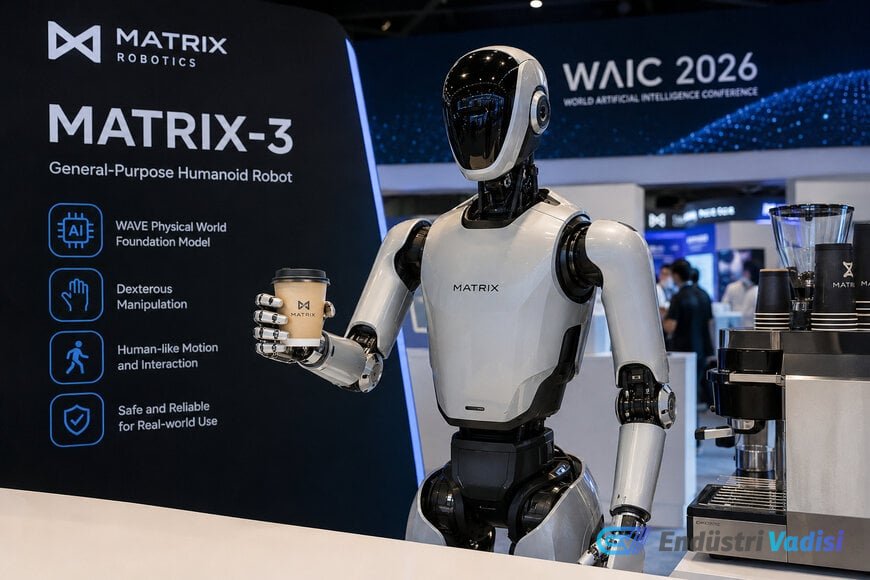
Matrix Robotics Revolutionizes Humanoid Robot Technology!
The World Artificial Intelligence Conference (WAIC 2026) in Shanghai witnessed a true technology spectacle with Matrix Robotics' third-generation humanoid robot platform, MATRIX-3, and its enhanced WAVE Physical AI Foundation Model. The company showcased human-robot interaction and autonomous manipulation capabilities across a wide range of applications, from commercial services to industrial use.
Versatile Applications and Flexibility 🌐
Matrix Robotics demonstrated how its robots can be utilized in various fields such as commercial services, retail, hospitality, public services, education, and warehousing. Four identical humanoid robots successfully performed different tasks using the same core AI model. This highlighted how a single software platform can be adapted to different scenarios and the importance of operational flexibility.
Physical AI Architecture: The WAVE Model 🧠
The company introduced an updated version of its WAVE Physical World Foundation Model, specifically developed for robots operating in physical environments. This model is designed to process physical interaction data collected from simulated and real-world environments. Thanks to its two-layer architecture, the model performs scene understanding, reasoning, and task planning, while a separate motion control model ensures coordinated full-body movements. This allows robots to offer autonomous decision-making and continuous motion control simultaneously.
Live Technical Demonstrations Were Breathtaking ☕📦🚶
- Coffee Service: A robot served as an autonomous coffee service assistant, utilizing a coffee machine.
- Human-Robot Interaction: A second robot showcased interactive communication and gesture recognition capabilities using speech recognition, semantic understanding, and visual perception.
- Object Manipulation: A third system demonstrated general object manipulation by identifying and transporting objects of different sizes, weights, and surface properties.
- Locomotion and Navigation: The fourth robot demonstrated locomotion and navigation capabilities in a crowded environment with autonomous visitor detection, obstacle avoidance, and coordinated full-body movement.
MATRIX-3 Hardware Platform 💪
MATRIX-3 was developed to operate in environments designed for human workers. Standing approximately 1.70 meters tall and weighing 65 kilograms, this robot features a tendon-driven hand structure with 27 degrees of freedom. This hand can use traditional human tools and grasp various objects. Distributed tactile sensing and biomimetic surface materials support close human interaction, while integrated motion control algorithms enable coordinated walking and manipulation. The robot can operate continuously for approximately four hours on a single charge.
Industrial Deployment and Future Vision 🏭
Matrix Robotics stated that its entire technology stack, including data processing, AI models, motion control, hardware design, and manufacturing, was developed in-house. The production facility in Shanghai aims to reach an annual production capacity of 5,000 units in 2026 and 10,000 units in 2027. The company announced that it has received approximately 1,000 robot orders from sectors such as hospitality, research, and commercial services, and pilot applications have begun to be evaluated in real-world conditions.
Key Announcements from WAIC 2026 📢
During WAIC 2026, Matrix Robotics announced the updated version of its WAVE Physical World Foundation Model and the launch of the MATRIX Global Partner Program, aimed at supporting regional distribution, system integration, and after-sales services. This event clearly outlined the company's vision to integrate Physical AI, humanoid robotics, and industrial deployment into a single platform.