








Mucitler Elektrik
Corporate
- Thread Author
- #1
GPU-Accelerated Simulations in Semiconductors and Autonomous Systems
Modern microelectronic design and multi-domain physical simulations encounter computational bottlenecks as they scale to sub-nanometer lithography nodes, multi-die 3D packaging, and real-time physical AI testing. Traditional CPU architectures prove insufficient to process dense partial differential equations and volumetric optical models within acceptable design cycle times, forcing engineering teams to compromise between numerical precision and simulation speed.
Synopsys and NVIDIA Collaboration
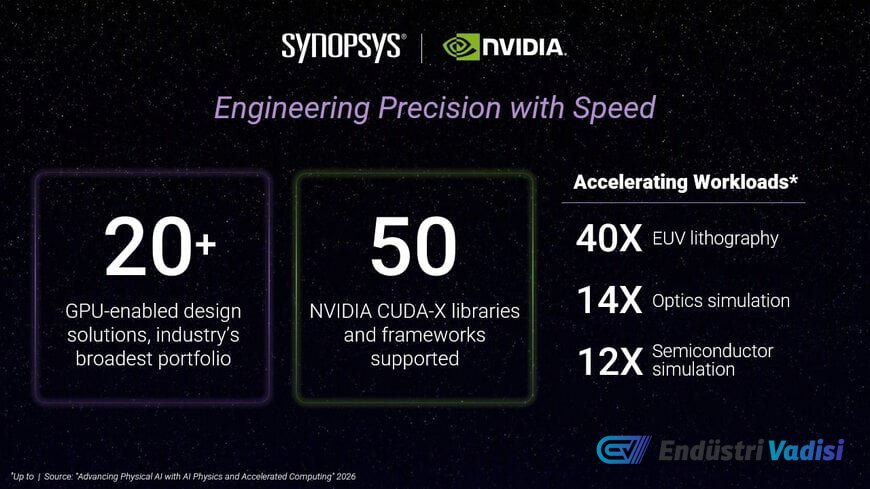
At NVIDIA GTC Berlin, Synopsys showcased its expanded portfolio of over 20 GPU-enabled electronic design automation (EDA) and multiphysics simulation tools, integrated with over 50 NVIDIA CUDA-X libraries and frameworks. This engineering initiative focuses on porting computationally intensive TCAD (Technology Computer-Aided Design), finite-difference time-domain (FDTD) electro-optic solvers, optical ray tracing, and autonomous vehicle safety verification workflows directly to GPU-accelerated computing architectures.
Semiconductor Manufacturing and Device Physics Solvers
Physical scaling in advanced node semiconductors requires deep process emulation and device modeling. In TCAD workflows, calculating electric field distributions, carrier transport, and thermal runaway under extreme voltage gradients involves solving large sparse linear equation systems.
- Infineon Example: Infineon leveraged Synopsys Sentaurus Device in conjunction with the NVIDIA cuDSS (CUDA Direct Sparse Solver) library, achieving a 12x reduction in simulation time for 3D electrical breakdown analysis in next-generation power electronics.
- Imec Example: European research institution Imec integrated Synopsys S-Litho computational lithography software into its process modeling flows. Utilizing NVIDIA CUDA-X accelerated libraries, Imec measured up to a 40x execution speedup on High-NA EUV benchmark workloads compared to traditional CPU environments.
Automotive Sensor Simulation and Traceable Functional Safety
Autonomous driving verification requires closed-loop validation where virtual environments project sensor stimuli directly into autonomous driving perception stacks.
- Synopsys integrated its verification suite with the NVIDIA Halos SAFE safety assurance framework to create a verifiable safety lifecycle workflow.
- T-Systems Collaboration: For optical exterior lighting simulation, Synopsys collaborated with T-Systems to run an automotive lighting workload, validated by FORVIA HELLA, on T-Systems’ sovereign Industrial AI Cloud. Running Monte Carlo optical ray tracing on NVIDIA GPU nodes via Ansys Speos reduced the total simulation time from 4.5 hours on CPU clusters to under 19 minutes.
Photonic Transceiver and High-Density Optical Interconnect Design
AI data center clusters demand optical interconnects to overcome copper channel loss, dispersion, and thermal dissipation limits. Integrated silicon photonic design requires full-wave electromagnetic modeling via 3D finite-difference time-domain (FDTD) methods, which discretize Maxwell's curl equations on sub-wavelength spatial grids over thousands of timesteps.
- iPronics Example: iPronics deployed Ansys Lumerical FDTD on NVIDIA H100 GPU clusters within the Amazon Web Services (AWS) infrastructure. The GPU-accelerated electromagnetic solver delivered a 13x speedup compared to a 96-core CPU baseline.
- Alcyon Photonics Example: Alcyon Photonics integrated Ansys Lumerical to model integrated silicon photonic transceivers, directional couplers, and broadband routing subsystems.
Additional Information: Architectural Transition of GPU Acceleration
The transition to GPU-accelerated computing within EDA represents an architectural shift from distributed, memory-bandwidth-constrained CPU clusters to massively parallel heterogeneous architectures. The introduction of NVIDIA cuDSS addresses this by implementing batched multifrontal Cholesky, LU, and LDLT factorizations optimized for GPU tensor and CUDA cores.
Competitive EDA Landscape
- Cadence Design Systems: Has developed Palladium Z2/Z3 hardware emulation platforms and the Cadence Millennium Enterprise Multiphysics Platform. The Millennium platform pairs custom GPU computing devices with proprietary finite volume computational fluid dynamics (CFD) and aerodynamics solvers, delivering 20x to 100x acceleration in mechanical and multiphysics modeling.
- Siemens EDA: Utilizes GPU acceleration in specific verification nodes, such as the Calibre nmPlatform (for optical proximity correction and machine learning-enabled DRC) and the Questa verification platform. While Siemens emphasizes distributed multi-threading across high-core enterprise server CPUs, Synopsys has expanded GPU acceleration across TCAD matrix solvers, finite-difference time-domain photonics, and physical lighting simulation pipelines.





















