








Cengiz Özemli
Academic
- Thread Author
- #1
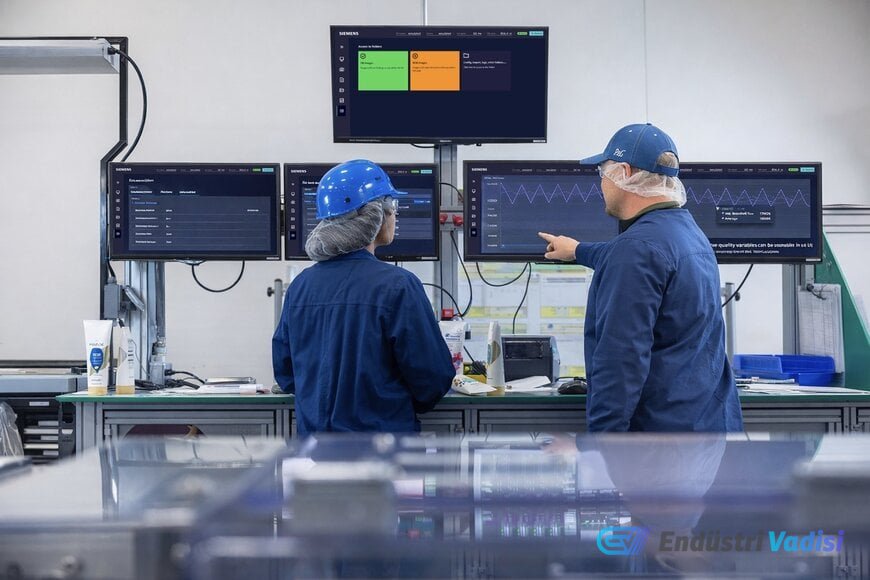
Industrial technology giant Siemens and consumer goods giant Procter & Gamble (P&G) are accelerating the global rollout of their jointly developed AI-powered quality inspection system. This edge-based platform, called the "Visual Inspection Cockpit" (VIC), enhances quality consistency by inspecting consumer products in real-time, at full line speed, during production, reducing scrap rates by 10% to 20% depending on the product line.
🔍 Background of the Collaboration
In high-speed consumer goods manufacturing, packaging and products often involve delicate, textured, and flexible materials. These materials can slip, stretch, or wrinkle at high line speeds. Traditional rule-based vision systems struggle to detect these subtle physical fluctuations, overlapping components, or low-contrast defects. They may require extensive reconfiguration and downtime when packaging designs, materials, or line parameters change.
To address these inspection bottlenecks and maintain flawless production on high-speed lines, a collaboration was established between Siemens and P&G. This partnership combines P&G's proprietary deep learning models and expertise in consumer goods manufacturing with Siemens' edge computing hardware, software scaling frameworks, and industrial AI portfolio. Rainer Brehm, COO and CTO of Siemens Digital Industries Automation, states that the system provides full inspection accuracy for thousands of products per minute in scalable architectures, solving industrial inspection challenges that traditional vision systems cannot handle.
🛠️ Technical Solution and Responsibilities
The technological framework combines localized AI inference with edge computing architectures directly adjacent to production machines. Responsibilities are distributed between the companies to ensure scalable software lifecycle management and deterministic line control:
- Procter & Gamble: Develops and maintains deep learning models tailored to high-speed consumer products, material behaviors, and packaging variations.
- Siemens: Provides industrial computing hardware, including industrial PCs powered by NVIDIA GPUs, the Siemens Industrial Edge platform, software scaling infrastructure, and long-term technical operations.
At the system level, the Visual Inspection Cockpit analyzes live camera feeds directly at line speed. Inference processing, delivered as an Industrial Edge application, occurs on-site, close to the production equipment. This enables real-time PLC integration and automated responses (such as escalating operator alerts or triggering pneumatic rejection mechanisms to remove defective units without stopping the line). The platform also includes the Visual Inspection Engineering Tool, which allows plant personnel to configure and update inspection models locally without dedicated data science teams. Quality data is continuously collected to identify process drift and guide long-term continuous improvement programs.
🌍 Implementation Strategy
The implementation strategy focuses on expanding the Visual Inspection Cockpit across P&G's global manufacturing footprint. Because VIC is designed as a standardized, modular application within the Siemens Industrial AI Suite, new line installations can be commissioned five to ten times faster than with custom optical vision solutions.
The ongoing global rollout provides P&G with comprehensive defect detection on high-speed lines while reducing raw material waste through early anomaly detection. By deploying AI inference on Siemens Industrial Edge platforms, the manufacturing network gains a unified, scalable inspection framework that dynamically adapts to new product designs and material variations.






















