








Hasan S. Cemkan
Corporate
- Thread Author
- #1
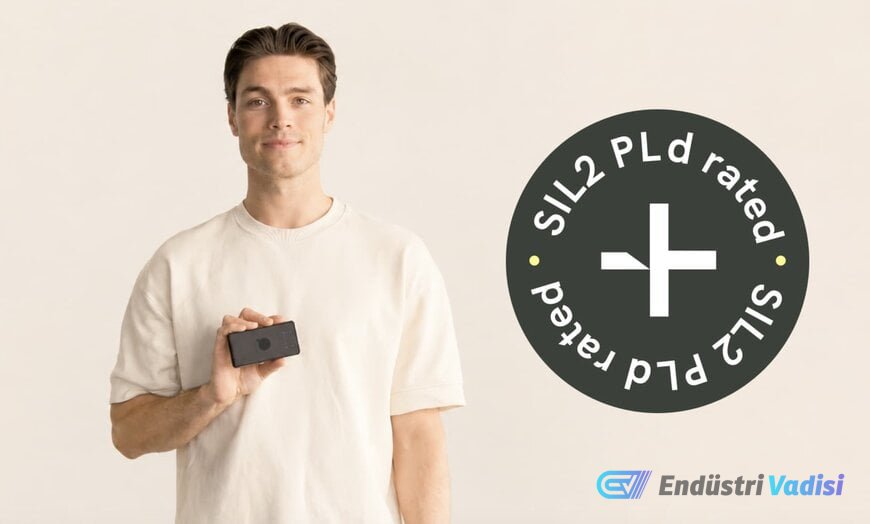
A groundbreaking development has occurred in the world of industrial automation! Sonair has announced that its ADAR One 3D ultrasonic sensor, specifically designed for human-robot collaboration (HRC) applications, has received independent functional safety certification. This innovative sensor meets Safety Integrity Level (SIL) 2 and Performance Level (PL) d requirements, making it approved for the safe detection of people and objects in accordance with the European Machinery Directive 2006/42/EC.
─────────────────────────
💡 A New Dimension in Spatial Awareness: 3D Perception Infrastructure
Traditional industrial safety systems often rely on 2D laser scanners. However, these systems have limitations due to blind spots above and below the scanning plane. ADAR One overcomes these volumetric constraints by offering a 180° x 180° field of view. This enables three-dimensional spatial detection of people and obstacles at any height.
This embedded device functions as an independent safety layer beneath higher-level machine vision systems, AI stacks, or robotic motion control setups. By using acoustic waves instead of light, it serves as a perceptual aid that complements standard camera infrastructure in environments where visual coverage is diminished due to lighting conditions, glare, or airborne particulate matter.
─────────────────────────
⚙️ Functional Safety and Software Framework
The sensor platform has been validated by exida, an independent body operating under the European Machinery Directive 2006/42/EC. The assessment confirmed compliance with various international functional safety criteria, including the IEC 61496 standard for evaluating human protection sensors within electro-sensitive protective equipment. It also met the IEC 61508 functional safety standard for electronic components operating in high-risk industrial environments and the universal ISO 13849 standard required for safety-related parts of control systems.
The validation results rated the sensor as SIL 2 and PL d, calculating the probability of dangerous failure per hour (PFH) to be less than 1.5 x 10⁻⁷. Structurally, ADAR One is the first safety-certified embedded system designed using the Rust programming language, chosen to maximize real-time performance, deterministic processing, memory safety, and operational reliability.
─────────────────────────
🏭 Industrial Application and Ecosystem Integration
The sensor has entered mass production and is being shipped for active use in industrial robotic platforms. Following a one-year testing program involving beta versions of the hardware, over 80 global robotics organizations have evaluated the system. In industrial logistics, Sonair has entered into a commercial agreement with beRobox, integrating the safety-certified sensor into their automated plug-and-play palletizing and depalletizing solutions. This application integrates 3D acoustic safety into high-throughput environments where human operators and machines share confined spaces.
For original equipment manufacturers (OEMs) and system integrators, the plug-and-play architecture offers a certified alternative to complex 2D LiDAR configurations across autonomous mobile robots (AMRs), automated guided vehicles (AGVs), collaborative arms, and humanoid form factors. Its compact nature allows the sensor to be embedded within a robot's chassis or protective frame without requiring major mechanical redesigns or special regulatory exemptions. This enables logistics providers to deploy robots within certified safety architectures recognized by insurance and liability frameworks.
─────────────────────────
🔬 Technical Details: The Heart of ADAR One
Industrial acoustic sensing and ranging platforms utilize solid-state micro-electromechanical systems (MEMS) to generate and analyze ultrasonic wave fields in air. The ADAR One sensor architecture features integrated Piezoelectric Micromachined Ultrasonic Transducer (PMUT) arrays. These miniature transducers operate in an ultrasonic frequency spectrum between 70 kHz and 85 kHz, emitting high-frequency acoustic signals and recording mechanical echoes returning from nearby reflective boundaries.
By implementing digital software beamforming algorithms on an integrated quad-core ARM system-on-chip (SoC), the sensor electronically steers and focus-pulses sound waves across a 180° x 180° hemispherical volume. This process occurs at a native frame rate of 18 Hz. The system calculates absolute spatial coordinates based on acoustic time-of-flight and phase-of-arrival deltas across the transducer array. This generates a real-time 3D point cloud with an average range accuracy of ±2 cm and angular accuracy of ±2° at the center of the field, within a 0 to 4-meter detection range.
The sensor's physical dimensions are 104 mm width, 54 mm height, and 25 mm depth, with a total weight of 200 grams. It operates within an IP64-rated enclosure at ambient temperatures ranging from -10 °C to +50 °C. Internal power consumption is rated at a maximum of 5 W under a 24 VDC electrical supply. For safety-critical communication, the hardware features a safe output interface consisting of a pair of Output Signal Switching Devices (OSSDs) that provide direct hardware-level stop commands to the machine's primary safety relays. The system allows operators to pre-configure up to 128 safety zone presets via 11 static control inputs, enabling simultaneous monitoring of one protective zone and two warning zones for each preset. General-purpose telemetry and 3D point cloud data extraction use a Fast Ethernet interface that transmits data via Constrained Application Protocol (CoAP) over UDP/IP.
─────────────────────────
🎯 Conclusion: The Future of Safe Automation
Sonair ADAR One is redefining safety standards in industrial automation. Its 3D ultrasonic technology eliminates the blind spots of traditional systems, offering a robust foundation for safer and more efficient operations in human-robot collaboration environments. This innovative sensor is poised to become an indispensable part of safety in future smart factories and logistics centers.





















