








Alper Aktaş
Endüstri Vadisi
- Thread Author
- #1
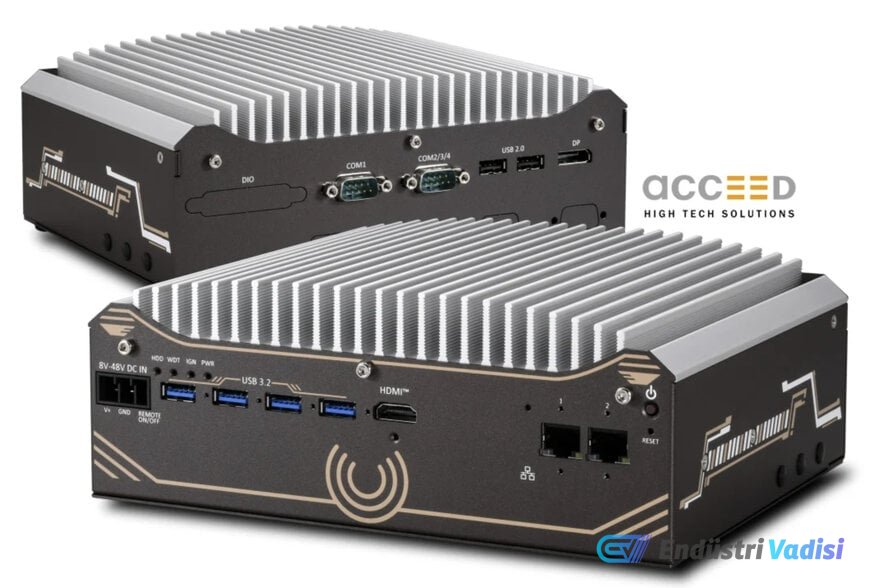
Powerful Solution for Industrial Environments
Neousys Technology and Acceed have launched the fanless Nuvo-11501 industrial box PC, designed for demanding industrial environments. Powered by Intel Core Ultra 200S processors, this platform was developed to meet edge AI inference workloads and factory automation needs.
Why is a Fanless Design Important?
In industrial environments, hardware often has to strike a balance between computing capacity and environmental resilience. Traditional high-performance systems require active cooling fans, which are susceptible to dust accumulation and mechanical stress. The Nuvo-11501 eliminates this problem through passive thermal management, enabling local data and image processing without the need for cloud connectivity in manufacturing facilities, autonomous mobile robots, and networked building infrastructures.
Technical Specifications and Performance
- Processor: Intel Core Ultra 200S (35W or 65W TDP), up to 24 processor cores with integrated NPU.
- Performance Boost: 20% CPU performance increase compared to the previous generation, up to 20% power consumption reduction in an equivalent thermal envelope.
- Cooling: Fully passive cooling architecture certified for ambient temperatures from -10 to +60 degrees Celsius.
- Durability: Reinforced external interfaces with screw-lock mechanisms (2.5 Gigabit Ethernet, USB 3.2 Gen 1) resistant to industrial vibration.
- Display Outputs: Dual display support up to 3840x2160 pixels with DisplayPort and HDMI.
- Serial Ports: One software-programmable RS-232/422/485 port and three additional RS-232 ports.
Expansion and Application Areas
The Nuvo-11501 allows for direct integration of wireless and serial modules thanks to its internal expansion slots. Two Mini-PCIe slots (with SIM card socket) and one M.2 2230 E-Key slot are suitable for Wi-Fi, 4G/5G modems, and additional COM port cards. Expandability via PCIe and MezIO modules facilitates the unit's adaptation to existing control cabinets.
Target application areas include machine vision in production control, onboard navigation for autonomous mobile robots, process monitoring, human-machine interfaces in control cabinets, and localized edge nodes for smart building systems. Offloading AI inference to the integrated NPU frees up CPU cores for real-time control tasks, increasing process stability, reducing network latency, and lowering maintenance costs in demanding industrial environments.




















