







Ahmet Ö.
Corporate
- Thread Author
- #1
In industrial drive systems, particularly in demanding sectors such as steel production and power plants, mechanical components are frequently exposed to extreme thermal stress. While standard elastomer materials rapidly degrade in such environments, high-temperature elastomer couplings provide reliable torque transmission even near heat sources like furnaces, steam plants, and turbines.
These specialized coupling systems stand out for their ability to dampen vibrations and compensate for misalignment. So, how does this technology make a difference in industrial operations?
─────────────────────────
💡 Technical Design and Operating Principle
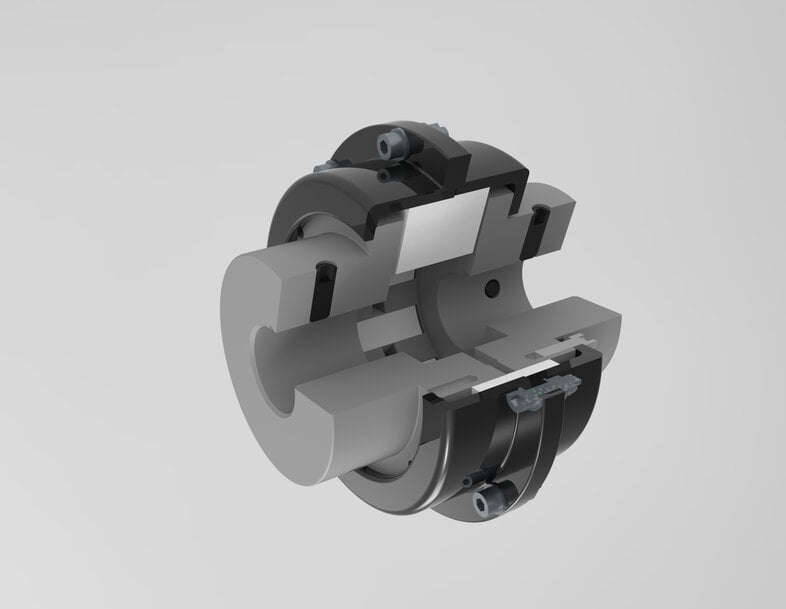
At the heart of high-temperature couplings is a special, white elastomer center element that maintains its structural integrity at continuous operating temperatures up to 177 degrees Celsius. Its mechanical architecture relies on metallic hubs with non-intermeshing, opposing teeth. This configuration isolates the metallic components from direct contact, preventing mechanical wear on the hubs during torque transmission.
Since the system operates without metal-on-metal friction, it does not require lubricating oil or grease. This eliminates routine re-lubrication intervals, reducing maintenance costs and downtime.
─────────────────────────
🛠️ Ease of Maintenance and Serviceability
Maintenance of machinery operating in high-heat environments often requires long cool-down periods for personnel to safely access the equipment. However, these couplings, thanks to their accessible central elastomer part, allow for the replacement of the functional element without needing to disassemble the entire coupling or move connected shafts.
This modular replacement capability directly reduces equipment downtime and increases overall machine availability during planned maintenance cycles.
─────────────────────────
📊 Performance Characteristics and Modularity
This coupling series supports nominal torques from 93 Nm to 601.5 kNm, while being able to handle transient torque peaks up to 1200 kNm. Bore diameters are available from 10 mm to 500 mm. For systems with different structural requirements, the modular architecture allows for bridging shaft gaps between 25 mm and 3000 mm using special spacers.
Shortened hub variants are produced for installations with restricted axial space. Additionally, hub configurations allow for the integration of secondary components such as braking mechanisms, auxiliary drives, and rotational sensors.
─────────────────────────
🔬 Additional Information: Why High-Temperature Elastomers?
While standard polyurethane or synthetic rubber elastomer couplings typically show thermal degradation limits between 80 and 90 degrees Celsius, special synthetic compounds can withstand up to approximately 120 degrees Celsius. Operating beyond these thresholds often necessitates a switch to all-metal couplings, such as gear or metallic membrane couplings.
Although all-metal couplings can handle extreme temperatures, they lack the vibration damping properties of elastomers and may require continuous lubrication. The use of specialized high-temperature elastomers fills this operational gap, offering both the damping capacity of a flexible element and the thermal resistance required for demanding industrial environments. This provides an ideal solution in terms of both performance and durability.