








Alper Aktaş
Endüstri Vadisi
- Thread Author
- #1
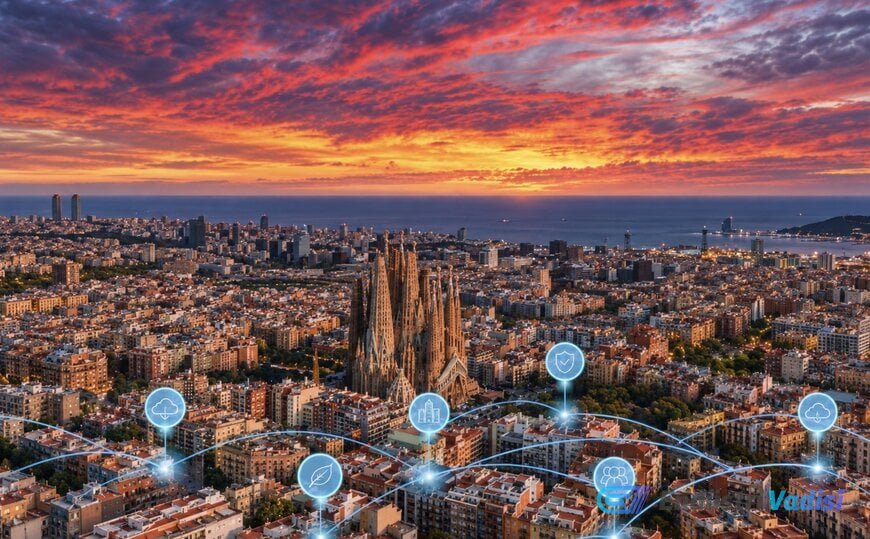
Advantech Brings AI to the Edge in Smart Cities
Advantech has introduced its next-generation edge AI platforms designed to process urban infrastructure data at the sensor level. These localized computing solutions target smart video analytics, physical security monitoring, and autonomous mobility systems.
Real-Time Data Processing and Low Latency
The company's hardware runs computer vision algorithms directly on the device to translate raw sensor data into actionable metrics. This reduces latency while minimizing continuous bandwidth dependency on centralized cloud networks.
Visual Data Analysis Powered by NVIDIA Jetson Architecture
Advantech's Video Analysis Platform (VSS) integrates the NVIDIA Jetson Thor architecture to perform visual data analysis directly at the edge for public safety applications. To support distributed AI deployments, the Next-Gen Smart CityMind platform utilizes the AFE-A702 hardware hub, which functions as a vision-language agent controller. This hub directly interfaces with the EdgeSight Sentinel system running on the AFE-R750 edge node, powered by NVIDIA Jetson AGX Orin. This setup establishes a hierarchical structure where localized field nodes relay continuous visual monitoring data and edge-inferred metadata to a central routing hub for complex scenario evaluation.
Integration for Public Transport and Traffic Analysis
In public transport applications, the technology integrates with existing CCTV cameras, avoiding the cost of full hardware replacement. Collaborating with Technis, the TREK-50N in-vehicle computing system is paired with NVIDIA Jetson Orin NX for real-time object classification and event detection on buses and trains. For traffic flow analysis, the MIC-733 computing platform processes 3D LiDAR spatial data generated by Ouster Gemini and BlueCity sensors. This configuration leverages CUDA and TensorRT acceleration to calculate measurable traffic density and speed analyses without the need for traditional optical camera tracking.
Autonomous Robots and Digital Infrastructure Scalability
Expanding digital infrastructure in public spaces, the MIC-770 and MIC-785 GPU platforms with RTX PRO 4000 Blackwell architecture support high-density video analytics applications developed by Macnica and Icetana AI. Furthermore, powerful edge computing enables localized spatial navigation for autonomous robots. By integrating the MIC-732 industrial system with an NVIDIA Jetson AGX Orin 64GB module, self-driving service robots can rapidly process multimodal sensor inputs to safely navigate dynamic, unpredictable real-world environments without requiring continuous external server connectivity.
Competition and Differentiation in Industrial Edge Computing
In the industrial edge computing market, AI inference platforms are evaluated based on their thermal operating range, ingress protection ratings, and total neural processing throughput measured in Tera Operations per Second (TOPS). Competitors such as Kontron and Axiomtek offer similar ruggedized edge gateways utilizing NVIDIA Jetson and Intel processor architectures for machine vision tasks. Differentiation among these digital infrastructure solutions is determined by the efficiency of hardware acceleration for specific deep learning frameworks, the availability of high-bandwidth I/O interfaces capable of processing multiple continuous video streams, and compliance with shock and vibration standards required for demanding transit and robotic deployments.























