







Süeda Asil
Corporate
- Thread Author
- #1
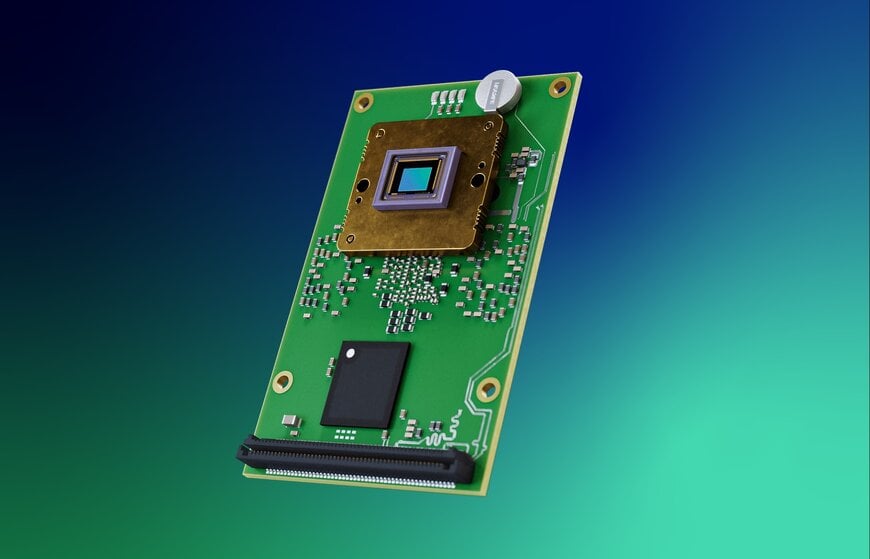
We are facing a groundbreaking development in the world of industrial automation! Vision Components has introduced a new generation of board-level camera platforms equipped with AI-powered, high-resolution image sensors. This innovative system takes integration and performance in industrial machine vision applications to a whole new level.
─────────────────────────
⚙️ VC EvoCam: All-in-One Smart Camera Solution
Vision Components' smart board-level camera, named VC EvoCam, makes embedded vision integration faster and easier than ever before, thanks to its MediaTek processor. This hardware, measuring only 65 x 40 millimeters, combines image capture and processing into a single module, eliminating the need for external processing units. It offers an ideal solution for computer vision tasks in industrial automation, robotics, and Internet of Things (IoT) architectures.
─────────────────────────
🧠 Processing Power and Hardware Interface: Intelligence at the Edge
At the heart of the system is the MediaTek Genio 510 Edge AI processor. This powerful processor features two ARM Cortex-A78 and four ARM Cortex-A55 cores, along with an ARM Mali GPU. It delivers 3.2 TOPS (Tera Operations Per Second) performance with an integrated NPU (Neural Processing Unit) for neural network workloads. The module is equipped with up to 2 GB of RAM and 16 GB of flash memory, offering expansion options via an SD 3.0 interface for extensive image data processing and storage. Running on a customized Debian Linux distribution, the system directly supports standard image processing functions.
Hardware integration is provided via a 100-pin board-to-board connector that exposes critical processor interfaces such as I/O, I²C, USB, Ethernet, Video DSI, and PCIe. The system architecture supports both internal image sensors and cable-connected remote-head configurations. Initial versions feature the Sony IMX900 image sensor with 3.2-megapixel resolution and global shutter capability.
─────────────────────────
📸 High-Resolution Global and Rolling Shutter Integration
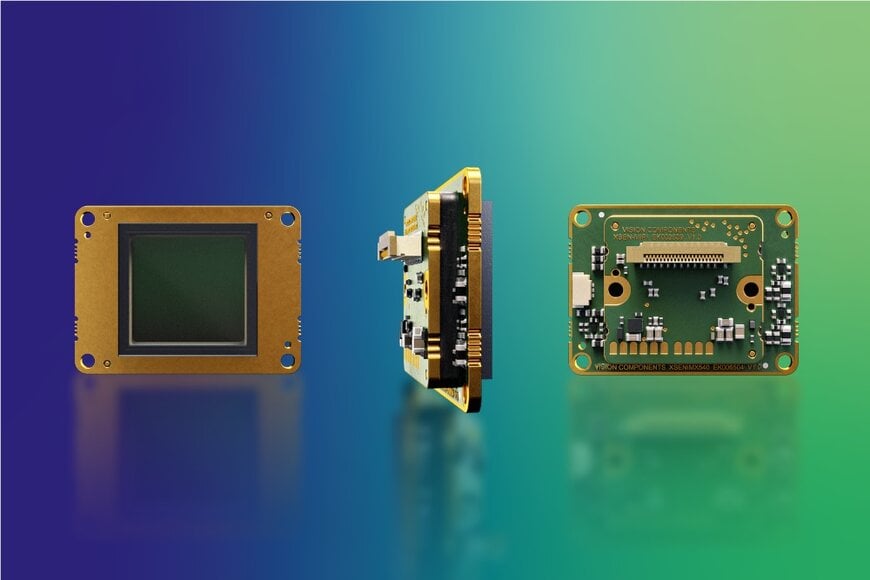
Expanding its MIPI Camera portfolio, the new MIPI IMX540 module implements a global shutter mechanism using a Sony Pregius S series sensor. Operating in a 1.2-inch format with 2.74-micrometer pixel size, the sensor achieves 24.5-megapixel resolution (5,328 x 4,608 pixels) at 22 frames per second in 8-bit mode. The precision of this architecture supports computer vision applications requiring sensitive object detection, such as humanoid robotics and complex machine vision inspection.
For applications requiring sensitivity into the near-infrared range, the MIPI AR2020 module uses the Onsemi Hyperlux LP rolling shutter sensor. This 20-megapixel module captures up to 24 frames per second at 5,120 x 3,840 pixels resolution in 10-bit capture mode. The sensor's low power consumption characteristics make it suitable for distributed edge AI and industrial IoT network deployments.
─────────────────────────
🔗 Signal Routing and Protocol Implementation
To ensure broad compatibility, Vision Components offers open-source drivers for its portfolio of over 50 image sensors. The core hardware ecosystem includes components for prototyping and serial integration, such as micro-coaxial and GMSL2 cabling. These cables can route signals up to 10 meters. Additionally, FPGA accelerators allow for hardware-level data processing within the MIPI data stream before the signal reaches the primary processor. The integration of high-performance processors and open Linux operating systems is a continuation of the industrial smart camera architecture developed by Vision Components founder Michael Engel in 1996.
─────────────────────────
📊 Technical Depth: Competition and Data Flow
The integration of the 3.2 TOPS NPU in the MediaTek Genio 510 positions the system competitively in the mid-range edge AI computing segment. Comparable embedded vision processors, such as the NXP i.MX8M Plus, typically offer around 2.3 TOPS of performance, while higher-end modules like the Rockchip RK3588 can reach up to 6 TOPS. Running a 24.5-megapixel sensor at 22 frames per second requires a significant data flow of approximately 538 megapixels per second. This necessitates a highly optimized use of the MIPI CSI-2 4-lane interface, whose theoretical bandwidth is about 10 gigabits/second. Effectively managing this data volume at the edge, relying on the integrated processing pipeline and NPU to perform localized inference tasks, prevents transmission bottlenecks in industrial vision networks.