








Elif Özaksu
Corporate
- Thread Author
- #1
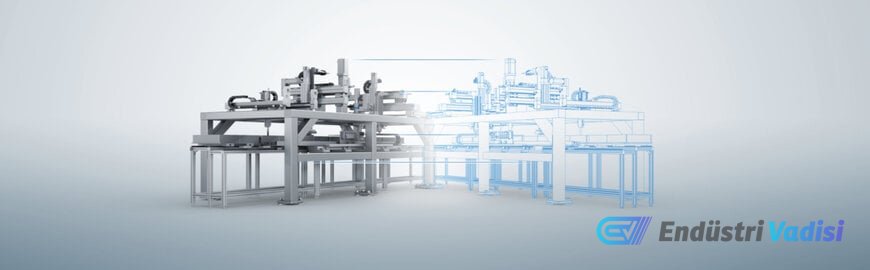
🛠️ Bridging the Simulation-Reality Gap in Virtual Commissioning
Commissioning complex industrial systems requires extensive validation before physical installation. Festo, NVIDIA, and ABB Robotics are developing physics-based digital twins by integrating NVIDIA Isaac Sim, Omniverse libraries, and ABB RobotStudio to accelerate this process. This collaboration aims to resolve machine integration errors in a virtual environment.
🔍 Physics-Based Simulation Architecture and OpenUSD Integration
Traditional CAD models often capture static 3D geometries but do not accurately reflect dynamic motion profiles or real-world mechanical compliance. Festo's simulation architecture extends existing Universal Scene Description (USD) data exports with dynamic motion behaviors and physical properties. USD-based models within the NVIDIA Omniverse ecosystem include kinematic chains, mass properties, and dynamic response characteristics.
Festo uses NVIDIA Isaac Sim to train and validate robotic perception and autonomous control algorithms. To ensure the accuracy of virtual components, a closed-loop validation workflow is implemented that compares simulated outputs with empirical test data. This calibrates digital twin parameters until the virtual model accurately reproduces real-world component physics.
🤝 Multi-Vendor Co-Simulation: Three-Axis Handling and Robotics
A significant industrial application of this architecture is a joint virtual handling cell developed by Festo, ABB Robotics, and NVIDIA. In factory automation, the integration of linear gantry or Cartesian handling units with articulated industrial robots creates challenges such as timing, workspace interaction, and controller synchronization.
To validate these multi-vendor workflows before hardware procurement, the partners connected a digital twin of a Festo three-axis handling system with an articulated robot within ABB RobotStudio. The system architecture uses the RobotStudio HyperReality extension, which combines ABB's offline programming environment with NVIDIA Omniverse libraries. Concurrently, the ABB Virtual Controller executes control software and robot programs that run on physical ABB controllers.
By running Festo three-axis handling kinematics and the ABB Virtual Controller in this combined simulation environment, machine builders can optimize cycle times, validate collision-free trajectories, and virtually debug PLC-to-robot communication protocols. This collaborative engineering approach enhances virtual commissioning for machine builders and supports the deployment of industrial-grade Physical AI.
🌍 Enterprise Scale and Scope of Industrial Application
Festo is developing these digital models to support its global customer base across more than 35 factory and process automation industries, including new LifeTech applications in medical technology and laboratory automation. Headquartered in Germany, Festo supplies pneumatic and electric automation technology to 300,000 customers in 176 countries. The company invests over 8% of its annual turnover in research and development and 1.5% in basic and advanced technical education supported by Festo Didactic SE.





















