








Alper Aktaş
Endüstri Vadisi
- Thread Author
- #1
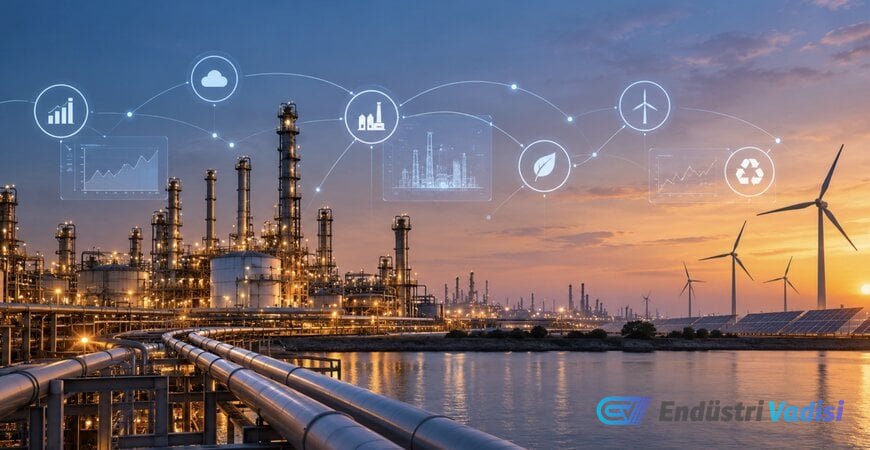
Digital Transformation Winds in the Energy Sector
The energy sector continues its rapid digitalization efforts to enhance operational efficiency, strengthen grid resilience, and achieve carbon emission targets. At the heart of this transformation are industrial intelligence platforms that integrate engineering, operational, and enterprise data. These platforms enable oil, gas, and renewable energy operators to manage complex systems and track emissions throughout the asset lifecycle.
Data Integration and Decarbonization Goals
While the Middle East plays a significant role in global oil production, it is also actively pursuing large-scale emission reduction targets. For instance, there is a goal to reduce emissions by 47% by 2035 compared to 2019 levels. The United Arab Emirates, in alignment with its 2050 net-zero targets, has committed to tripling its renewable energy capacity by 2030 and investing up to AED 200 billion towards this goal. To achieve these ambitious production and sustainability targets, continuous monitoring of industrial environments, prevention of unplanned downtime, and elimination of data blind spots are critically important. The consolidation of raw data and the embedding of intelligence within energy systems are indispensable for maintaining energy resilience, affordability, and operational scalability.
System Architecture and Predictive Asset Optimization
Platforms that serve as a data architecture for the design, construction, operation, and optimization phases of industrial assets demonstrate integration with industrial workflows through data-centric engineering, digital twin foundations, and AI-powered asset health monitoring. Operators can integrate their own large language models with industrial data. Furthermore, software modules such as Unified Supply Chain, Process Optimization, and Predictive Asset Optimization allow operators to run "what-if" scenarios and predict mechanical or process issues across the value chain.
Digital Twin Applications and Telemetry Analysis
These systems are used to derive operational value from localized industrial data. The concept of a "living digital twin," which creates a 360-degree view of a plant's energy consumption and emissions by combining engineering and operational data, is also supported through these platforms. High-speed data management, data visualization, and performance analysis capabilities are also utilized in high-frequency environments such as motorsports. For example, for the Porsche Motorsport Formula E team, it processed race and vehicle telemetry, playing a significant role in the 2025/26 Drivers' and Manufacturers' World Championship titles.
Competition in the Industrial Data Ecosystem
In the industrial data ecosystem, such platforms compete with other enterprise-level industrial IoT and data integration platforms. Competitive benchmarking in this sector typically evaluates high-frequency time-series data ingestion capacity (measured in millions of data points or "tags" per second), the breadth of industrial protocol support (such as OPC UA, MQTT, and Modbus), and the ability to transform unstructured data into relational knowledge graphs. Some platforms focus on DataOps and contextualization for heavy asset industries, while others emphasize real-time operational data management, historical data storage capabilities, and native integration with engineering and process simulation environments.





















