








Semih Asil
Industry Valley
- Thread Author
- #1
💡 AI Integration in Manufacturing Redefined
As manufacturers continue to adopt AI agents, Cognizant has launched a platform that combines physical systems and agency-based AI into a single package, while also featuring governance capabilities. This innovation emerges as a physical AI platform as a service, built upon the "Intelligence Spine," aiming to bring together the AI agents companies use in their operations.
🧠 A Platform Operating Like a "Central Nervous System"
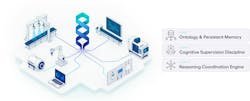
Cognizant describes its platform as a sovereign enterprise PaaS for physical AI. It integrates physical AI systems with agency-based AI into a single system by combining physical factory elements such as sensors, cameras, robots, and AI twins with a reasoning and acting agency layer. Vijay Narayan, Cognizant's Global Head of Physical AI and Manufacturing, Logistics, Energy, and Utilities Business Unit, explains this system as "think of it as a 'central nervous system' that permeates multiple physical assets, can sense, reason, act, and learn as a single entity."
🌍 Caters to a Wide Range of Industries
This platform is designed to be used across eight different industries, including manufacturing, oil and gas, utilities, logistics, transportation, aerospace and defense, healthcare and life sciences, consumer, retail, and packaged consumer goods.
🧩 Solution to the "Intelligence in Pockets" Problem
Narayan states that in manufacturing environments, physical AI systems collect data but do not share this intelligence with each other. Calling this "intelligence in pockets," Narayan emphasizes that this makes it difficult for manufacturers to scale AI. Cognizant's platform aims to solve this problem by bringing together AI agents produced by different companies and used for different functions.
🚗 Application Examples in Automotive and Semiconductor Sectors
- Automotive: It can combine different physical agents such as computer vision systems, automated guided vehicles, and humanoid robots produced by different OEMs and operating in the same factory. For example, while windshields are assembled by physical AI agents on an assembly line, a separate inspection line agent might not be aware of what's happening on the assembly line. Cognizant's platform can create a cohesive intelligence system that operates these fragmented OEMs as a single AI.
- Semiconductors: The platform is also used in semiconductor manufacturing facilities where humanoid robots work alongside human workers. These humanoid robots can take safety precautions, maintain human spatial awareness, and monitor thousands of sensors. They can also provide advice to human workers and intervene on the assembly line.
🔒 Governance Features and Cybersecurity
The platform has features that enable businesses to maintain security while combining different AI platforms. Enterprise memory stores information from different agents, while the context-aware engine ensures that no action or reasoning occurs outside the enterprise context. These features allow for a smarter implementation of cybersecurity. As manufacturers continue to be the primary target of ransomware attacks, such security measures are of great importance.
The platform also allows the same ethical constitution to be applied across all fragmented agents. Samih Fadli, Cognizant's Chief AI Officer, says, "We didn't change cybersecurity. We did something that will unlock the potential of cybersecurity." The platform's governance model allows an enterprise to upload its ethical constitution, and all physical AI models operate in accordance with this constitution. Furthermore, by keeping audit trails of every decision in a ledger, it makes it possible to retrospectively trace agent decisions if an incident occurs.























