







Cengiz Özemli
Academic
- Thread Author
- #1

🤔 Manufacturers' Common Question: How to Use AI in the Factory?
Every manufacturer today is asking the same question: How can we use AI in a factory setting? It's a perfectly valid question, and many businesses have already started using AI in their daily work (data export, asking questions, writing code, etc.) beyond just writing emails.
But there's a limit, and factories are reaching it faster than expected. The problem isn't with AI itself, but with the data available for the technology to work.
📉 Limitations of the Current Approach
Let's take the best-case scenario: your company has an enterprise agreement, so your data isn't being fed into a public model. While this solves the security issue, it doesn't solve everything.
When an engineer uses ChatGPT or Copilot to analyze process data, they are still working with exported data. They pull the data into a spreadsheet, paste it into the tool, and ask why yield is down. The tool provides a reasonable, perhaps even helpful, answer.
But when you ask the same question two days later, you're starting from scratch. There's no memory of your factory, your process, your tags, or any context from the previous conversation. Each session is a blank slate, the same process repeated from the beginning.
Data recency is another issue. When you export, clean, and paste data, you're working with a snapshot. This can tell you what happened, but not what's happening right now.
Moreover, many companies don't have such an enterprise agreement. Engineers using free or personal accounts often don't realize that data sent through consumer versions can be used for model training and reviewed by the provider.
For a factory dealing with proprietary process data or any data with regulatory sensitivity, this is a serious risk, and compliance teams often realize it too late.
None of this means these tools don't have a place. They do what they were built for. They just weren't built for this job.
💡 What the Factory Environment Expects from AI
Factories that are getting real results from industrial AI aren't using better prompts. They have a completely different setup.
- Live Data Connections: What enables successful use cases are live connections to the historian, not exports. The AI reads current data, meaning it can answer questions about what's happening now, rather than two hours ago or last Tuesday.
- Factory Knowledge: These setups know their factory, from tag names to units to the asset framework. This context is loaded once and persists with every question. You stop explaining your process over and over and just start asking questions.
- Verifiable Answers: Every answer references the actual data or document it came from. In a factory setting, you need to be able to verify what you're acting on. An AI that sounds confident but can't show its work has no place near an operator's screen.
Achieving this is about having the data infrastructure that makes it all possible.
🚧 The Current State of Most Factories
Unfortunately, many manufacturers currently trying to actively implement AI are not yet fully ready for it.
A commonly used framework for thinking about digital maturity in manufacturing divides readiness into five stages:
- Stage 1: Essentially no meaningful data collection.
- Stage 5: A fully unified platform with no data silos and proactive, real-time decision-making across the organization.
The minimum threshold for AI to work reliably is Stage 4. This is where data is widely accessible, people are using it to make decisions daily, and the organization has developed real habits around treating data as part of operations, not just an occasional reference point.
Most factories currently pursuing AI projects are in Stage 3. They have a historian. Engineers can review past performance. But silos still exist, tag naming is inconsistent, and half the organization doesn't look at data unless something goes wrong.
Trying to run AI on a Stage 3 foundation tends to produce unreliable outputs, low adoption, and a general feeling that the technology doesn't work. In fact, it does work. It just needed a better starting point.
✅ What Does It Mean to Be AI-Ready?
Reaching Stage 4 doesn't require an AI initiative. It requires doing five fundamental things right:
- A Performant Historian: High-speed data collection, gapless, store-and-forward so nothing is lost during network outages. Platforms like dataPARC or other Industrial Historians can give you what you need if configured and maintained correctly.
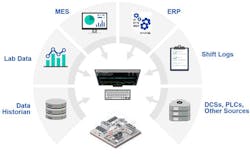
- Data in One Place: Lab data in a LIMS, production data in an MES, process data in the historian—none of it connected. This is the norm in many factories and makes unified AI analysis impossible. A single environment where these sources come together changes the game.
- Tag Quality: This is often an overlooked topic. Consistent naming, useful metadata, and an asset hierarchy that matches how your factory is organized. Without this layer, AI can pull data but can't interpret what it means.
- Governance: Who can access what, and is there a record of how data is used? Role-based access and audit trails aren't just IT concerns. They are what make AI answers defensible and actionable.
- Open Integration: Factories built around OPC UA, REST APIs, and SQL connectors can plug in new tools without a months-long integration project every time. Proprietary, closed systems cannot.
Do these five right, and being AI-ready will be a byproduct, not a separate goal.
❓ A Few Questions to Determine Your Data Foundation
Before looking at an industrial AI tool, a few questions to ask to ensure your data foundation is ready:
- Can your team pull process data on their own, or do they wait for an export? If they're waiting, that's the first problem to solve.
- Would a new person understand your tag names without an explanation? Inconsistent tagging is the fastest way to outputs no one trusts.
- Do your data systems talk to each other, or does each live in its own world? Partial data means partial answers.
- Are your people already using data to make decisions, or is it mostly looked at after something goes wrong? AI reinforces existing culture. It doesn't build a culture from scratch.
💪 Data Is the Hard Part
One version of the AI in manufacturing conversation treats the technology itself as a breakthrough. Get the right tool and improve everything. This framework keeps many vendors employed and leads to many frustrated factory managers.
Factories that are getting value from industrial AI aren't special because they found better software. They got there because their data was clean, their systems were connected, and their people already had a habit of using data to make decisions.
AI stepped into an environment that was ready for it.
Building that foundation takes longer than buying a piece of software. But it's the only thing that makes the software worth buying. Start there, and the AI question becomes much easier to answer.