





Erkan Teskancan
Corporate
- Thread Author
- #1
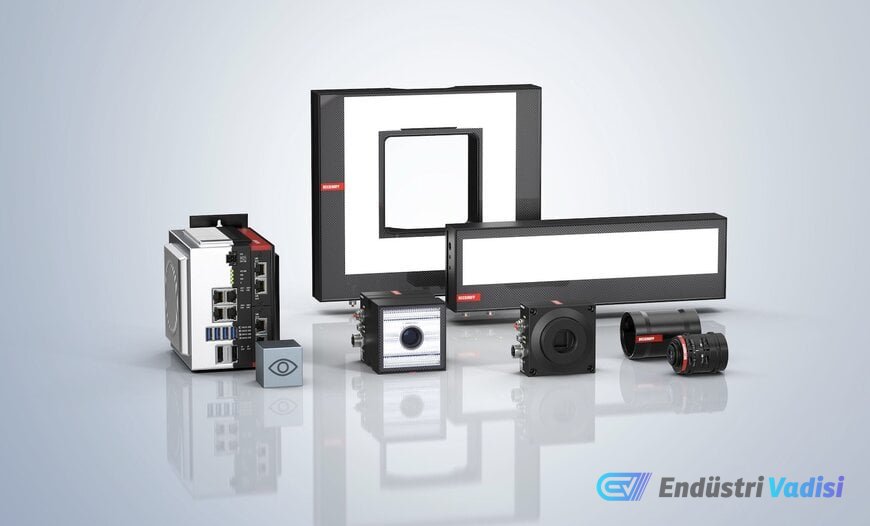
Beckhoff is expanding its automation portfolio with TwinCAT Vision, integrating machine vision algorithms directly into the programmable logic controller (PLC) environment. This innovative architecture enables applications such as quality assurance, tracking, and adaptive process control to operate synchronously with motion and robotics in the manufacturing and logistics sectors.
⚡ End to Latency and Hardware Interfaces!
Traditionally, machine vision operates using separate controllers, which leads to latency. Beckhoff eliminates this problem by executing image processing algorithms in the same real-time environment and task cycles as the PLC, motion control, and robotic logic. Eliminating the external vision controller ensures that the system exhibits synchronized processing and strictly deterministic behavior. Thanks to the distributed clock function of the EtherCAT network protocol, camera image acquisition, lighting triggers, and machine kinematics can be synchronized with microsecond precision.
⚙️ Hardware Components and Network Integration
The vision hardware is based on EtherCAT-compatible VCS2000 series line scan cameras with IP65/67 ratings for industrial environments. These cameras use monochrome and color Sony CMOS sensors, offering resolutions up to 24 megapixels and a transmission speed of 2.5 Gbit/s. The hardware ecosystem includes robust C-mount lenses with anti-reflective coatings for visual (VIS) and near-infrared (NIR).
To simplify installation, Beckhoff uses EtherCAT P technology, which transmits both data and power over a single cascaded cable. For instant integration, the Vision Unit Illuminated (VUI) offers an all-in-one assembly that includes the camera, LED illumination, and electronically focusable optics.
🧠 Algorithm Processing and Machine Learning
From a software perspective, the architecture remains open to third-party GigE Vision cameras. The TwinCAT 3 Vision Base library performs operations such as algebraic image processing, Fourier analysis, color processing, and contour/blob analysis. For advanced object classification, TwinCAT 3 Vision Matching 2D adds template matching and keypoint detection.
Furthermore, the system bridges to data-driven production by seamlessly integrating data recording with TwinCAT Analytics and TwinCAT 3 Machine Learning. This integration allows trained neural networks to run directly in the PLC runtime at application clock speed, enabling end-to-end processes from image acquisition to AI-powered quality control and predictive maintenance.
This comprehensive vision portfolio will be showcased at the VISION fair in Stuttgart from October 6-8, 2026.
🔍 Technical Details and Comparative Analysis
The integration of machine vision directly into the PLC runtime represents a structural shift in industrial automation, driven by the need to reduce network latency. Comparable systems include B&R Industrial Automation's Integrated Machine Vision.
A primary criterion for these integrated systems is deterministic synchronization between the camera trigger, illumination flash, and the position of a moving robot axis or conveyor. Traditional setups, by routing GigE Vision data to a separate industrial PC and sending OK/NOK signals over standard Ethernet, often introduce jitter at the millisecond level, limiting maximum conveyor speeds. Beckhoff's TwinCAT Vision uses the EtherCAT distributed clock to achieve microsecond-level synchronization, placing it in direct structural parity with B&R, which uses the POWERLINK protocol for the same deterministic, microsecond-level synchronization. By avoiding external gateways and processing image matrices directly within the IEC 61131-3 logic environment, both platforms offer objective, measurable improvements in high-speed sorting and adaptive robotic guidance compared to independent smart cameras.