








Ahmet Ö.
Corporate
- Thread Author
- #1
Advanced semiconductor giant AMD, in collaboration with engineering partners such as Foundation Robotics, Robotec.ai, and Avnet, has developed an integrated hardware and software framework designed to directly execute real-time physical AI workloads on autonomous robotic platforms. This collaboration aims to eliminate computational bottlenecks arising from running complex tasks like multi-modal sensing, motion planning, and semantic navigation on power-constrained edge hardware.
🛠️ Technical Framework and Responsibility Distribution
The implementation of physical AI requires tight synchronization between low-latency actuation control, computer vision inference, and high-level behavioral planning. To overcome this challenge, the partners deployed heterogeneous computing hardware combining central processing units (CPUs), graphics processing units (GPUs), and neural processing units (NPUs) on unified embedded platforms. AMD, within this framework, provided the foundational processing architectures, specifically embedded processors and developer platforms configured for standard Robot Operating System (ROS 2 Jazzy) support.
Specialized partner organizations implemented domain-specific robotic stacks:
- Foundation Robotics: Integrated full-body humanoid control systems into an embedded processing unit, coordinating bipedal locomotion and dual-arm manipulation on a single real-time platform.
- Robotec.ai: Designed an open simulation pipeline configured to run directly on compact hardware, enabling seamless policy transfer from simulated environments to physical actuators.
- Avnet: Developed edge control applications for bipedal systems, driving real-time sensor processing, gesture-based control, and voice recognition through integrated GPU and NPU hardware pipelines.
⚙️ System Integration and Application Parameters
This collaborative implementation adopts the principle of using zero proprietary middleware. Native ROS 2 interfaces are utilized to ensure deterministic data routing between distributed robotic nodes.
In semantic navigation use cases, the system directly integrates command-driven foundational segmentation models with the ROS 2 navigation stack (Nav2). Software running natively on compact computing nodes identifies arbitrary obstacle classes and distinguishes varying ground surfaces in indoor and outdoor industrial environments without prior model fine-tuning. For autonomous manipulation workflows, a mobile manipulator pairs embedded heterogeneous hardware with standardized ROS 2 communication data buses, performing real-time object classification, inverse kinematics, and grasp execution without remote offloading.
🏭 Industrial Applications and Operational Impact
Targeted deployment areas include logistics automation, industrial assembly, and hazardous material inspection. By integrating multi-axis motion planning, perception algorithms, and spatial reasoning into edge-level silicon, this architecture eliminates the latency penalties associated with cloud-dependent decision loops. This structural approach enhances process stability, maintains operational determinism in communication-deprived environments, and simplifies hardware integration for autonomous mobile robots and humanoids.
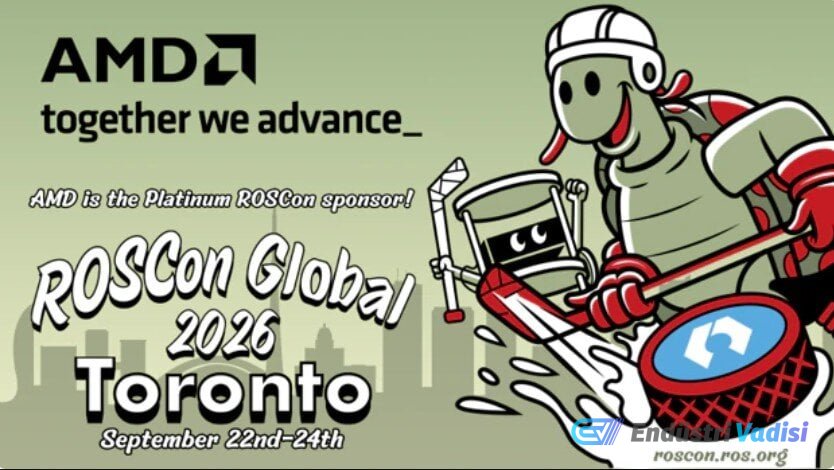
Technical demonstrations and end-to-end cloud-to-robot training workflows were presented at ROSCon 2026, held from September 22-24, 2026, at the Sheraton Centre Toronto in Toronto, Canada.





















