






Cengiz Özemli
Academic
- Thread Author
- #1
🚀 A New Era in Manufacturing Automation
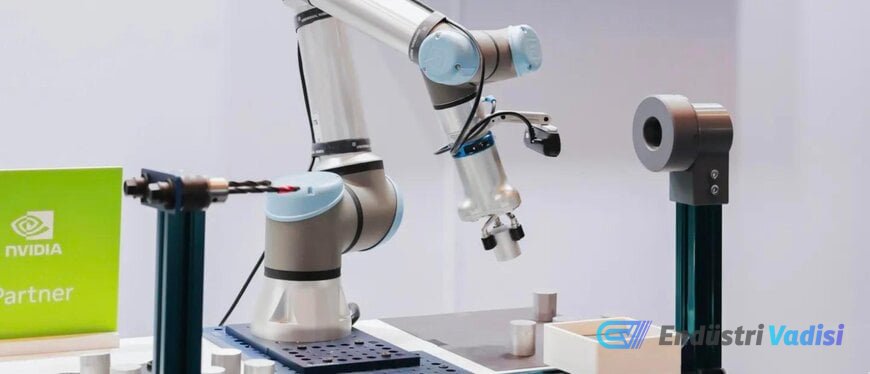
Universal Robots and NVIDIA have forged a groundbreaking collaboration in the field of industrial automation. This partnership aims to integrate GPU-accelerated perception and motion planning software with industrial collaborative robot hardware, enabling the deployment of real-time AI applications in manufacturing environments.
⚙️ Challenges and Solutions in AI-Powered Robotics
Robotics development processes often rely on tools like the open-source Robot Operating System (ROS). However, transitioning from virtual simulations to physical industrial deployment presents significant engineering challenges. Combining high-throughput neural network inference with physical actuators requires real-time motion execution, standard communication protocols, and certified safety architectures. To bridge this integration gap, pairing hardware-accelerated computing modules directly with open industrial robot controller interfaces is critically important.
🛠️ System Architecture and Technical Details
The technical architecture of this collaboration combines NVIDIA's edge computing and perception libraries with Universal Robots' mechanical manipulators and controller interfaces.
- NVIDIA's Contributions: The Isaac ROS software suite includes GPU-accelerated ROS 2 packages validated on Jetson edge hardware. Key modules include FoundationStereo for depth estimation, FoundationPose for six-degree-of-freedom object pose tracking, and cuMotion for GPU-accelerated collision-free trajectory generation.
- Universal Robots' Contributions: Six-axis collaborative robot platforms are offered, featuring TÜV-certified safety systems, official ROS and ROS 2 drivers, and the Universal Robots AI Accelerator software development kit. The hardware provides real-time telemetry, joint positions, force-torque data, and kinematic states through open interfaces such as Real-Time Data Exchange, XML-RPC, TCP/IP, a C++ client library, and native ROS 2 communication embedded in URScript on PolyScope X.
Andrew Pether, Head of AI Partnerships at Teradyne Robotics AI Group, explains the rationale behind this architecture: "Isaac ROS allows us to bring perception and AI-based solutions to market much faster than building them from scratch. Components like FoundationStereo, FoundationPose, and cuMotion, already validated by NVIDIA on Jetson, address the variability of a real robot workspace, so our engineering effort focuses on the application itself rather than the perception and motion planning layers."
🏭 Manufacturing Integration and Operational Impact
In manufacturing deployments, the perception and planning pipeline runs locally on a single NVIDIA Jetson edge computer placed next to the robot work cell, communicating with the robot controller via standard ROS 2 interfaces. The direct integration of ROS 2 messaging into URScript allows native robot programs to receive real-time pose estimates and dynamically planned trajectories at runtime. This runtime bridge enables automation integrators to deploy advanced machine vision and motion planning capabilities within standard robot programming workflows, without requiring low-level ROS 2 software engineering.
Combining GPU-accelerated spatial perception with deterministic industrial controllers enables robotic manipulators to locate, grasp, and process parts presented in variable orientations. This eliminates the need for rigid mechanical part presentation fixtures, reduces cell tooling costs, shortens changeover times for high-mix production, and provides a scalable, safety-certified path from simulation to mass production in vision-guided manipulation and autonomous assembly workflows.