





Hasan S. Cemkan
Corporate
- Thread Author
- #1
🤖 Revolutionary Platform Unites Physical and Agent AI
With the proliferation of AI agents in industries, one company is offering a new solution that aims to unify physical systems and agent AI into a single, sovereign platform.
🧠 Cognizant's "Intelligence Spine"
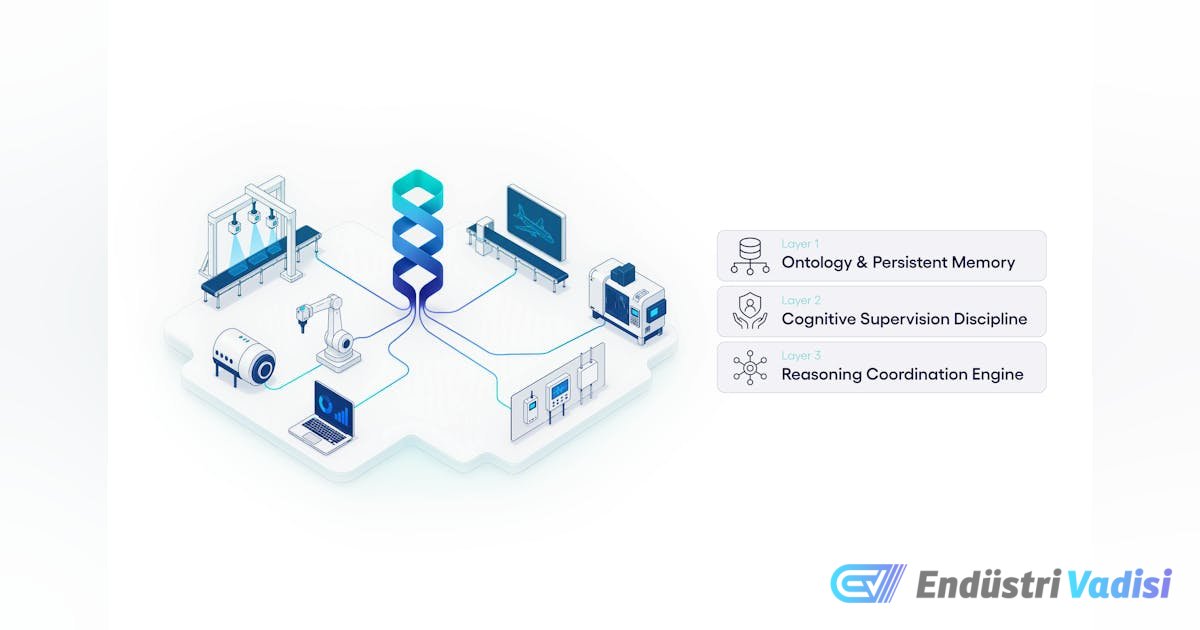
In June, AI and technology services provider Cognizant launched its physical AI platform as a service, built on what it calls the "Intelligence Spine." Company leaders describe this spine as a sovereign enterprise AI platform for physical AI. This platform integrates physical factory elements such as sensors, cameras, robots, and AI twins with an agent layer that reasons and acts, transforming physical AI systems into a single, integrated system with agent AI.
"Think of it as a central nervous system that is pervasive across multiple physical assets and can perceive, reason, act, and learn as one entity," says Vijay Narayan, Cognizant's global head of physical AI. Narayan states that this abstract layer makes physical assets more intelligent.
🧩 Solving the Problem of "Intelligence in Pockets"
In manufacturing environments, physical AI systems collect data about the physical environment but do not share this intelligence with each other. Narayan calls this "intelligence in pockets" and notes that it makes it difficult for manufacturers to scale their AI. For example, a manufacturer might use physical AI agents produced by different companies for different functions. The platform was developed to solve this problem.
"Unless we find a way to make all of these [agents] think as one entity, it's hard to scale that enterprise-wide across plants, assembly lines, and shops," Narayan says. "Everyone is collecting information about the same physical environment, but they don't have a complete view of what's going on. That was the problem we were trying to solve, and that was the genesis of what we created."
According to Cognizant, the platform can be used across eight sectors, including utilities, oil and gas, manufacturing, logistics, transportation, aerospace and defense, healthcare and life sciences, and consumer, retail, and packaged goods.
🔒 Central Nervous System for Cybersecurity
The platform features capabilities that work together to unify systems while maintaining security for businesses. For example, the spine has an enterprise memory to store information from different agents. It also has a context-aware engine, meaning that any action or reasoning does not occur outside the context of the business, creating unified reasoning across platforms.
These features and others allow businesses to implement cybersecurity more intelligently. The spine also enables users to apply the same ethical constitution to all fragmented agents.
"We didn't replace cybersecurity. We did something that will unlock the potential of cybersecurity," says Samih Fadli, Cognizant's chief AI officer. The spine has a governance model, which means a user can upload an enterprise's ethical constitution, and all physical AI models will operate according to it. This includes topics such as when external intervention is required and what actions are prohibited.
"Everyone can create one policy, and that can propagate across the entire fragmented system," Fadli says. It also keeps audit trails of every decision in a ledger, allowing users to trace agent decisions retrospectively if an incident occurs.
"Every time a system reasons in our infrastructure, a ledger is created in a blockchain, and if a model tries to do something against the [enterprise's] constitution, because it's an integrated blockchain, the ledger can prevent it," Fadli adds.
🚗 Case Study: OEMs and Assembly Lines
One example of systems the spine can unify are physical agents produced by different OEMs working in the same factory; for instance, computer vision systems, automated guided vehicles, and humanoid robots.
While not yet widely available, it is currently being implemented with a handful of manufacturers, utilities, and automotive companies, and Cognizant is in advanced discussions with others. For example, an automotive company using the spine has fragmented AI across its assembly lines, all produced by different OEMs. Windshields are being assembled on one assembly line, but the separate inspection line is unaware of what's happening on the assembly line because the agents are produced by different companies.
"What you'll see here is we're going to go from manual manufacturing to a fully robotic AMR system. In that system, you have multiple OEMs with different OEM sensors," Fadli says. The spine can then create a "fully functional, coherent system of intelligence" where all these fragmented OEMs operate as a single AI connected by the spine.
"When you have all this intelligence in the same environment, it can create correlations that nobody thought of," Fadli adds.