








Süeda Asil
Corporate
- Thread Author
- #1
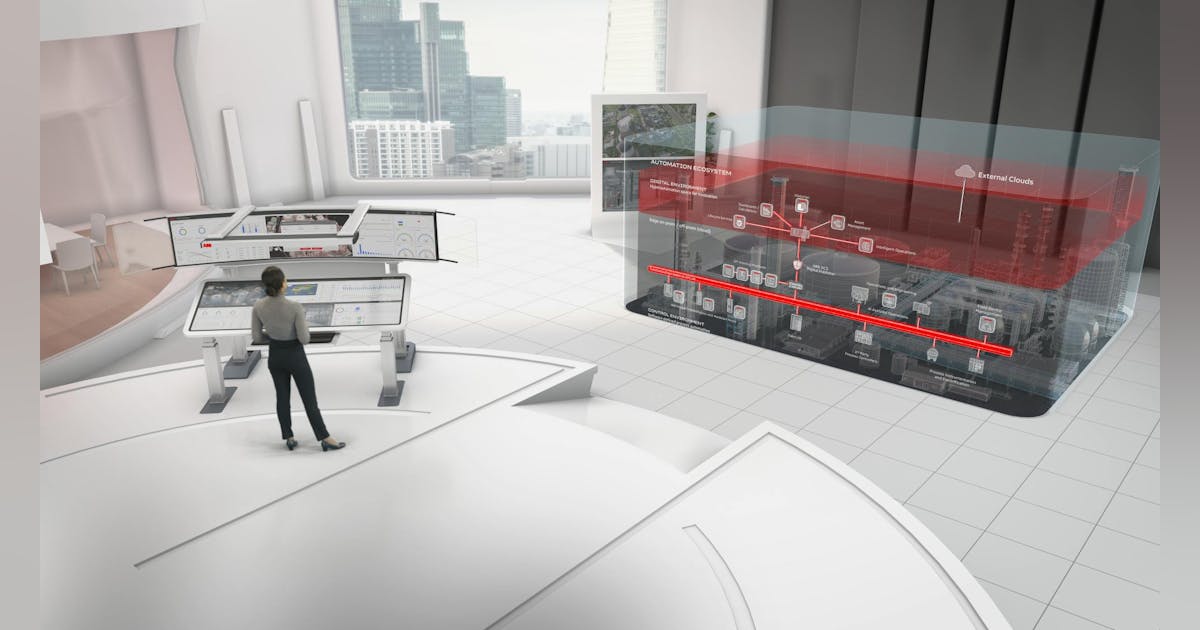
Industrial facilities, despite the countless opportunities offered by new digital hardware and software technologies, face a significant dilemma: How will they manage and maintain their existing automation systems, which have proven reliable for years, while simultaneously digitally transforming their operations? In this transformation, the use of artificial intelligence (AI) and advanced analytics plays a critical role, while increasing cybersecurity requirements cannot be ignored.
─────────────────────────
⚙️ The Secret to Seamless Transformation: The Two-Environment Approach
Is it possible to overcome all these challenges without disrupting production or completely replacing the existing infrastructure? This is precisely where ABB's new Automation Extended program comes into play. ABB describes this program as "a new approach to automation." Its goal is to address concerns about advancing industrial operations without interfering with existing systems. It achieves this by creating two separate environments: one for stable, real-time process control, and the other for more flexible and evolving digital capabilities. Both environments are securely integrated.
─────────────────────────
🎙️ Expert Opinion: Interview with Stefan Basenach
To better understand this innovative approach, we met with Stefan Basenach (SB), ABB's senior vice president of automation technologies. Basenach explained to us what Automation Extended is and how this new technology ecosystem works in practice.
─────────────────────────
📊 A Big Step for Legacy Systems
Automation World (AW): Automation Extended is described as an evolution of ABB's distributed control systems (DCS). What makes this important for industries currently using older distributed control systems?
SB: Automation Extended is the first step of our Automation Vision technical report, which we published four years ago and described our vision for future automation systems. With ABB's large active user base, we work in close collaboration with our customers, discussing how they will effectively operate their plants for decades, while also maintaining continuous innovation. The area of innovation is becoming increasingly important because our customers are facing new challenges in the market. Combining these two capabilities in a single architecture is the primary goal of Automation Extended.
Automation Extended provides a way to create a secure connection point between the digital and core control environments. For example, a new setpoint developed by artificial intelligence (AI) can be securely transferred to the core control system to improve the algorithm of the core control loop, without changing the control loop itself.
─────────────────────────
🔒 Separation of Control and Digital Environments
AW: The automation ecosystem in Automation Extended involves a separation between the control environment and the digital environment. Can you explain these two separate environments and why this architectural choice is critical in terms of what problems it solves compared to traditional DCS architectures?
SB: Automation Extended redefines the decentralized control system architecture. We understood from our customers that stable and reliable core control is crucial, but at the same time, they need to innovate on the digital side. That's why we came up with the idea of creating an ecosystem where these two environments coexist, connected by a well-defined, interoperable, but also secure interconnection. We use the NAMUR Open Architecture standard for this connection, which guarantees that the core control is always protected. This way, no application, service, or intervention from the digital environment can harm the reliable core control part. This is a simple step, but it represents a fundamental difference for Automation Extended: combining these two environments with consistent lifecycle management. Although these environments are separate, they are managed from a single holistic platform; both are treated like a distributed control system with a single management portal. This is what makes a big difference for the end-user.
─────────────────────────
📈 Incremental Deployment of Digital Capabilities
AW: To clarify the digital environment capabilities in Automation Extended, I understand that it allows the use of functions such as AI-powered condition monitoring, predictive maintenance, alarm management, augmented operator decision support, and remote operations without affecting core control functions. Can you explain how this works and how a company can incrementally deploy such functions, as each of these advanced capabilities is still relatively new for many industrial companies?
SB: The digital applications used in Automation Extended have been around for decades and were typically implemented by creating a two-way communication. This meant that you always had to touch the core control to connect a digital application at the edge. But this could be very difficult and had the potential to lead to errors; it was also not secure. What we are now changing with Automation Extended's core control and digital environments is that we are uniting them through NAMUR Open Architecture-approved connection points. This means you can plug in any digital application that supports this standard and use the existing connection that is part of Automation Extended. This means that two-way communication exchange is no longer necessary, and you can always be sure that your digital application cannot harm the core control. You don't need to touch the core control, and you can always manage digital applications through the management portal. You can turn them on and off, download patches, and add additional features without disturbing the core control environment. That's the key point.
- Automation Extended's centralized lifecycle management allows you to download patches to different devices connected to the system – even devices like smart field instruments in the field – when needed.
─────────────────────────
✅ Reliability and Continuity
AW: Just to clarify, by leaving the core control functions as they are and layering digital applications on top of them, are you saying that you can ensure the reliability and continuity of the core control functions?
SB: Yes, and we did this by following customer demands, because core control is an automation logic that has remained unchanged in their operations for decades. Although some companies have implemented more automation than others, in both cases, the control loops have largely remained unchanged, because this is not something you want to disturb. With Automation Extended, you don't have to do that. For example, Automation Extended provides a way to create a secure connection point between the digital and core control environments; where a new setpoint developed by artificial intelligence (AI) can be securely transferred to the core control system to improve the algorithm of the core control loop, without changing the control loop itself. In this process, humans remain a critical part of the loop and must approve the algorithm change before it is applied.
─────────────────────────
🔄 Preserving Existing Infrastructure
AW: Since most industrial companies have decades of automation investments, can you explain how Automation Extended allows them to update their control systems without having to completely replace their existing architectures?
SB: With our ABB Ability™ System 800xA® distributed control system, the operator is always responsible for how the control system is manipulated. Since System 800xA has long served as an integration platform, connection services are already built into 800xA and can even be used with our older control systems. Now we are taking the next step: bringing 800xA operations down to the core control layer and creating a shell around this core control that provides connectivity to the digital environment. With our latest long-term release, System 800xA 7.0, we have installed this stable core control along with a shell that opens the door to Automation Extended functionality.
─────────────────────────
🌟 Conclusion: Stepping Confidently into the Future
ABB's Automation Extended program is a bold step towards the future of industrial automation. It offers the possibility to seamlessly integrate the innovations brought by digitalization while preserving existing, reliable systems. This allows companies to increase their competitiveness by taking advantage of advanced technologies like artificial intelligence, minimizing cybersecurity risks, and without disrupting their production. This hybrid approach, bringing together the old and the new, serves as an important bridge in the industry's digital transformation journey.


















